


Big podcasts and large publications chase Bezos-level names who talk about strategy from 30,000 feet: it’s inspiring, yes, but useless if tomorrow you are walking into a meeting with your client and a deck to defend…
EDGE, a format by Consulting Intel, is where I sit down with operators, consultants, and investors working between business, tech, and AI… and where I distill what I learn in something you can read in ~7 minutes.
LFG! 🔥
If you have ever sat through a “strategic re-org” that felt like a very expensive reset button, this one is for you.
Mitch Morris argues you can build a company that never needs that ritual, not because everything gets fixed magically, but because you wire learning into the bones from day one.
That claim grabbed me.
I wanted a practitioner, not a theorist. Mitch has rebuilt universities’ tech stacks, shut down and sold companies, and spent decades in the weeds.
He is suspicious of performative acts, allergic to bureaucracy, and oddly serene about complexity, because he treats it as a system, not a story.
Here is the hook: three pillars to run any organization, a continuous loop that prevents periodic implosions, and a ruthless focus on throughput over optics.
If you lead a team, advise one, or aspire to, you will walk away with a lens you can deploy immediately, and a contrarian idea worth testing: perhaps re-orgs are a tax you pay for not iterating fast enough.
Set-up.
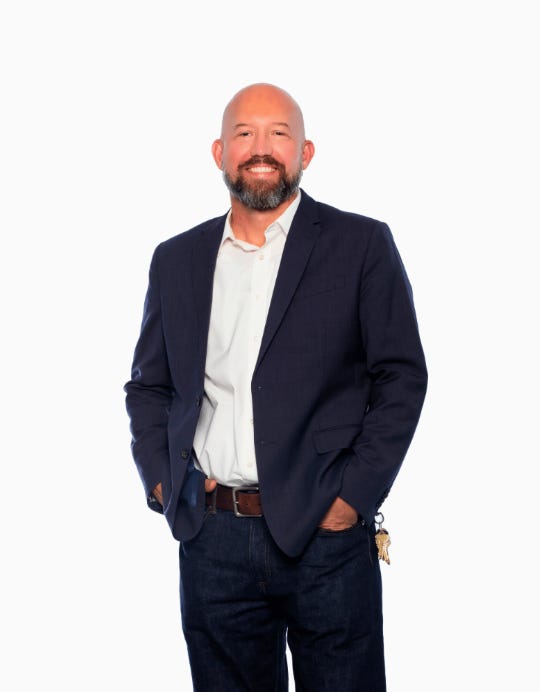
Mitch is a principal advisor at Conrad Alois, ex-CIO, serial founder (8 companies; 4 active), angel since ’98, adjunct professor at Cal State San Bernardino, and co-founder of Inkind Thrift, a thrift store and sustainability venture funding a local nonprofit foundation in Chino, California.
His thing: operational simplicity, continuous improvement from day one, and frameworks that actually work because they start from first principles.
Let’s jump into the conversation!
Origin Story
Mitch did the time in the trenches: PC technician to CIO, then founder.
Some wins, some shut-downs, one very expensive lesson in 1997 that cost him $50K to close. He says it taught him more than his MBA ever did. It also shaped a simple belief that runs through everything he does: operations rhyme across industries. The product changes, but the load-bearing processes do not.
That view translates into how he teaches.
He is the “unlearning” professor, taking students from tidy lecture-hall linearity to the confusing and chaotic execution.
Strategy, for him, is not a slide but a loop: start → learn → adjust → continue. If you do that from the beginning, you do not need yet another re-org at $10m, $50m, $250m, or whatever milestone. You just keep evolving the organism.
Edge
Two frameworks sit under his work: Foundational Thinking and the SIMPL method.
Foundational Thinking
At its core this is Mitch’s attempt to translate first‑principles thinking into the complex world of business operations.
Instead of treating strategy as a grand linear plan, he frames it as an iterative cycle: you start, you encounter friction, you adjust, you continue. That cycle is the foundation.
In practice, it means getting brutally clear about the problem at hand, naming the work that must be done, and breaking it into milestones that can be started immediately. Progress then becomes an act of disciplined iteration rather than waiting for a perfect plan.
His contention is subversive: if you wire this continuous learning process into the company from day zero, you do not need to periodically rip out and rebuild the organization at every growth stage. The re‑org, in his eyes, is a symptom of neglecting iteration.
Foundational Thinking demands humility (the willingness to admit you do not know everything upfront) and merciless follow‑through, because business will always expose new checkboxes that spawn more work.
The framework insists you move anyway, compounding small corrections rather than freezing for the illusion of certainty.
The SIMPL Method (Simple Innovation Management Practice for Leaders)
Not yet fully published, but the bones are clear. A CEO should have only three direct reports, mapped to three irreducible pillars:
Brand (including Sales & Marketing),
Operations (finance, tech, the plumbing),
Product/Service Delivery (even services treated like products).
Strip away the ornamental boxes, and design to reduce ambiguity. Build an organization that is “always sufficient and responsive.”
Where this gets interesting is failure.
Mitch does not pretend frameworks are autopilot. The failure mode is seldom the model but the manager.
Two firms, same product, can yield diverging outcomes because the executive’s judgement, appetite for reality, and willingness to loop fast are different. The work, then, is as human as it gets: establish a common language (“where are we, where do we want to be, what is the gap?”), reduce fear by making progress legible, and keep it moving.
He illustrated this with concrete stories at both ends of the spectrum.
On one side, a retail-service startup led by two brilliant scientists (a psychologist and a bioengineer) with almost no business acumen. They had ambition and budget, but no frame for how to start. Mitch broke it down into visible steps, forcing them to think five years ahead while still acting today.
On the other side, a $200m company where the CFO controlled five departments and choked the flow of information to the CEO. There, Mitch reframed the conversation for the board, built a common language, and mapped the gap between present state and desired future state.
Different scale, same playbook: create clarity, expose the gap, decompose the work, iterate. He is allergic to theater. He is addicted to throughput.
On specialist vs generalist, we sparred.
I argued specialists still need the same meta-skills (eg, framing, persuasion, translation). He agreed the market punishes narrow technicians who cannot explain or own consequences. He has seen too much of the cleanup work from “smart” specialists who yank one lever and break three others...
Future
We had to talk about AI.
Mitch’s view is blunt: it will vaporize the regurgitators. In SMB land, that is most of the “consulting/coaching” market, people who sell compiled internet advice. That tier becomes a commodity bot.
The winners - he believes - will be practitioners with real scars who can (1) query machines well, (2) fuse best-practice with belief, and (3) show up for implementation.
He predicts a return to old‑school consulting, with sleeves rolled up, embedded and accountable.
In his view, AI will wipe out the tier of advisors who simply recycle frameworks and produce decks, because clients will get that from machines at zero marginal cost. What cannot be automated is the credibility and stamina required to sit in the trench with a client and shepherd the execution. That is what old‑school meant: partners who did not just advise from the sidelines, but who carried risk, fixed the plumbing, and saw the plan through to impact.
If he were 22 today, he would join a boutique under a killer operator and learn by exposure, instead of spending three years buried in a 50-person workstream. He recalls that his own career accelerated because a mentor threw him into client meetings at 24, let him make mistakes, and forced him to own them in front of executives.
That exposure (ie, the apprenticeship model) is what he believes will matter even more in the AI era, when analysis and decks are commoditized.
Grounding and Legacy
Mitch spoke to me about the years he spent in martial arts (everything from Tai Chi to full‑contact MMA) and how those disciplines left him with injuries that now prevent sparring but gifted him something more enduring: the internal practices.
Daily meditation, slow intentional movement, and the focus on breath: these, he says, keep him grounded. The manual projects (fixing cars, laying tile, lifting weights) are not just hobbies but counterweights. In consulting and executive work, outcomes can take quarters or years; in manual labor, you see the result instantly.
That fast feedback loop is an antidote to the glacial pace of organizational change, and a reminder that progress can still be tangible, immediate, and personal.
If time and money were unlimited, he would build trade‑school‑style entrepreneurship schools where tuition doubles as seed capital and learning happens by shipping.
Mitch described a vision where students would pay $20,000, and instead of it being sunk tuition, that sum becomes their starting capital. The program would throw them into the act of building (not only theorizing) supported by mentors who had actually done it before. The school would combine the grit of a trade program with the creativity of a startup accelerator.
For Mitch, this is about access more than pedagogy. He wants people who believe entrepreneurship is “not for them” to experience that it is! It blends his philanthropic streak (already visible in his thrift‑store foundation model) with his obsession for practice over theory.
His ideal classroom is not a lecture hall but a workshop where students learn by risking, doing, failing, and adjusting in real time.
🔹 What you can steal
Ship your own Foundational Operating Loop.
Day one of any engagement:
Start by naming the present as it really is. Then name the desired state in words the board can actually repeat without jargon. Expose the gap between the two in plain daylight, and convert that gap into a visible worklist with owners and feedback cadence. Then move. Quick progress creates belief, and belief is the only currency that buys you the next lever.
Simplify your org lens to three pillars in discovery and exec comms: Brand, Ops, Product/Service. If an issue does not map to one, you are probably naming symptoms, not causes. This also kills vague debates. “Is this a sales problem?” becomes “Is this a Brand problem (positioning/pipe), an Ops problem (pricing/finance/tech), or a Product problem (quality/fit/cost-to-serve)?”
Treat soft barriers like any other risk, and operationalize everything: “What is the fear/assumption? Where are we now? Where do we need to be? What is the smallest action that tests the fear?” Put that in the tracker like you would a tech dependency. Humans move when the next step is real and safe.
And if you manage people: think of three directs as a feature. Anything you cannot place under Brand, Ops, Product is either duplication or drift.
🔹 Maurizio’s Take
Mitch’s edge is discipline.
Where many consultants try to dazzle with clever slides and intellectual fireworks, he insists on operational gravity, which is the force keeping the rocket on trajectory when the launch hype has faded.
That distinction is very important: novelty fades quickly in boardrooms, but discipline lasts for far longer.
His frameworks are not designed to impress but to survive in the complex realities he has lived through. They are useful only if they accelerate decision‑making, when managers are stuck between imperfect choices. In my reading, SIMPL and Foundational Thinking pass this test because they reduce degrees of freedom and remove options: in that reduction lies speed, clarity of execution, and resilience over the long haul.
The contrarian bit I loved: the claim that if you wire continuous improvement from day zero, you may never need the dramatic “new org design” performative acts.
That goes against the deeply embedded religion of the periodic re-org, where leaders perform a ritual reset to signal control or progress.
Mitch’s argument is more intelligent: most of those sweeping redesigns are nothing more than a very expensive way to admit you stopped learning along the way.
In his view, and it matches what I have seen, every “big-bang” transformation is a hidden tax on leadership attention and organizational trust, basically a giant detour that could have been avoided with smaller and more disciplined adjustments.
The cost is in money, momentum, morale, and credibility.
Continuous iteration may not be as glamorous, but it keeps the company alive and adaptive without the disruption exercise that eats years of progress.
👀 Where to find more about Mitch
If you enjoyed today’s conversation and read Consulting Intel, please do me a favor: share this post, spread the edge.
👋
⚠ Check these links out
My first book Beyond Slides became a #1 Amazon Best Seller in the USA, UK, Australian and Italy;
The Leaders Toolkit is a deck of 52 tools, frameworks and mental models to make you a better leader (use code CONSULTANT10 for 10% off);
The Consulting Intel private Discord group with 250+ global members is where consultants meet to discuss and support each other (it’s free).

Loved this - although I come from a pure consulting/ professional background so much of what Mitch says aligns with my own lived experience. One thing that really resonated: my early days as an auditor were long enough ago that I was thrown into client meetings with senior execs at the age of 22. I remember going on my own to speak with the CFO of a huge manufacturing plant that employed 5,000 people less than 6 months after I started.
The most person lesson here for me is: decide, do, learn, iterate. My question: If you don't already have this continuous learning loop embedded in your culture, how do you re-engineer the culture to live and breathe this way?
Really good insights here. I really appreciate the point about avoid so many re-orgs. In my experience, re-orgs are often a massive drain on the org and productivity and ultimately counterproductive. I’m curious where he thought an HR/People function would report.
Thanks so much for this one!