


Big podcasts and large publications chase Bezos-level names who talk about strategy from 30,000 feet: it’s inspiring, yes, but useless if tomorrow you are walking into a meeting with your client and a deck to defend…
EDGE, a format by Consulting Intel, is where I sit down with world-class operators, consultants, and investors working between business, tech, and AI… and where I distill what I learn in something you can read in ~7 minutes.
LFG! 🔥
Brian O’Connor thought he understood how business worked.
Six years in Deloitte. Ops boot camps. Growth and corporate strategy inside Monitor. Multi-hundred-million-dollar programs where a single slide could move a market.
Then a partner told him he had “single-handedly turned around” a $200M+ Paycheck Protection Program project… and handed him a gift card.
That was the moment the glitch appeared in the matrix.
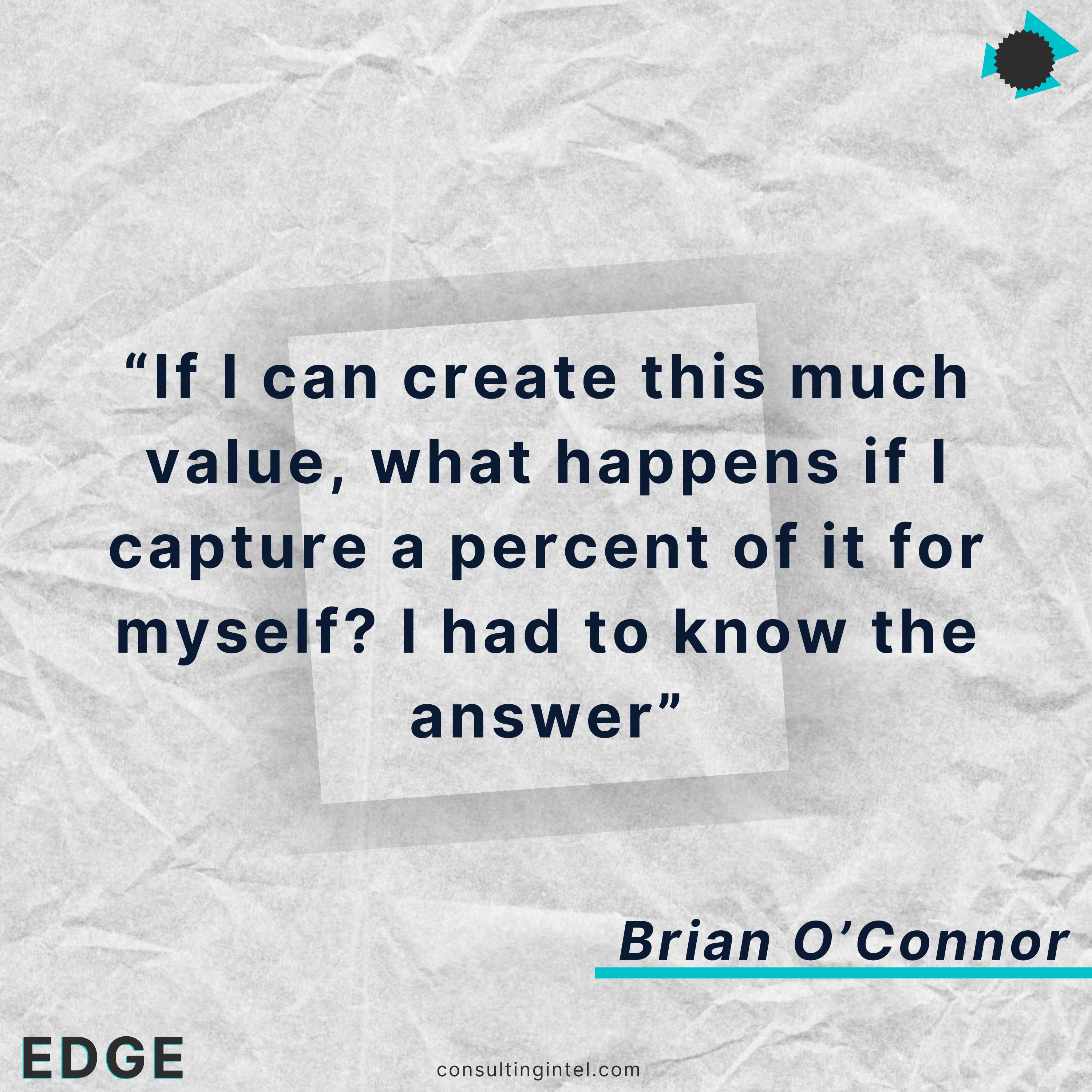
“If I can create this much value under someone else’s logo,” he thought, “I need to know what happens if I try to capture even one percent of that for myself.”
Today Brian is a fully nomadic founder and operator. He runs a recruiting and staffing agency that places remote talent into US businesses, with 115+ placements and a pipeline that throws up 3,000 applicants per role. He and his partner have already built an AI recruiter that screens and interviews candidates, and they are now pushing into “AI After Dark” – AI customer support that takes over when the human clock hits 5pm.
It took some courage: Brian walked away from a high-margin solo CMO / advisory business that was making him very good money, to build a harder, lower-margin, more operationally painful agency… because he cannot stand living in the “advisor only” layer. He wants to build, not just point.
And he thinks most white-collar careers are far riskier than people want to admit in the age of AI.

Origin Story
Brian Fernando O’Connor Gonzalo Rubio grew up in Boston, in a Latin household with a banker father.
Dad was not just “in finance”, he used to talk strategy, balance sheets and deals at the dinner table. Brian jokes that he had corporate finance piped into the womb.
He was addicted to business early: high school and college were already full of small startup attempts. The obsession was there, the direction less so…
His first “real” job was in commercial banking: he thought he was going into investment banking because he did not fully understand the difference (Wolf of Wall Street fantasies, commercial banking reality).
From there he joined GE Capital, underwriting aircraft debt and working through a rigorous finance training program, aiming to sell aircraft debt and leasing. When GE Capital was sold, the program vanished and so did the job, and that forced a choice.
On one side: an investment bank interview in a dingy office with water literally dripping from the ceiling, two computers with no mouse, and an interviewer asking, “How do you feel about sleeping under your desk?”
On the other side: a Deloitte floor full of bright lights, color, twenty-somethings solving problems together. The feeling that “if you are smart and have a personality, you go here.”
He chose Deloitte.
The first three years were an operations boot camp: target operating models, big transformations, messy execution, the next three became a strategy boot camp: growth, corporate and competitive strategy inside Monitor. Brian came out with a very particular blend: half “how to run a business,” half “how to grow a business.”
The turning point, though, was not a promotion. It was that PPP project during COVID.
A major US bank was failing to get PPP loans out the door, and Deloitte’s name was on the line. The project was on fire, so Brian was parachuted in as “the strategist who can actually turn things around.”
They fixed it. Hundreds of people on the project. At the end, the partner pulled him aside and said: “Brian, you single-handedly turned this project around. Thank you.”
Then handed him a gift card. The cognitive dissonance did the rest…
He did not suddenly become “confident.” He was already overconfident by his own admission, but what changed was the question in his head:
If I can create this much value in someone else’s system… can I do it outside the umbrella? Or am I only valuable with a big logo behind me?
That question has been driving him ever since.
Edge
Brian’s edge is simple to say and hard to live:
He is obsessed with solving hard problems, not with preserving his comfort zone or maximizing short-term margin.
He believed, naively but usefully, that if he could operate inside giant complex organizations, then small businesses would be easier.
“These companies are so complex, they must be the hardest things to build,” he thought. “If I can do this, a small business must be easy, right??”
Wrong.
He discovered that his “how to run a business” skills translated well. Systematizing processes, designing operating models, thinking in people / process / tech – that stuff ported nicely.
His “how to grow a business” skills did not translate at all.
In big-corp strategy, growth questions sound like:
“Do we launch an investment bank in Brazil?”
“Which products do we roll out in Mexico?”
“Do we build or buy?”
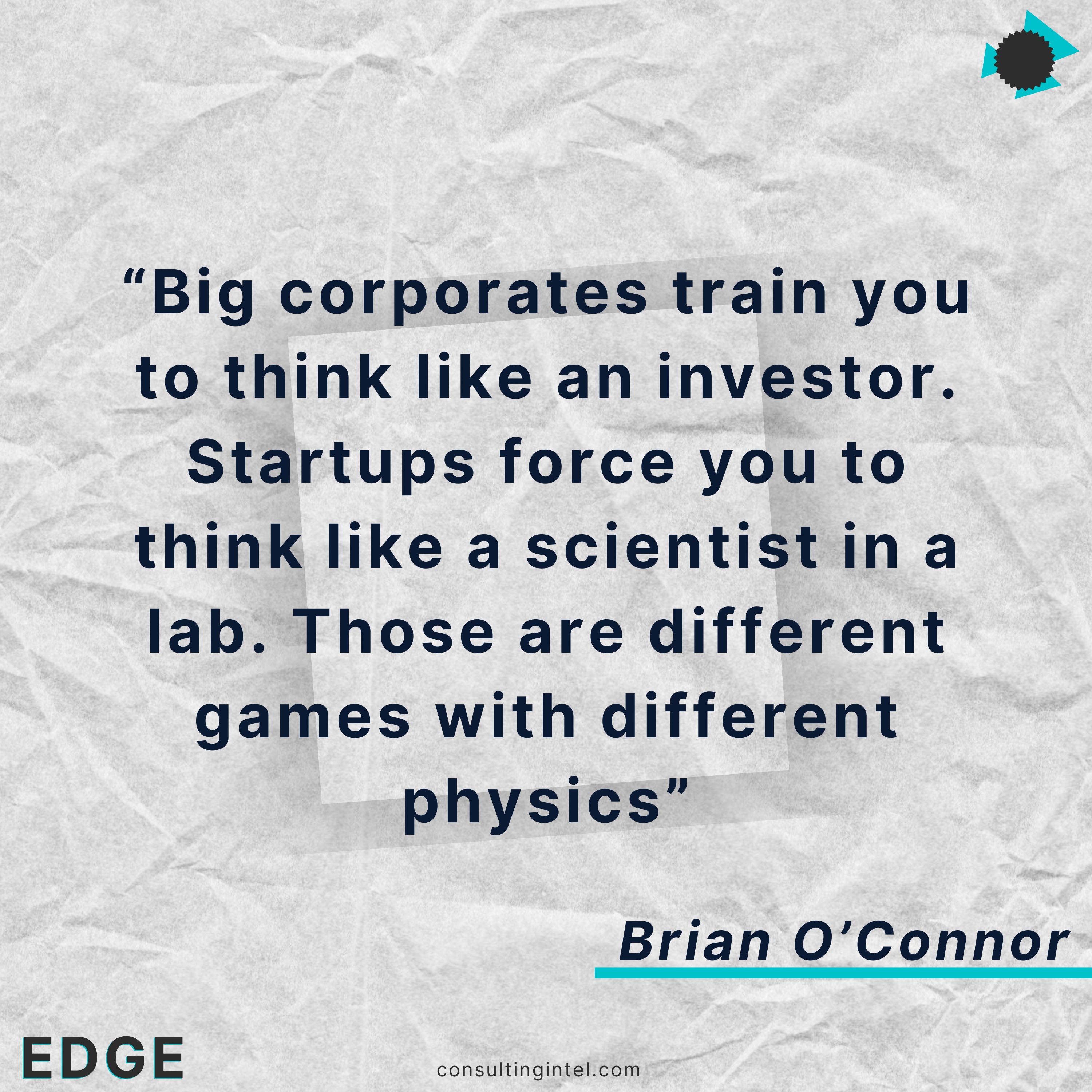
You think like an investor. You allocate capital. You speak in markets, curves and scenarios.
In a small business, growth sounds like:
“How do we get someone to click this ad?”
“How do we build the first funnel that actually converts?”
“Which channel do we test this week with fifty bucks?”
You think like a scientist in a lab. You run experiments. You learn tactics that no boardroom ever mentions.
Brian discovered he knew nothing about that layer and had to learn from zero.
He also learned how deeply “brand permission” matters. Strategy is interesting to founders only after they hit roughly eight figures. Before that, they do not want your slide about UBS; they want someone who can get leads in the door. His early positioning as “growth strategist” did not resonate. To many small businesses, “strategy” is a luxury item.
In parallel, he accidentally built a high-margin solo business: CMO-style advisory for companies big enough to care about proper marketing systems. Three clients, ten hours a week each, $10k–$20k per month per client, and the rest of the time spent on marketing and content. Very good money for a very light calendar!
But it did not scratch the itch. He wanted to build something real, with people, processes, tooling, and compounding assets, so he leaned into the emerging second business: a recruiting and staffing agency that helped companies find remote talent – customer support, customer success, project managers, and so on. Lower margins. Much more operational headache. Far more scalable. And far more satisfying to him.
The agency now gets ~3,000 applicants per role, has placed 115+ people, and is layering AI across the funnel: from resume screening to an AI interviewer that speaks with candidates and shortlists them.
His girlfriend (and co-founder) is the CTO and builds the AI systems. Brian designs the systems and the offers and then sells them.
He is consciously choosing the harder route.
“If I wanted to make the most money, I would focus on the CMO work. But I had to know if I can build, not just advise. I am making less money doing this than I did in marketing, and I still do not regret it.”
Where does this approach hit limits?
When you confuse mental models from phase three (big corporates, maintain and optimize) with phase one (find product market fit). When you start by building the website instead of talking to the customer. When you assume the “smart slide” is enough, instead of learning how to write a brutal, ugly ad that actually converts.
Future
Brian sees AI not as magic, but as a pipeline with 3 stages:
Human takes real-world context and asks the AI a question.
AI produces an answer.
Human verifies, interprets and connects that answer back into the real world.
AI will dominate stage two. Stage one and three are where humans still matter. Which means the “translation layer” job becomes even more important.
That is the same job the best consultants already do.
He remembers a classic boardroom scene in a big bank during one of his projects. Fifteen executives shouting across the table. Everyone talking past each other. A partner walks up to the whiteboard, draws three boxes, and says:
“You are all talking about this. We actually need to solve this.”
Silence. Alignment. Movement.
The value is not the slide! It is the ability to name the real problem.
Brian’s view is that banking executives who are brilliant at credit cards business but average at problem framing will ask AI the wrong question, in the wrong way, at the wrong time. They will get answers that are precise, fast, and useless.
Consultants are, in his words, the translation layer between subject-matter experts and clarity. And between messy organizational politics and clean decisions.
He sees AI accelerating execution work in consulting – research, modelling, standard analysis – but not replacing the framing and synthesis. If anything, the bar goes up: when research becomes cheaper, you run more tests, you validate more options, and the expectation for quality rises.
On white-collar work more broadly, he is blunt. He likes the framing of AI as “Amplified Intelligence”:
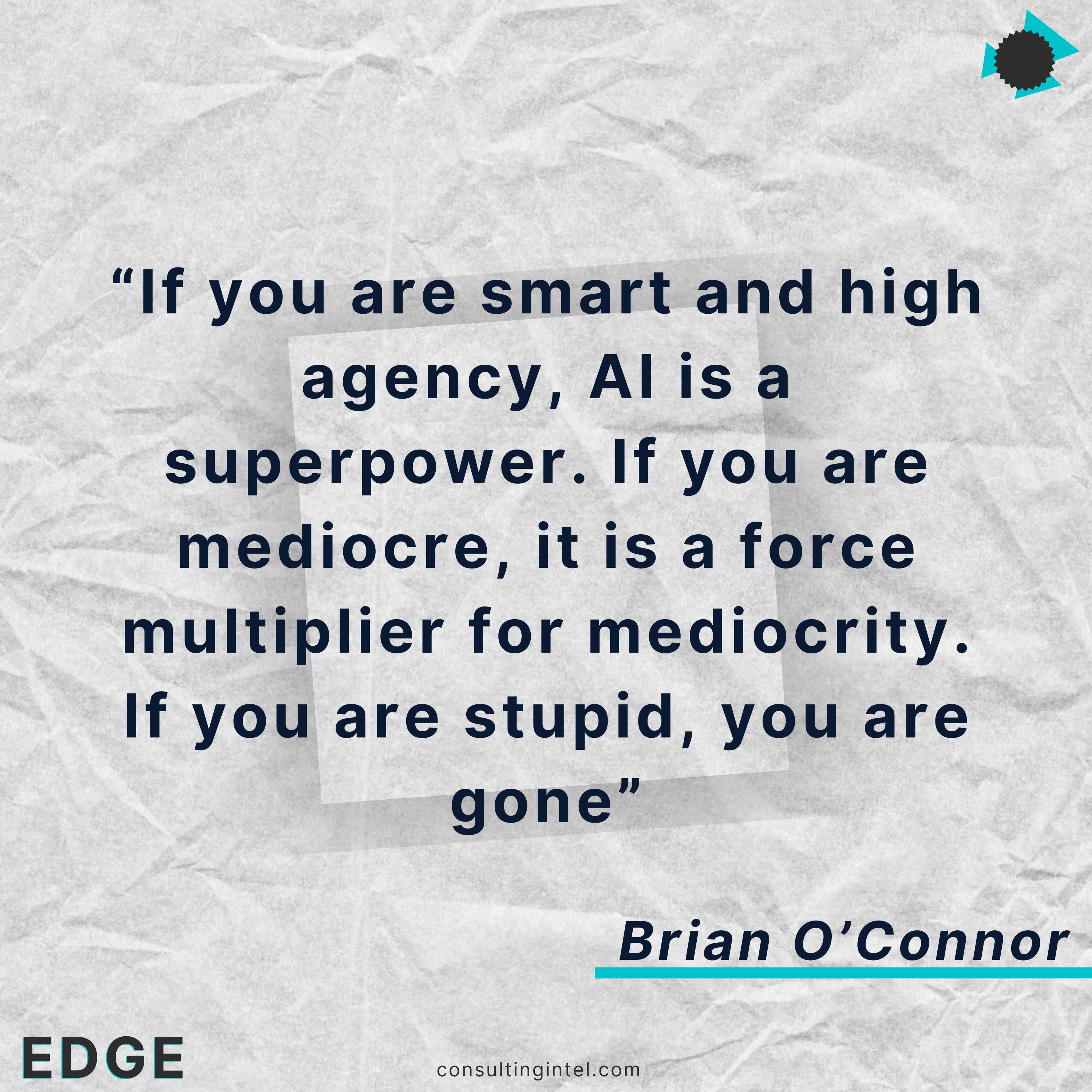
If you are already sharp and high agency, this is an incredible time. The tools give you more leverage than ever. The gap between thought and reality shrinks. You can think something in the morning and have a working version in the afternoon.
If you are average, AI will make you average at scale.
If you are bad at what you do, you are finished.
He also thinks the classic “safe” corporate path is much riskier than it used to be: roles that felt solid can dissolve under you.
If he had to advise his younger self, he would not say “skip college” in some generic hustle-porn way (he knows he needed structure and consulting to learn how to problem solve), but if the goal was entrepreneurship, he would not tell 20-year-old Brian to “go start something from scratch.”
He would tell him to go and work for one rock-star entrepreneur. Hitch himself to someone exceptional, learn at high compression, and build skills, network and resources before striking out.
Grounding and Legacy
Brian’s lifestyle looks chaotic from the outside: fully nomadic, new country every one to two months, no fixed home base, Mexico, Rome, Sicily, Sydney, Tokyo are all just coordinates in a calendar.
His day, however, is brutally simple.
He wakes up as early as he can.
He gets to work as fast as he can.
He works until his energy drops.
Then he walks, lifts, or stares at a problem until he finds a way through.
Then he gets back to work.
He is not trying to minimize working hours. He is trying to maximize time spent wrestling with hard problems.
He uses the gym as a 3pm reset button. When his output drops, he moves his body to recharge his brain. He walks to consolidate ideas. He uses music intentionally as a state-changing tool: high-energy when he needs to push, focus tracks or binaural beats when he needs to dive deep.
At night he reads in Italian until he falls asleep, because he plans to go back to Rome and actually hold his own at the dinner table.
He jokes about solving problems in his sleep, but beneath the joke is a serious pattern: his life is built around mental challenge, and the geography is just a backdrop.
When asked what he would do with unlimited time and unlimited resources (a question I always like to float), he does not say “start a fund” or “buy a sports team.”
He wants to attack a hard social problem with the same caliber of talent that currently swirls around hedge funds and big tech.
Violence in South Side Chicago. Food deserts and hunger. Civic problems that have chewed through committees and foundations for decades.
What bothers him is not the lack of money, but the lack of concentrated IQ and problem-solving intensity dedicated to these issues. He would like to bring a band of killers together (the smartest operators and problem solvers he knows) and aim them at one of these problems until it cracks.
He is self-aware enough to know he is not ready yet. He wants more skills, more network, more reps before he jumps in, but the direction of travel is clear: build real businesses now, so he can redirect those muscles later to something beyond his own bank account.
🔹 What you can steal
Treat yourself as the translation layer.
Your job is not to worship AI’s output. Your job is to take messy, contradictory real-world context, compress it into the right question, feed that into the machine, and then judge the answer against reality. Start every AI prompt with “What is the real problem here?” rather than “What can this tool do?”
Know which game you are playing.
Are you in phase one (find product market fit), phase two (scale what works), or phase three (maintain and optimize)? In phase one, you are a scientist in the lab, running cheap experiments and learning tactics. In phase three, you are an investor allocating resources.
Build at least one thing where the work compounds.
Advisory work is fine. It pays well. But copy Brian and choose at least one arena where you are building a system, a product, or an asset that you can improve every day and stand on tomorrow. Even if it is harder. Especially if it is harder. That is where your edge forms.
🔹 Maurizio’s Take
I like people who are slightly wrong first and then relentlessly right later…
Brian misjudged how hard small businesses are. He assumed a smaller version of a thing must be easier. He discovered that small business is a different physics, not a different scale.
He also refused to stay where life was maximally comfortable. He had a sweet setup as a high-margin advisor with light hours and good cash, and voluntarily walked into the operational meat grinder of an agency because he wanted to build something that exists when he is not on the call.
His edge is not “Deloitte background plus Spanish plus nomadic Instagram life.” His edge is the willingness to keep putting himself in rooms where he is under-skilled for the problem and then grind until he is not.
On AI and consulting, he lands very close to my own view.
Consultants who behave like deterministic machines are dead. Analysts who think their job is “running the template” are dead. The people who survive are the ones who can look at a room full of executives, a heap of data and a manic AI assistant and say:
“No. The real question is this.”
The more AI we get, the more that skill matters.
If you take one idea from Brian, let it be this: in a world of amplified intelligence, the only safe seat is at the problem-framing layer. Everything else can, and will, be automated, arbitraged or annihilated.
The rest is commentary.
👀 Where to find more about Brian
If you enjoyed today’s conversation and read Consulting Intel, please do me a favor: share this post, spread the edge.
👋
⚠ Check these links out
My first book Beyond Slides became a #1 Amazon Best Seller in the USA, UK, Australian and Italy;
I recently met with Rashi, writer of the Decks and Diapers newsletter, for a long chat on a bunch of topics, from parenthood to career. If you are interested, have a look at the post!
The Leaders Toolkit is a deck of 52 tools, frameworks and mental models to make you a better leader (use code CONSULTANT10 for 10% off);
The Consulting Intel private Discord group with 250+ global members is where consultants meet to discuss and support each other (it’s free).


What a great read. Can relate to a whole bunch of this. The translation layer is so important, with or without AI in the picture. The best leaders I’ve worked alongside are phenomenal at it.
TOP! Such a great concept. Every time I read EDGE, it feels like I’m unlocking some next-level knowledge you can’t find anywhere else