


Big podcasts and large publications chase Bezos-level names who talk about strategy from 30,000 feet: it’s inspiring, yes, but useless if tomorrow you are walking into a meeting with your client and a deck to defend…
EDGE, a format by Consulting Intel, is where I sit down with world-class operators, consultants, and investors working between business, tech, and AI… and where I distill what I learn in something you can read in ~7 minutes.
LFG! 🔥
Most “tech gurus” are obsessed with the shiny and new. Mario Peshev is obsessed with what actually works when the bill comes due. While the world treats AI like a magic wand, Mario treats it like a high-speed assembly line that is currently running out of raw materials.
He believes AI is currently cannibalizing itself. Businesses are optimizing internal processes to save costs, but they aren’t actually creating new wealth: if everyone gets 40% more efficient at the same task, the price of that task simply drops to zero. Mario’s story is a roadmap for how to survive the “race to the bottom” by pivoting from a service provider to a “Value Creator.”
Mario is the CEO of DevriX (enterprise engineering and RevOps) and Growth Shuttle (SME consulting). He is an angel investor in over 25 companies—including Substack, Beehiiv, and Doola—and has clocked over 10,000 hours training engineers at the world’s most elite organizations, from CERN to Saudi Aramco.
Let’s jump into the conversation!

Origin Story
Mario’s career didn’t start in a boardroom; it started in 1999 with a single website and a passion for engineering. For the next two decades, he wore “multiple hats,” maturing alongside the internet. He watched the era of the home PC give way to the era of the Cloud, and the era of social media transform into the era of the “Growth Loop.”
A big shift for Mario came when he realized that being a “great engineer” was no longer a moat. In the mid-2010s, he saw the agency model fracturing: clients didn’t want to buy “code” or “HubSpot workflows” anymore—they wanted to buy revenue.
This led to the transformation of DevriX from a technical shop into a high-level Revenue Operations (RevOps) firm. He stopped speaking the language of “features” and started speaking the language of the CRO.
Edge
Mario’s differentiator is his refusal to get distracted by “trendy” terminology.
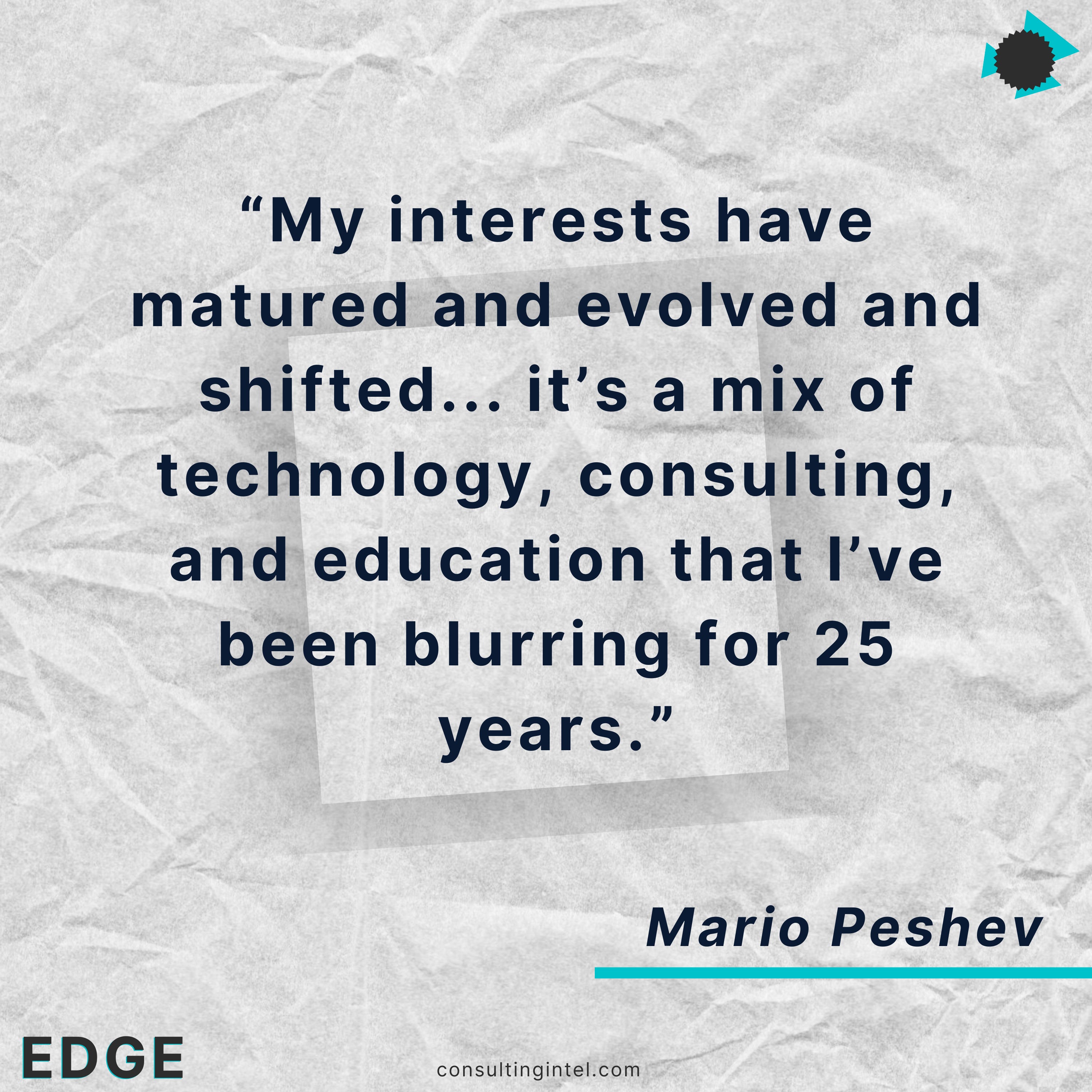
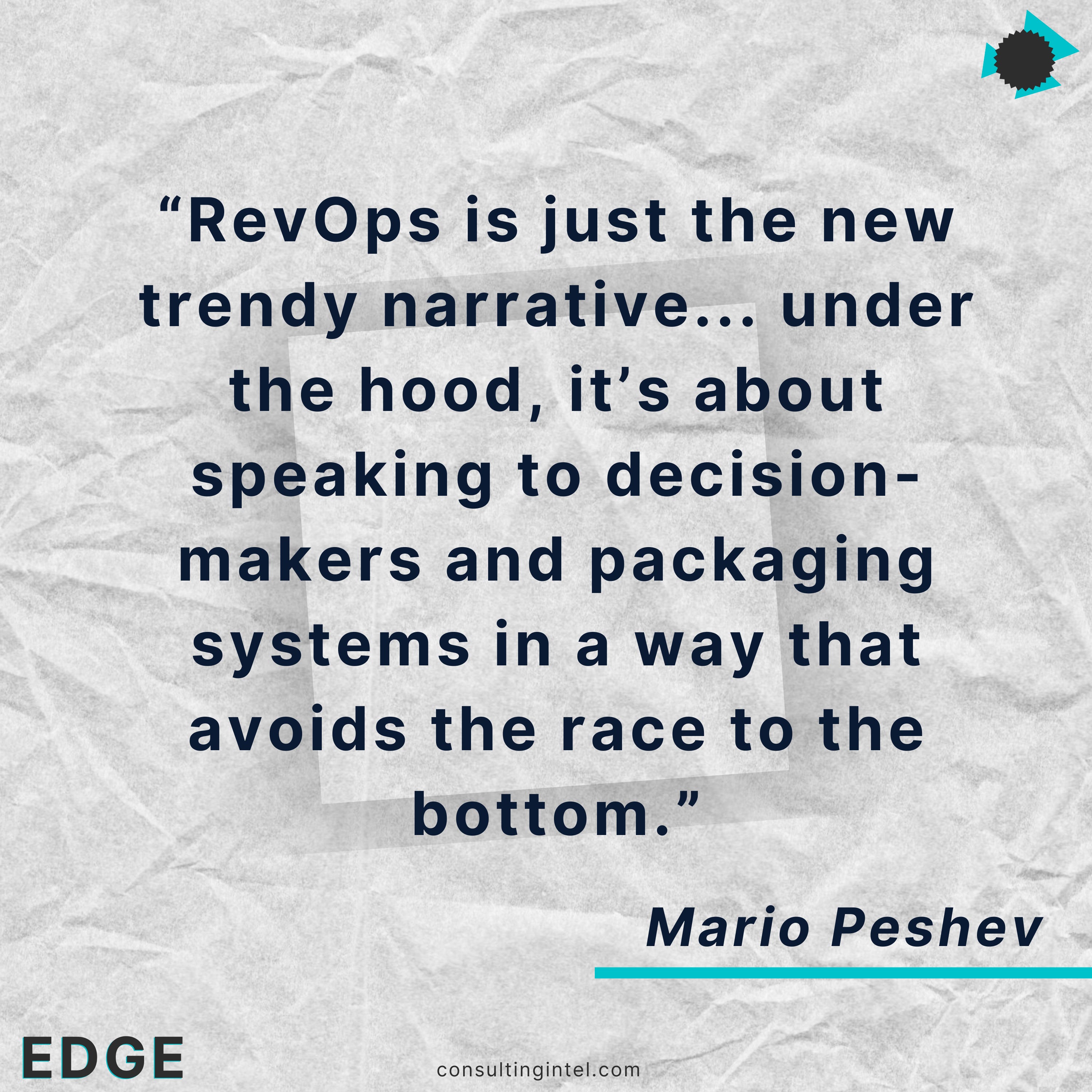
Whether people call it “Smarketing,” “The Flywheel,” or “RevOps,” Mario views it all through the lens of Value Creation. His edge lies in the Agentic Layer, using AI not just for chat, but as a systematic infrastructure that connects marketing leads to sales data to customer retention.
Mario made the contrarian move to bring his team fully in-house in Sofia. He recognizes that while digital talent is globally mobile, “desk job” work is becoming a commodity. By maintaining a physical headquarters, he creates a “security moat” for enterprise clients. Data doesn’t leak between fragmented VPNs across dozens of countries; instead, it lives in a controlled environment where peer review and collective “hacking” happen in real-time. This physical proximity transforms “consulting” into a high-security, high-reliability operation that remote-only agencies struggle to match.
Mario is a Vibe Coding practitioner. He uses tools like Cursor and Google’s Anti-gravity to build prototypes in hours that previously cost $80,000 and took months. He recently rebuilt his company’s entire accounting system from scratch because off-the-shelf SaaS tools like Xero couldn’t provide the granular data he needed—specifically, gross profitability per team and real-time bank statement “leakage” analysis. He didn’t wait for a vendor; he built a local, secure SQLite-based software on a Saturday.
Mario’s differentiator is his recognition of physical bottlenecks.
He points out that while you can use AI to plan a construction project 40x faster, you still need a human to lay the bricks, a government official to sign the permit with a “wet signature,” and a supply chain to ship the materials. His edge is knowing exactly where the digital world hits the brick wall of reality.
Future
Mario isn’t buying into the singularity hype just yet. His perspective is rooted in a sobering economic reality: Efficiency is not the same as growth. While social media and Reddit threads hum with predictions of overnight transformation, Mario looks at the structural bottlenecks that AI simply cannot solve with code alone.
Citing Satya Nadella, Mario argues that for a technology to be truly revolutionary, it must drive at least 10% GDP growth year-over-year. Currently, we are seeing “incremental improvements.”
Businesses are using AI to optimize internal processes—making a team of 4 able to do the work of 5—but they aren’t necessarily creating new markets:
If every design firm uses AI to work 40% faster, the market doesn’t suddenly need 40% more designs. Instead, the service becomes a commodity, the price drops, and the “pie” remains the same size.
Real growth requires new revenue streams, not just cost-cutting. Until AI can fabricate new clients or solve the “physical constraints” of production and logistics, it remains an operational tool rather than an economic savior.
One of Mario’s most grounded insights is the persistent friction of the Public Sector and Physical World. We live in a “duplex” reality: our LLMs move at light speed, but our institutions move at the speed of paper.
Mario predicts it will take decades for the most impactful changes (like robotics in construction) to hit critical mass, also due to regulatory resistance. Whether it’s the banking sector’s refusal to trade 24/7 or the government’s requirement for a physical signature on a permit, human systems are designed for stability and safety, not pure digital efficiency.
As AI commoditizes “average” work, Mario predicts a brutal thinning of the herd:
The bottom 50% of performers in “desk jobs”—those who look for safety and work-life balance without exceptional output—will find their roles evaporated.
Whether your craft is microbiology, logic, or communication, being “good” is no longer enough. To be safe, you must be in the Top 1%. This is the only level where human intuition and complexity still outpace the machine.
If Mario could travel back to 1999 Bulgaria, he wouldn’t tell himself to learn a specific language; he would tell himself to prioritize Adaptability over Habits. He admits to having “missed the boat” on certain leaps by sticking to old narratives for too long.
In a recession or a tech-led disruption, the first people let go are those who aren’t “helpful.” Mario’s advice is simple: be the person who is used to grinding, staying helpful, and evolving faster than the framework you are currently using.

Grounding and Legacy
Mario stays grounded through a “high-gravity” family life.
Despite managing global time zones and 25+ investments, he treats family time as the primary purpose of his work.
He workouts 3x a week with his partner—a ritual that serves as both a physical regime and a relationship anchor. He stays humble by opening X (formerly Twitter):
“You see everyone doing exciting stuff, and you realize it’s time to get back to work.”
If resources were unlimited, Mario would launch a Proprietary Data Powerhouse.
In a world where AI has scraped the entire “public” internet, the only remaining moat is private, high-fidelity data. He would hire 20 world-class journalists to go into the field and extract the “internal secrets” of the private markets, creating a data source that no LLM can replicate because the data doesn’t exist online.
How cool!
🔹 What you can steal
Mario’s approach can be articulated in 3 high-level tactical concepts:
The “Saturday Prototype” Rule: If you have an idea for a tool that would save your team 5 hours a week, don’t put it in a Jira ticket for next quarter. Use Cursor or Replit this Saturday to “vibe code” a proof of concept. If you can’t build a clickable version in 4 hours, your idea is too complex.
Audit Your Moat: Ask yourself: “Am I doing work that depends on a desk and a VPN?” If yes, you are competing with the entire world’s talent pool and AI. Find a way to tie your work to local compliance, physical assets, or high-trust relationships.
The Language Shift: Stop selling “services” (e.g., “I do SEO”) and start selling “Value Creation” (e.g., “I optimize the marketing-to-sales data bridge to increase EBIDTA”). Move your narrative from the How to the CFO’s bottom line.


🔹 Maurizio’s Take
Mario Peshev is the “Engineer-Philosopher” we need in 2026 because he refuses to play the game of digital make-believe.
My conversation with him left me with a sharp realization: We are currently building Ferraris (AI agents) to drive on dirt roads (the physical and regulatory world).
If you use AI to do your job 40% faster, but the physical world (permits, construction, supply chains) doesn’t accelerate at the same rate, you haven’t created growth, you have only just created idle time. In a capitalist system, idle time without new revenue leads to one thing: commoditization.
If everyone is 40% more efficient, the market value of that work simply drops by 40%.
This is where Mario and I align most closely.
The “middle” is a dangerous place to be. If your job is a “desk job” that relies on general knowledge, you are competing against an LLM that has read the entire internet. Mario’s strategy of using AI to build highly specific, proprietary tools is a smart way to stay ahead.
The most contrarian takeaway from our talk was his “Legacy Project.”
While everyone else is trying to build the best prompt, Mario wants to hire journalists to find data that doesn’t exist online yet. In an age of infinite synthetic content, truth and proprietary data are the only currencies that won’t inflate to zero.
To survive the next decade, you have to build the proprietary data layer and the high-trust physical presence that makes the funnel irrelevant. If your value can be summed up in a prompt, you have already lost.
👀 Where to find more about Mario
If you enjoyed today’s conversation and read Consulting Intel, please do me a favor: share this post, spread the edge.
👋
⚠ Check these links out
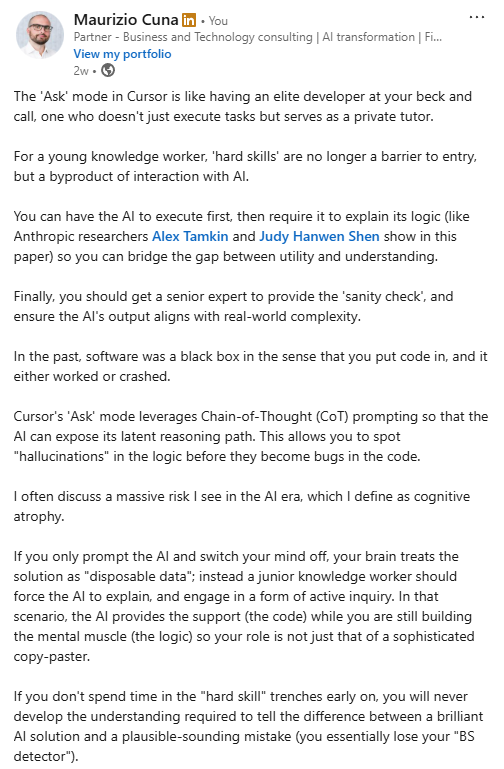
I have shared a paper by Anthropic’s researchers Alex Tamkin and Judy Hanwen Shen (How AI impacts skill formation) in one of my recent LinkedIn posts. You can click the image below (and don’t forget to connect with me, I always appreciate it!!):
My first book Beyond Slides became a #1 Amazon Best Seller in the USA, UK, Australia and Italy;
The Leaders Toolkit is a deck of 52 tools, frameworks and mental models to make you a better leader (use code CONSULTANT10 for 10% off);
The Consulting Intel private Discord group with 250+ global members is where consultants meet to discuss and support each other (it’s free).


Love this especially the point: Efficiency is not the same as growth. This is what people miss about the impact of AI. Just cutting jobs/ costs won't work for any business - sooner or later they will run out of customers this way. Watch out for people Mario who are focused on value creation
Another solid read.
"The bottom 50% of performers in “desk jobs”—those who look for safety and work-life balance without exceptional output—will find their roles evaporated."
I say this exact thing to my Gen Z daughters. What can you do that only YOU can do?
I read a piece the other day that said if AI can do 80% of a job, they can't close the final 20% - they just improve at the 80%. That 20% gap is where humans come in. Smart humans who can do things that AI can't ever do.
I work with $5-100m rev construction firms. AI can be used for a handful of tasks but it will never be able to do the outside work. That's def a gap.
Thanks as always for sharing your insights.