


“Only fish.
Only fresh.
Only in the evening.”
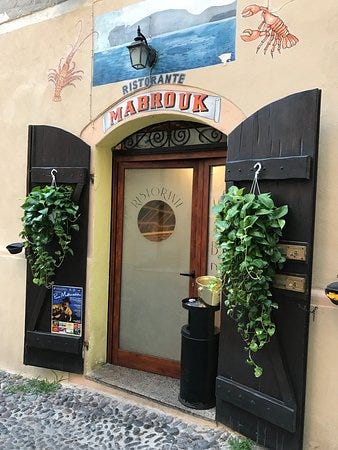
A restaurant in Alghero (in the beautiful land of Sardinia, Italy) named Mabrouk is a culinary institution, and a case study in marketing. That motto, those three short lines (“Only fish/Only fresh/Only in the evening”), is a positioning statement so tight it could cut through steel:

A steakhouse in London named Flat Iron only serves one cut of meat (the “Flat Iron steak”, sold for £15), and if you want to eat something else you better book at a different place. I was there last summer, and the steak was pretty good.

These couple of examples I just gave you are not only about food, but also about identity, and the principle applied doesn’t work only with seafood restaurants or steakhouses, but with consulting firms too.
In consulting, identity becomes profit margins.
Let me explain.
The misunderstood positioning lever in consulting
Most consultancies think positioning is a tagline, something Marketing will figure out after the Partners agree on the latest five-year vision that no one will read.
Real positioning is rarely written. Positioning (at least, positioning that actually works) is lived, embedded in what you say no to, in the deals you walk away from, the slide you refuse to show because it has nothing to do with your craft.
Positioning is existential, especially for a small or mid-sized firm.
I have worked in start-up, small, medium, and large consulting firms, and I learned something: you can win as a small firm, or you can win as a big firm, but you cannot win trying to act like both.
Let me show you why.
Big firms sell breadth, small firms sell depth
Large strategy-to-execution consultancies (think the Accentures of the world) play a different game.
It is not that they lack depth - in fact, many of their people are world-class - but their strategic advantage lies elsewhere: global reach, political access, and the ability to mobilize massive delivery machines across continents in days.
They sell assurance at scale.
When you hire a big firm, you are buying expertise, of course, but also alignment, credibility, executive cover: “This is serious. We brought in the navy.”
Their playbooks are polished, their frameworks are industry-defining, their decks come with social proof baked in, they have a bunch of case studies: “We helped 17 of your peers do this exact thing.”
That model works, especially when the stakes are very high, or regulators are involved, or when the client needs bodies in 40 markets by Friday.
But let’s look at the other side of the story, because that same scale brings constraints.
Delivery is often decoupled from sales, so customization can slow down. The Partner who sold you on the project is not the same person who is going to deliver the work for you: likely, the person who is going to deliver the work for you will be, let’s say, greener than the Partner who sold it.
The deeper you go into the project, the more you feel the weight of the massive machinery: procurement, offshore delivery centers, layers of approval, service lines, quarterly pressures, etc. The brilliance is there, but often buried under operational mass.
This is where smaller expert firms, if positioned well, carve out their advantage.
They show up with fewer people, but sharper answers. They are not there to de-risk, but are able to go straight at the pain.
What smaller expert firms know that generalists never learn
I once worked with a small global boutique that only did core-banking replatforming projects. That’s it.
They knew the systems, the workflows, the processes, the tribal politics inside procurement. We had a 100MB spreadsheet with 2,000 variables that could estimate the size of any bank’s project to the dollar, and the scariest thing was that it was accurate.
When we pitched alongside a Tier-1 consultancy, the big firm had a fancy framework with six colored pillars and a McKinsey-style logic tree.
Instead, our Partner walked in, and said something along these lines:
“Here is how your last two integrations failed. We know because we reviewed the org design of the acquired units and spotted the same pattern. We have done this 11 times across 4 continents with banks just like yours. You can get a 6-month strategy from those guys, or a 10-month implementation plan from us. You choose.”
Guess who won the work? Yes.
Now, guess why? Because specificity beats generality. Specificity builds trust faster than logos or awards ever will.
Here is what nobody tells you:
The narrower your positioning, the easier your operations become.
This happens for many reasons, including the following:
Delivery becomes repeatable. You are not reinventing the wheel for every project;
Hiring becomes easier. You are not looking for “smart generalists”; you are looking for mercenaries trained in your theatre of war;
Business development becomes surgical. You do not chase leads. You chase signals (like a core banking vendor change or a regulatory deadline) that scream: They need us now.
You compound learning at an insane rate. A generalist firm might run 100 projects in a year and learn 100 lessons. Those lessons are all different because the projects and the industries were all different. A well-positioned expert firm might run 30 projects in one narrow field, and learn 300 lessons all related to and reinforcing each other, because the insights build on top of one another.
That is how you build intellectual property. That is how you charge more and deliver better. That is how your profit margins go up.
It is easy to be everything to everyone, and, in my experience, that is how most firms start. You simply must say yes to stay alive.
However, I noticed that staying broad is a fear-driven choice: you are basically constantly hedging, hoping that something lands.
Strong positioning takes some guts.
Like that Sardinian restaurant that only serves fish, only fresh, and only for dinner, strong positioning means writing on your homepage “We do X. Only for Y”, and letting the rest walk away.
It means telling a head of strategy at a $10B client:
“We are not the right firm for that. But if you ever need to [insert niche pain point you can actually fix], we are the best in the world.”
You say it with a smile and with confidence, because you intrinsically know that honesty today is the seed of compounding tomorrow.
The bigger game
Consulting is a long game, and, in the long game, brand > pipeline.
That boutique core banking firm’s brand among bank CTOs was a golden pass: one intro led to five, which meant they were never chasing leads, because they were too busy fielding invites.
They had positioned themselves not just as consultants… but as a known quantity.
Strong, intelligent, deliberate positioning gives you at least these three things:
predictability,
pricing power,
peace of mind.
Clients crave confidence. And nothing builds confidence like knowing exactly what you are, who you serve, and what you do better than anyone else.
Once you understand that clients crave confidence, and that nothing builds confidence like knowing exactly what you are, who you serve, and what you do better than anyone else, then you will appreciate that being narrow is anything but a risk.
Being narrow is the signal, and the narrower the signal, the sharper the impact.
Do I think about this in the right frame? Let me know in the comments…
👋
👀 Links of interest
A few places somewhere in the internet you may find interesting:
My first book Beyond Slides is out in ebook and paperback format on Amazon (or wherever you purchase books online);
The Leaders Toolkit is a deck of 52 tools, frameworks and mental models to make you a better leader (use code CONSULTANT10 for 10% off);
The Consulting Intel private Discord group with 230+ global members is where consultants meet to discuss and support each other (it’s free).
Richard Feynman didn’t get his Nobel Prize by pursuing “win a Nobel Prize” as a goal. He played with problems, often placing arbitrary limits on himself: what if we assume this system has no dissipation? What if we ignore spin? He looked for elegance within boundaries, not outcomes. His freedom came from self-imposed structure. - From Smart People Don't Chase Goals; They Create Limits by Joan Westenberg

Love it. The irony is that most people think being narrow limits opportunity, when in reality, it unlocks operational scale.