


Note for the readers (and, just for today, viewers too): Ani Bruna and I recorded a chat where we discussed 2 essays we wrote independently trying to answer the question: “Is good writing too cheap?”
This is the video of that conversation. You can find Ani’s essay here, and my essay just below.
For most of modern history, writing was our primary Proof of Thought.
If you could put a clear argument on paper, this would show that you had wrestled with an idea in the dark for hours.
The page was the receipt for your cognitive labor.
Today, instead, we are facing the Great Devaluation. Generative AI has made “clean text” so cheap that its value is approaching zero rapidly, and we are about to be flooded with a sea of prose that is syntactically perfect and intellectually empty.
If you didn’t spend any energy to write it, why should I spend any energy to read it?
Anyone with a laptop or a mobile phone can produce text that looks like thinking. It is confident, coherent, even a bit “spiky”, but which is the intellectual equivalent of those vending machine espressos you find in dusty train stations in the middle of nowhere.
It looks like coffee, it might even smell like coffee, but the moment it hits your tongue, you realize that drink is more similar to dirty water.
A strong opinion I hold is that writing is thinking - in the sense that if you are not writing regularly, you are not really thinking.
When you bypass the struggle of structure and the complexity of finding the right word by constantly using GenAI, you are bypassing the actual development of your own brain.
Readers are starting to sense this: we are developing a banner blindness for the written word.
We see a block of text that is too balanced or too polished and our brains just slide right off it. We sense the lack of effort and we react with a respect deficit.
If it looks like a LLM, it sounds like a LLM, and it stinks like a LLM, it is probably a LLM.

The pointer: why the menu is not the meal
Prince Hamlet would inquire: “To write, or not to write? That is the question.”
If the written word is losing its monopoly on credibility, does it just die? As a proper management consultant, my answer is “it depends”. It may just change jobs.
Think of a great Italian trattoria in Rome. Outside on the street, there is a menu. That menu is essential, because it tells you what the chef believes in and coordinates your expectations. The menu is a pointer, but nobody goes to a restaurant to eat the menu. You go for the pasta, the wine, the lamb cutlets, the tiramisu, and the shouting in the kitchen.
I have developed this idea that a great essay now serves as a coordination tool, as it consolidates a complex worldview into a readable format that says: “I have done the work. If you like how this map looks, come see the actual territory.”
It points the reader toward the podcast, the video, the live conversation, the webinar or the conference.
If your writing doesn’t lead to a place where I can see your human presence, I will assume you are just another kiddo with a ChatGPT subscription.
The premium is in being human
We are entering an era of the human premium. When everything is easy to produce, we crave the things that are earned through risk and exposure.
I think about my nonna making pasta by hand.
You could go to the supermarket and buy a box of Barilla for a few dollars.

It’s consistent. It’s “syntactically clean”. But instead you pay a premium for the handmade version because you can see the effort and the history. You know that if nonna is having a bad day, the pasta might taste a bit different.
The human premium in writing comes from 3 things that AI cannot do:
The lived history: AI has no past. It hasn’t failed a business, it hasn’t had its heart broken in middle school, it hasn’t learned a hard lesson from a mistake. Your credibility now comes from your verifiable track record, not just your vocabulary.
The signature of the weird: Every person has a unique voice, and nobody (except your spouse, perhaps) is always correct. What’s the specific way you see the world? If you try to sound “professional”, you will sound like a robot. If you sound like yourself, you will sound like a person.
The stake: To be a human writer, you have to put skin in the game. You have to say things that might make people disagree with you. AI is programmed to be a polite assistant that never offends anyone. If your writing is safe, it is synthetic.
In the old days, a great writer could be a hermit. Today, if you read like a genius on the page but you sound like an internet lemon when you show up on a podcast, you are cooked.
People think there are too many podcasts already, instead I think we are only at Day 1: unscripted, long-form conversation is basically the only place where the AI cannot hide.
An AI can fake a thirty-second clip of a person speaking with terrifying accuracy, but try to keep that AI in a three-hour deep dive with someone who knows how to ask questions: within the first twenty minutes, the logic starts to loop and the artificial thinking becomes circular, because he AI lacks the on-the-feet agility to handle a sudden change in topic or a niche personal question.
We are masters of the vibe check. We evolved to spot a fake across a campfire. We look for the micro-hesitation before a punchline, the way a person’s voice cracks when they talk about a genuine failure, or the beautiful awkwardness of a long silence. These are the features that prove the lights are on and someone is home.
Imagine an AI trying to handle a Hot Ones interview (this is the episode with Harry Potter):
Could a machine maintain a coherent philosophical argument while its virtual tongue is being scorched by a sauce with two million Scoville units? Probably not. It would default to a damp error message. A human, however, will sweat, curse, laugh, and lose their train of thought. That loss of control is the ultimate proof of life.
In my view, great writers are entering a statistical war zone.
As the cost of production falls to zero, the Signal-to-Noise ratio is collapsing. Imagine being in a crowded piazza where 10,000 people are shouting the same joke at the same time. This is the discovery nightmare.
The Expected Value of clicking on a link is dropping: if most text is now low-cost AI filler, the reader’s rational move is to stop clicking entirely to protect their finite attention!
Some may be tempted to perform some Bayesian tricks, like using only lowercase letters or adding fake typos to manipulate the reader’s probability check. Lots of fake writers on the internet do it, but this is what we call a “pooling equilibrium”: in game theory, this happens when different actors (like a human and a bot) send the exact same signal.
Because the signal is identical, the observer can no longer distinguish between them.
The only way to be found is to move away from the mean of the AI distribution. If a language model calculates the most probable next word, you must become the high-variance outlier. You have to be the thing the model cannot predict. You have to be you, you have to be unpredictable.
The solution, I believe, is to stay true to your voice and use your writing as a bridge to your presence. Good writing isn’t too cheap. It is actually becoming more expensive than ever because it now requires a verifiable human life to back it up.
How to survive as a Category of One
If you want to be taken seriously, don’t just show me your words: show me the person who thought those words, and demonstrate to me you are not an internet lemon.
To do this, you need a process that the machines cannot replicate. I will close this brief essay with my blueprint for the new era of the word.
Step 1: Fermentation - Stop starting with a cursor on a white screen. That is where the AI has the advantage because it is faster at filling space than you are. Start with a notebook and a pen. Go for a walk. If your idea doesn’t make you feel a little bit uncomfortable or excited, it is probably an average idea. It is predictable. You need to ferment the thought until it has a flavor that is uniquely yours. If there is no mental struggle, there is no signal.
Step 2: Pointer - When you finally write, treat the text as a high-density map. Your goal is not to be long; your goal is to be high-variance. Use your personal history as the anchor for your claims. If you are talking about business, tell me about the time you lost a client because you were too arrogant (true story). If you are talking about philosophy, tell me how it helped you when your daughter is throwing a tantrum (true story, again). These are the un-promptable details. This text is your pointer. It should lead directly to your unscripted self.
Step 3: Verification - Every major piece of writing should have a human anchor. Record a conversation about the essay. Don’t read the essay; talk about the struggle of writing it. This shows me if you are that lemon. If someone reads your Pointer and is intrigued, they should be able to click a link and find you in a long-form, unscripted setting. This is where you prove that the thinker who wrote the words is actually present in the room.
Step 4: Discovery - Gaming the algorithm won’t help you. Distribution is now about social proof: we only listen to the people our friends trust. Focus on high-quality interactions in the piazza. Answer questions, engage in debates, and show your face. When you become a verifiable human entity, your writing starts to gain Expected Value. People click on your link because they know there is a 100% probability that a human is on the other side.
Step 5: Category of One - The goal is to move from being a writer to being a trusted presence. A writer is a commodity. A trusted presence is a monopoly. When you combine verifiable history, unscripted personality, high-density writing, you create a Category of One that doesn’t compete with the AI: the machine is playing the game of probable text while you are all about earned truth.
Note to self: don’t be afraid of the cheap text. The more of it there is, the more the world will starve for something real. I will become the person who provides the meal, not just another copy of the menu.
As usual, if you enjoy reading Consulting Intel, please do me a favor: spread the word and share this post.
👋
👀 Links of interest
A few corners of the internet you may find interesting:
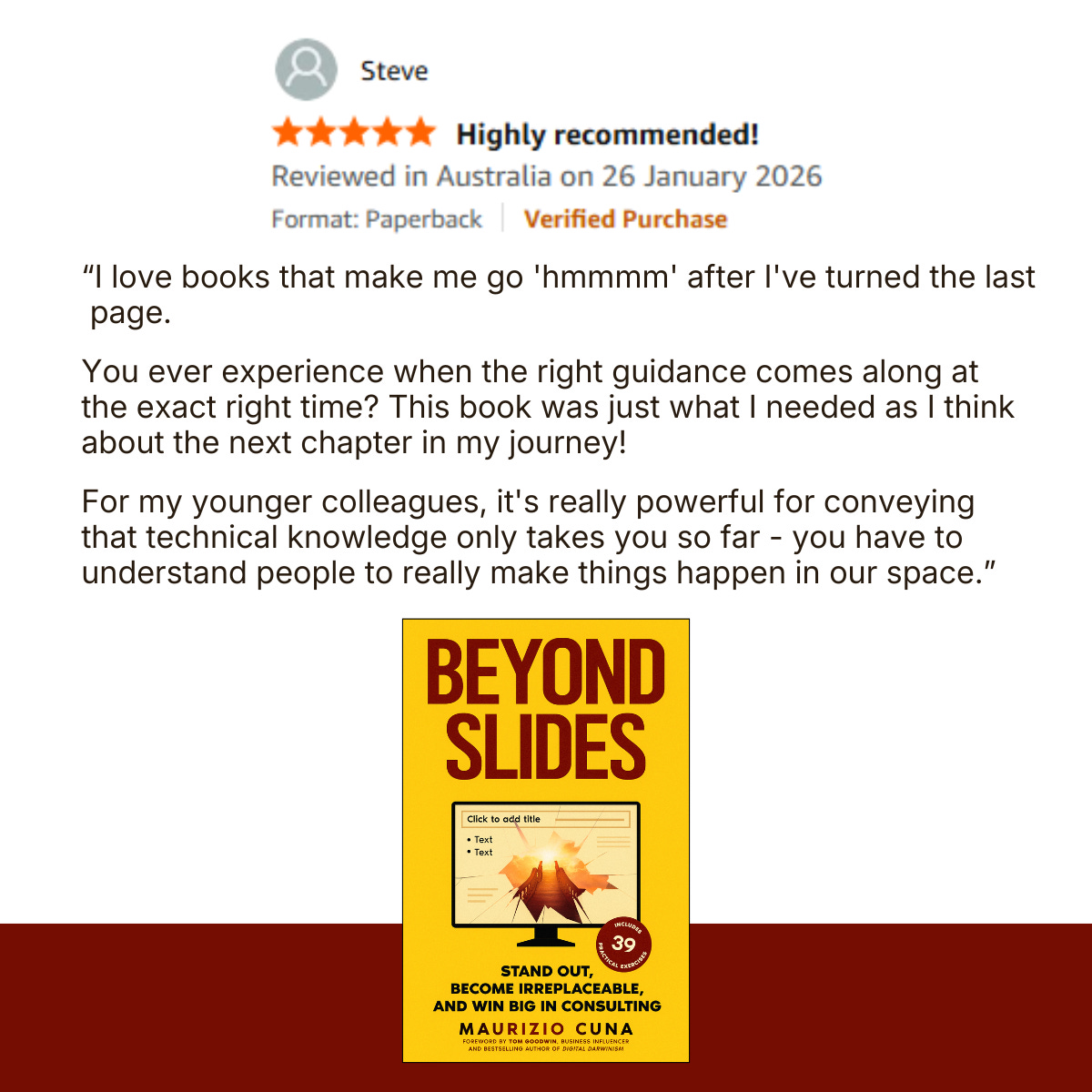
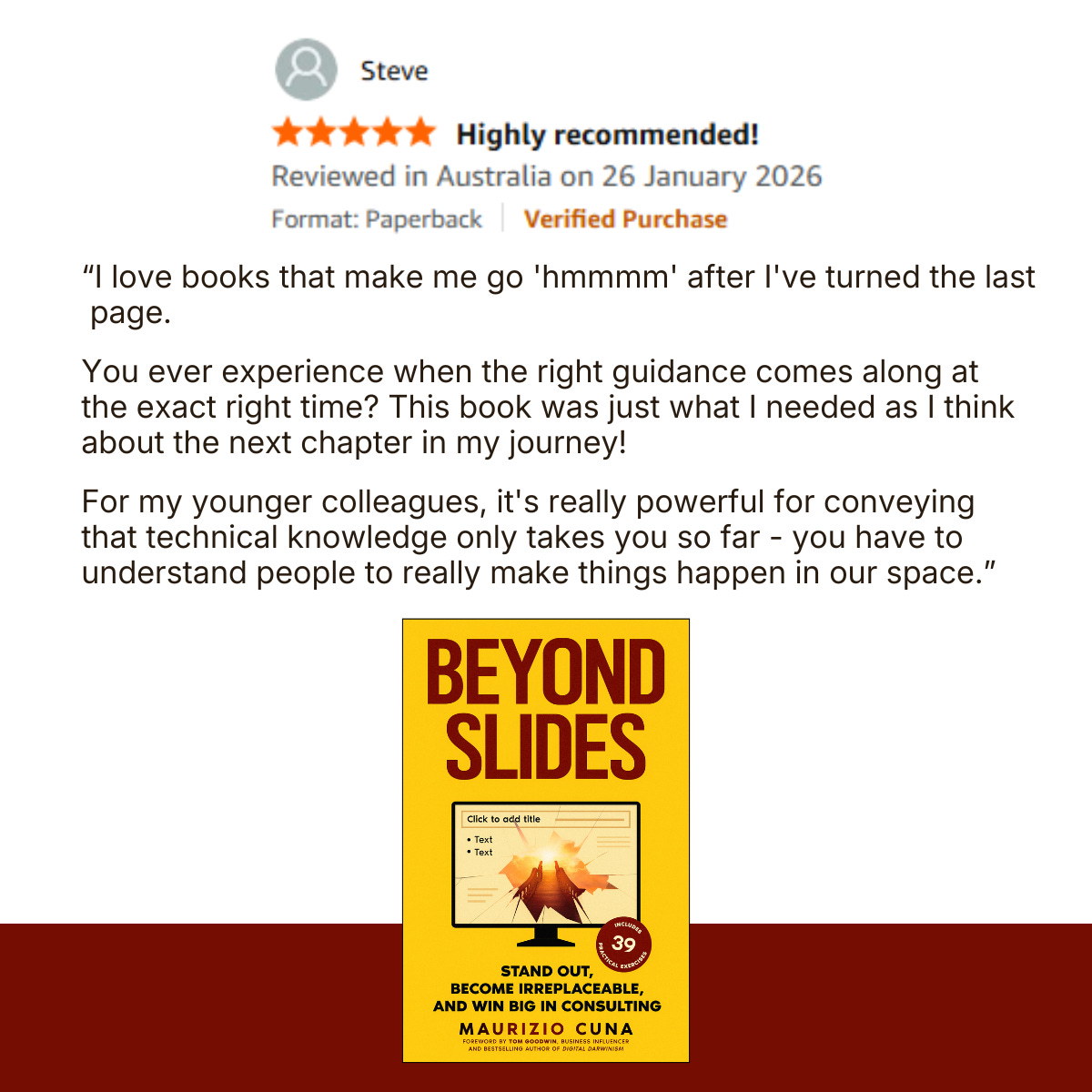
My first book Beyond Slides became a #1 Amazon Best Seller in the USA, UK, Australian and Italy. This is a review from a reader:
Have you looked into the Leaders Toolkit? It is a deck of 52 tools, frameworks and mental models to make you a better leader (use code CONSULTANT10 for 10% off);
The Consulting Intel private Discord group with 250+ global members is where consultants meet to discuss and support each other (it’s free).
I'm seeing this with a relative. I know how he speaks in person. Everything written down now sounds nothing like him. Polished. It may make someone sound 'smarter' to people who don't know the writer, but it is a clear disconnect from the real person.
This piece blew my mind in the best way. As a writer myself, this is one of the most important ideas today. Amazing ~human generated~ work @Maurizio 👏