


Let’s start here: a workshop is not a play.
Hamlet, or The Tempest, or The Antigone, are other things. You don’t get to rehearse a workshop, and no one is giving you a standing ovation for reciting bullet points off a deck.
A better analogy for a workshop is a football match (soccer, for the uninitiated) or a live F1 race. You can prepare your tactics, study the opposition, map out scenarios, but once the whistle blows or the flag goes off, it is all dynamic and adaptive.
The client might pivot the agenda 15 minutes in, a senior stakeholder may show up late and derail the discussion, someone in the room might have an unspoken grudge, and that “simple” prioritization exercise might get caught in a swamp of egos and territorialism.
You cannot script that. But you can train for it.
Trajectory > Agenda
This is the part most junior consultants do not get.
They spend hours fussing over the agenda slide like it is a sacred ritual. “At 10:05 we will do stakeholder alignment. At 10:30 we will run the dot-voting. Then a quick bio break...”
No, the agenda is not the point. The trajectory is.
What is the underlying transformation you are trying to enable in the room?
Are you shifting mindset?
Extracting clarity from the mess they are in?
Getting political buy-in masked as technical consensus?
Creating space for decisions that have been avoided for months or quarters?
A great consultant knows the difference between the structure and the purpose: you build the structure to serve the purpose, not the other way around. Of course, you must prepare, but the preparation required is not exactly what you might think.
Preparation is not about over-engineering every slide or having a 40-page appendix on standby. Preparation is about being mentally ready for what the room may throw at you.
I once ran a workshop in a Dutch bank’s basement room that had no windows, no wi-fi (we used a USB dongle to connect to the internet), very bad coffee (a classic in the Netherlands), and a dozen angry execs who thought I was there to waste their time. Had I come in clinging to my script, I would have been destroyed by lunchtime (which, in the Netherlands, would have meant eating bitterballen after getting annihilated in a meeting room).

Instead, I came in with:
An opening story that connected to their reality;
Three non-negotiable outcomes for the day;
A whiteboard strategy in case the tech failed (it did, because tech never works when it needs to);
The confidence to change pace based on the room’s temperature;
A few well-placed questions to stir participation.
That’s what good preparation looks like.
The art of reading the room
Reading the room is a fundamental part of the game. When in a meeting, I keep scanning the space and asking myself:
Are people leaning in or checking their phones?
Who is speaking most, and who hasn’t said a word?
Is that silence after your question confusion, disagreement, or disinterest?
Is the client sponsor subtly endorsing you, or rolling their eyes?
These signals determine your next move, because, if you pay attention, they tell you when to push, when to pause, when to reframe, when to joke, when to break the fourth wall and say, “It seems we are stuck. What’s really going on here?”
This skill only comes with experience, but you can accelerate it by doing two things:
watching great facilitators in action,
debriefing yourself like a coach after every session.
Ask: What landed? What didn’t? Why?
There is a dangerous myth among rookies that “winging it” equals “senior consultant swagger.”
WTF!!
Improvisation is NOT lack of preparation (absolutely not!); improvisation is surplus of mastery. You are too good, therefore you can improvise.
A jazz musician improvises because they know the structure, the scale, the chord progression. They have practiced so much that their brain is free to play, adapt, go with flow.
Same with you: if you know your materials, your frameworks, your facilitation tools so well that you can shift between them mid-sentence, then you can improvise, otherwise you are basically gambling, which is not smart practice in management consulting.
Last weekend I took my daughter to the circus (we love it).

There was this act, one of those rotating death wheels, where two giant steel rings, one inside the other, swinging like a pendulum twenty metres into the air. A man ran inside the wheel as it turned, then (because that wasn’t insane enough) he climbed on top of the wheel, at its highest point, and tried to skip rope.
He tried to skip rope, on a moving, rising, spinning ring of steel.
He missed, and almost fell! The rope tangled. His body jolted. And, for a moment, everything stopped.
He recovered with a smile, bowed slightly, and said sorry to the audience. Then, he tried again. This time, he landed it, but that pause, that small slip, stayed with me.
See, this guy had obviously rehearsed that act thousands of times. His core, timing, grip: everything was honed, but it still almost ended badly. He was not underprepared of course, but there is a cost in doing something live, in a non-repeatable format, in front of people who expect perfection.
Some workshops can feel the same.
They are high-stakes live acts, with a dose of inherent instability. You can prepare like hell, and still slip.
Like that circus performer, the consultant has a choice.
You can panic, blame the rope, blame the lighting, retreat to your notes, or call an early coffee break. Or you can acknowledge the slip, own the moment, rebalance, and go again.
That is actually the real test: what you do when what you prepared doesn’t work.
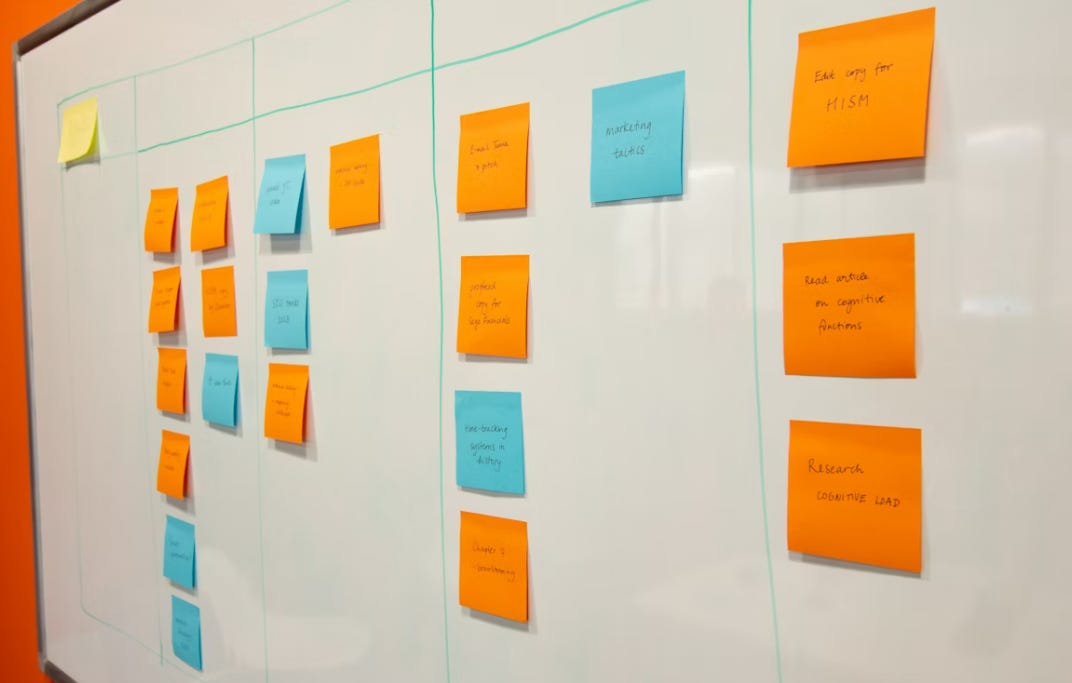
Your job is to create movement. If nothing has moved by the end of the workshop (eg, no decision made, no insight unlocked, no alignment built, no next steps defined, no logical continuity discussed, etc) then you just ran an expensive meeting with Post-its.
The movement you need to facilitate might be:
From stuck to unstuck;
From divergent to convergent;
From ideas to next steps;
From passive attendance to emotional commitment;
From any State A as-is to State B to-be.
That movement requires not just logic, but emotional intelligence, and often even a bit of perception management: you might need to provoke, charm, challenge, or disarm; you might need to switch the energy with a story, or throw out your slide and go full Socratic.
There is no manual for that: practice and self-awareness is the best solution I came up with after 20 years of trial and error.
Know your role
Finally, remember that when you run a workshop, you are holding the space, since you are acting like the conductor of a messy orchestra.
Don’t be there to show off your intelligence or dominate the room, just keep reminding yourself that your success is not “being right” but making the room smarter.
That is what great consultants do: they fabricate action where there was indecision.
The manual is in your head, but more importantly, it’s in how you show up, listen, respond, and hold the trajectory while surfing the mess.
What do you think? Let me know in the comments…
👋
👀 Links of interest
A few corners of the internet you may find interesting:
My book Beyond Slides (#1 Amazon Best Seller in the Consulting category in USA, UK, Australia, and Italy) is out in e-book and paperback format on Amazon (also available as an audiobook in the USA);
The Leaders Toolkit is a deck of 52 tools, frameworks and mental models to make you a better leader (use code CONSULTANT10 for 10% off);
The Consulting Intel private Discord group with 230+ global members is where consultants meet to discuss and support each other (it’s free).
What blue-collar workers knew for decades came for knowledge workers and the LinkedIn class: when the entire planet is thinking about how to do more with less, one day, you will be the “less”. - From A world view on work by João Landeiro

Really loved this - so many workshops are 400 slides/ 40 gallons of coffee/ 4 hours - with no thought beyond the content. The jazz thing is a great comparison - look up a Henry Farrell post on Brian Eno's theory of democracy for an interesting related set of ideas
Great perspective. Completely jives with my experience and that of others. There is a real challenge of skilling the art side of this capability. The science side is easier to share. Part of it, I think, requires the junior practitioners to have a sense of themselves to be able to know their “style” of improvisation. That can be tricky and usually pretty iterative. And you have to be comfortable with the uncertainty of the ensemble.
Love this post! You bring great insights to old and young alike!