


There is an AI bubble… Let’s get that out of the way first.
Valuations are clearly running ahead of realized value: anyone who has lived through dot-com, Web2, crypto, or even the early cloud years can smell that part from a mile away.
Capital always arrives before productivity shows up on the P&L.
However, I believe another thing to be also true: calling it just a bubble misses what is being built underneath.
If your only exposure to AI is ChatGPT as a clever autocomplete machine, I understand the skepticism. ChatGPT does feel incremental, cute even, a nice productivity hack more than a civilizational shift.
The picture looks very different once you see agents wired into real systems: databases, browsers, internal tools, Auth, workflow engines. Engineers playing with these setups already know the bottleneck is no longer “can the model do this?” but “are we brave enough to give it access?”
That is an important distinction, and it also explains why the commercial story looks confusing right now.
Microsoft has reportedly cut sales targets for its agentic AI software by as much as 50%. Copilot, despite the distribution advantage, is struggling to convert curiosity into conviction. Internal tests earlier this year showed AI agents failing to complete tasks up to 70% of the time.
While I do not necessarily see that as hype collapsing, I do think this is immaturity being exposed.
When agents sit at the edge of the system, failure is annoying, but when they sit inside the system, failure is existential, and so no CIO is going to green-light broad access when error rates still look like that.
This, inevitably, also shows up in market share.
ChatGPT commands roughly 61% of usage. Google’s Gemini sits around 13%, but is growing fast. Microsoft’s Copilot is hovering around 14%, despite being embedded everywhere from Outlook to Teams.
Distribution alone seems not to be enough. Reliability and trust matter more.
We are in an awkward in-between phase: capabilities are compounding (very) fast, infrastructure is being laid even faster, but value creation always lags, because organizations (especially large ones) are social systems, not codebases. Trust, security, governance and incentives move at human speed, not GPU speed.
History is boringly consistent on this point.
Banks, for example, still run on COBOL (there are still an estimated 220,000,000,000 lines of COBOL in use worldwide): this happens not because COBOL is a particularly elegant language, but because IT WORKS, and the downside risk of change is asymmetric.
Large institutions optimize for survival first, innovation second. “If it ain’t broke don’t fix it” is not stupidity but basic risk management.
Adoption will be uneven, slower than Twitter thinks, but faster than most executives expect.
I am not convinced we are staring at mass unemployment tomorrow. In my view, the more interesting question is whether expectations for products and services simply explode. If every firm can build 3–4x more, does that mean fewer jobs… or just a much higher bar for what “good” looks like? Are we staring at the modern instance of Jevons paradox, as I discussed in this LinkedIn post?

My instinct is that we will automate away mediocrity long before we eliminate ambition.
Average, low-leverage roles will feel the pressure sooner than people want to admit, while highly capable operators will be asked to do far more.
That gap matters.
The real constraint right now is permission, secure access, enterprise-grade guardrails, comfort with delegation to machines. Those things take time to socialize, standardize and regulate, but when they fall into place, value creation will catch up with valuations.
Not all at once. Not evenly. But decisively.
There is froth. There always is.
However, beneath it, something structural is happening, and once you see agents doing real work inside real organizations, it becomes very hard to dismiss this as just another hype cycle.
We have seen bubbles before.
We have also seen what survives after they burst.
As usual, if you enjoy reading Consulting Intel, please do me a favor: spread the word and share this post.
👋
👀 Links of interest
A few corners of the internet you may find interesting:
I have been working on a small project……. EDGE, a format by Consulting Intel, is where I sit down with operators, consultants, and investors working between business, tech, and AI… and where I distill what I learn in something you can read in ~7 minutes.
IT IS COMING SOON on Consulting Intel!
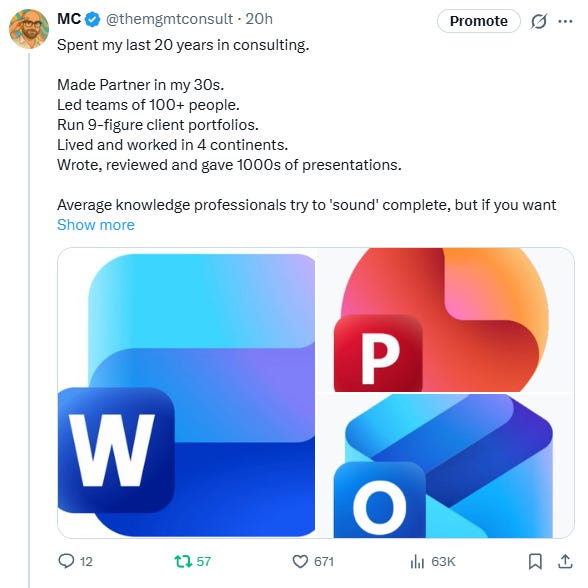
In this post on X (which kind of went “viral” and got over 1,000 bookmarks), I articulate 5 actionable tips to uplift your communication and presentation skills:
Have you looked into the Leaders Toolkit? It is a deck of 52 tools, frameworks and mental models to make you a better leader (use code CONSULTANT10 for 10% off);
The Consulting Intel private Discord group with 250+ global members is where consultants meet to discuss and support each other (it’s free).


I really like this summary Maurizio. I think we should also recognise that the competitive landscape may change radically. If there is a traditional capital markets bust, this is very disruptive at the level of which companies survive and which die. We may see a tech world that is a very different shape on the other side.
Amidst the deafening AI hype, there’s a massive blind spot that few are talking about: the sheer inertia of the modern corporation.
While the world moves at breakneck speed, the view from inside the C-suite is much gloomier. For most employees, AI isn’t a superpower—it’s a "restricted access" notification. Rigid security protocols and compliance bottlenecks have created a environment where the dynamic of change isn't just slow; it’s glacial.
Then there’s the elephant in the room: the Microsoft dependency. Most enterprises have tethered their entire digital existence to the Microsoft ecosystem. It’s the safe choice, the "no one gets fired for buying IBM" of our decade. But here’s the truth: compared to the cutting-edge innovation happening on the fringes, these corporate-grade tools are often mediocre and clunky. By defaulting to the "safe" infrastructure, these companies are inadvertently opting for the slow lane.
This creates a fascinating, albeit predictable, divergence. The future won’t belong to the loudest or the largest, but to those rare few who can bridge the gap between rigorous risk management and operational agility.
The real winners will be the organizations brave enough to experiment while others are still filling out compliance forms. But looking at the current landscape? I suspect those winners will be few and far between.