


I have been been there: sitting in an important meeting, listening along while someone uses an acronym I had never heard before, or describes an idea so unfamiliar it feels like they are speaking Kiswahili.
Typically, my heart rate would climb, and I would feel quasi-paralyzed by the fear that if I speak up, I will be “found out.”
It is a lonely, frustrating feeling that makes me feel like an idiot.
Have you been there too?
Judging by the amount of questions I get about this topic, the answer must be a resounding yes.
In the scenario I just described, you are standing at a fork in the road. You have a choice:
Stay silent: Protect your ego in the short term, but risk a costly, high-stakes mistake later because you didn’t truly understand the mission;
Speak up: Lean into the discomfort, reclaim the narrative, and steer the conversation back toward something clearer.
Successful operators know that asking for clarification is an important tool of high-level execution: when you ask the question everyone else is too afraid to ask, you are both helping yourself and leading the entire conversation.
This ability is, by the way, entirely learnable.
To help you navigate these moments with total confidence, I have curated 51 powerful questions categorized into 7 strategic frameworks.
You might already be asking a few of these questions as part of your regular style. Others are worth experimenting with in your next meeting. A few may simply point you in a direction that feels interesting or useful and, from there, you will likely end up crafting a version of the question that fits your own context better.
It’s all fine.
Use these ideas as you please: they may change the trajectory of your future meetings.
LFG!!!
Feel free to print the image below if you want to have all the questions in one place
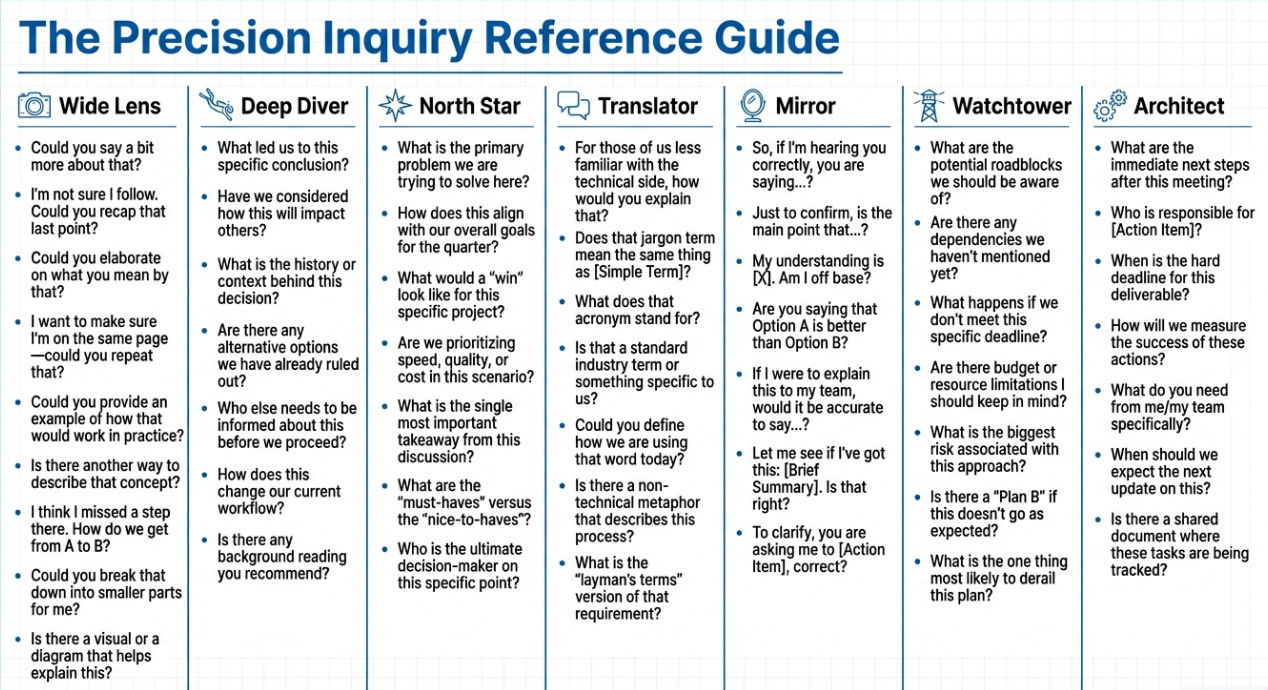
1. The “Wide Lens” (General Clarification)
Pick one of these questions when the overall concept feels fuzzy and you need a high-level reset.
Could you say a bit more about that?
I’m not sure I follow. Could you recap that last point?
Could you elaborate on what you mean by [Term/Phase]?
I want to make sure I’m on the same page. Could you repeat that?
Could you provide an example of how that would work in practice?
Is there another way to describe that concept?
I think I missed a step there. How do we get from A to B?
Could you break that down into smaller parts for me?
Is there a visual or a diagram that helps explain this?
2. The “North Star” (Goals & Objectives)
Pick one of these questions when you understand what is being done, but not why it matters.
What is the primary problem we are trying to solve here?
How does this align with our overall goals for the quarter?
What would a “win” look like for this specific project?
Are we prioritizing speed, quality, or cost in this scenario?
What is the single most important takeaway from this discussion?
What are the “must-haves” versus the “nice-to-haves”?
Who is the ultimate decision-maker on this specific point?
3. The “Translator” (Technical & Jargon)
Pick one of these questions when the “alphabet soup” of industry speak is blocking the message.
For those of us less familiar with the technical side, how would you explain that?
Does [Jargon Term] mean the same thing as [Simple Term] in this context?
What does that acronym stand for?
Is that a standard industry term or something specific to our internal process?
Could you define how we are using the word [Term] today?
Is there a non-technical metaphor that describes this process?
What is the “layman’s terms” version of that requirement?
4. The “Mirror” (Confirming Understanding)
Pick one of these questions when looking for the most effective way to ensure your mental model matches theirs.
So, if I’m hearing you correctly, you are saying...?
Just to confirm, is the main point that...?
My understanding is [X]. Am I off base?
Are you saying that [Option A] is better than [Option B]?
If I were to explain this to my team, would it be accurate to say...?
Let me see if I’ve got this: [Brief Summary]. Is that right?
To clarify, you are asking me to [Action Item], correct?
5. The “Watchtower” (Risks & Constraints)
Pick one of these questions when you need to surface the hidden dangers in a plan.
What are the potential roadblocks we should be aware of?
Are there any dependencies we haven’t mentioned yet?
What happens if we don’t meet this specific deadline?
Are there budget or resource limitations I should keep in mind?
What is the biggest risk associated with this approach?
Is there a “Plan B” if this doesn’t go as expected?
What is the one thing most likely to derail this plan?
6. The “Architect” (Next Steps & Accountability)
Pick one of these questions when the meeting is ending, but nobody knows who is doing what.
What are the immediate next steps after this meeting?
Who is responsible for [Action Item]?
When is the hard deadline for this deliverable?
How will we measure the success of these actions?
What do you need from me/my team specifically?
When should we expect the next update on this?
Is there a shared document where these tasks are being tracked?
7. The “Deep Diver” (Context & Background)
Pick one of these questions when you need to know the “story” behind the decision.
What led us to this specific conclusion?
Have we considered how this will impact [Other Department/Project]?
What is the history or context behind this decision?
Are there any alternative options we have already ruled out?
Who else needs to be informed about this before we proceed?
How does this change our current workflow?
Is there any background reading you recommend so I can get up to speed?
The Golden Rule (if you are still not convinced): If you are confused, at least 3 other people in the room are too!
All the best. Share this post with a friend or a colleague who may need it, and go practice!
As usual, if you enjoy reading Consulting Intel, please do me a favor: spread the word and share this post.
👋
👀 Links of interest
A few corners of the internet you may find interesting:
My first book Beyond Slides became a #1 Amazon Best Seller in the USA, UK, Australian and Italy;
I had the opportunity to be an advanced reader for the upcoming book by my friend Kevin Ertell The Strategy Trap. He has done an excellent job at simplifying an otherwise complex subject, that people with decades of experience still do not understand. The book is well researched (which I like) and full of relatable stories. Follow Kevin Ertell and his newsletter The Strategy Trap Newsletter!
Have you looked into the Leaders Toolkit? It is a deck of 52 tools, frameworks and mental models to make you a better leader (use code CONSULTANT10 for 10% off);
The Consulting Intel private Discord group with 250+ global members is where consultants meet to discuss and support each other (it’s free).
I know this will definitely date me, but Detective Columbo from the TV series of the 1970s was a role model for me in his willingness to ask the basic questions that made him look foolish. Often times, not only did it help to cement his understanding, it also revealed how much the person he asked really understood the situation themselves, or perhaps were even misrepresenting the situation. Thank you for the great resource!
Excellent stuff! I re- read it to check, but couldn't find the intervention that asks "did we just make a decision? ". Useful to prompt the minute taker when things get blurry.