


Let’s talk about the most frustrating pain point in a professional’s life: hitting the ceiling.
You are capable. You want to advance. You are working exhausting hours and doing everything right, yet somehow, you don’t progress as fast as you think you should.
When driven professionals hit this wall, they realize they can’t break through it alone, and start to desperately look around for a painkiller.
And what does the market hand them? A placebo.
Everyone everywhere is suddenly a “coach.”
Credentials are popping up overnight, usually minted the moment someone throws thousands of dollars at a certification program.
But who exactly is buying all these coaching services? And why aren’t they actually curing the pain?
I know I have mentioned Consulting Edge in a few recent Consulting Intel emails, and I debated hitting publish on this piece because I never want my writing on this newsletter to read like a glorified ad.
But I need to share my thoughts because I have spent many years thinking through why certain careers don’t go as well as others, and I realized something fundamental is broken.
Maybe I can be helpful.
I’ll say this straight away: I firmly believe everyone needs guidance.
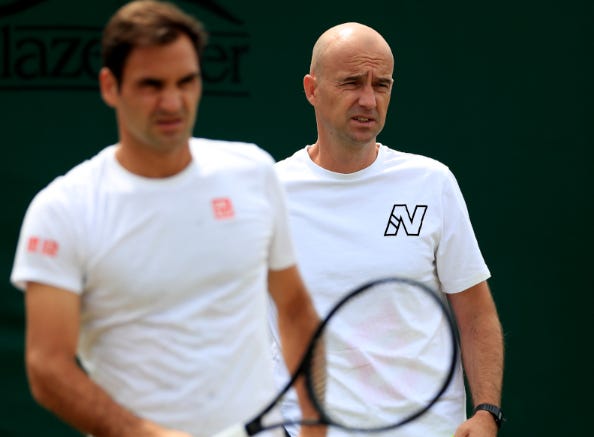
If Roger Federer needed a coach, it’s safe to assume you do, too. But what the corporate world calls a ‘coach’ is very different from a coach in sports.
The inner game
I lean heavily on sports as a metaphor for life.
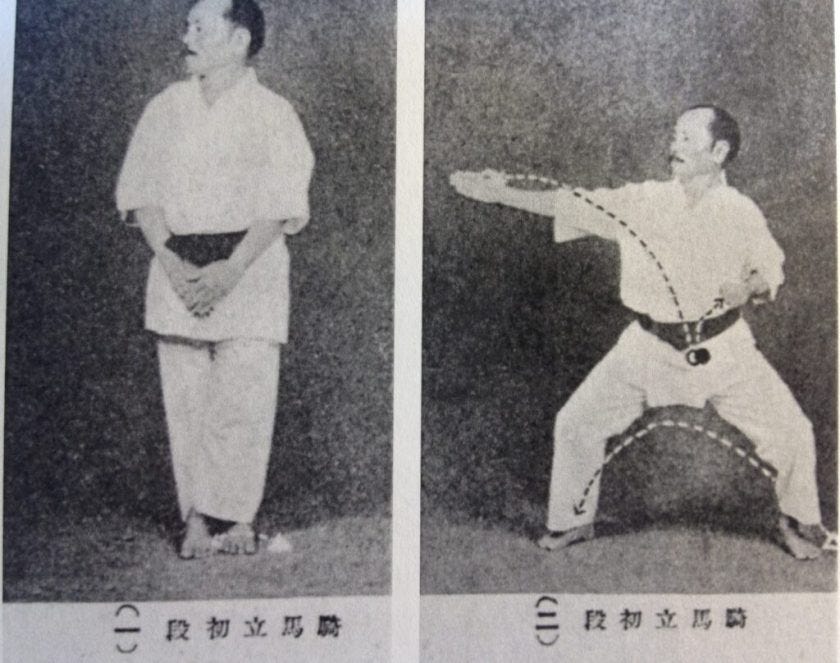
As a lifelong soccer player, an advanced tennis player, and now a beginner Karateka (8th Kyu in Shotokan), I love how sports reveal the inner game.
Martial arts, in particular, fascinate me because of their dual nature: they require equal parts physical technique and psychological conditioning. You have to learn the mechanics, for example how to strike, how to move, how to generate force, but you also have to acquire a specific mindset.
Practicing Karate has taught me that a true Karateka internalizes the dojo’s philosophy so deeply that it bleeds into their daily life (this book by legendary master Gichin Funakoshi is a fantastic read).
Excellence demands relentless discipline. You must be willing to perform the EXACT same strike hundreds or thousands of times until it becomes pure instinct.
It is an infinite game. It’s clear to me that true perfection is never reached because there is always a tiny micro-adjustment or refinement to be made.
Call it cliché, or call me a LinkedIn lunatic… I don’t care, but I genuinely believe your professional craft operates as a martial art.
Growth and progress in your career require that same willingness to repeat the fundamentals endlessly until they are second nature, continuously refining a craft that is never truly “finished.”
And if your career is a martial art, we need to rethink who we look to for guidance. We don’t need coaches or mentors.
We need senseis.
Coaches, mentors and senseis
I often say (half-jokingly) that coaches are cheerleaders: they keep your morale high and maintain your motivation.
Mentors are storytellers: they share war stories and high-level advice over coffee.
Senseis, instead, are masters of form. They have done the work themselves, they command immediate respect, and they can point out exactly where you are wasting your energy.
In martial arts, a flawed strike leaks power.
You can swing as hard as you want, but if your mechanics are off, the energy dissipates. That’s why you need a sensei to correct your posture, ensuring that 100% of your energy is focused directly into the impact.
In your professional life, a sensei does the exact same thing.
The devil is always in the execution
Let’s be honest for a second: most of us do need help getting out of the chair.
As I heard once from Derek Sivers, “if more information was the answer, we would all be billionaires with six-packs”. It is one thing to read a book on how to punch; it is an entirely different beast to execute it flawlessly when you are tired, stressed, and under threat.
What driven professionals really need is someone to dissect their execution, eliminate the unseen waste, and force them to direct their effort only where it yields actual results. They need a sensei to push them through the daily reps and hold them to an uncompromising standard.
Incidentally, this is why Consulting Edge shouldn’t be seen just as a static piece of paper.
The Edge Report gives you the precise blueprint, but knowing the path isn’t walking it!
For those who recognize they need rigorous psychological conditioning to actually change their behavior, we pair the system with deep-dive calls or transformation sprints. This is where a sensei steps onto the mat with you, demanding the form required to master your craft until it becomes pure instinct.
Professional coaching has hit an exhaustion threshold.
That practice relies on a cycle of 1-hour chats, accountability prompts and subjective opinions (plus a lot of cheerleading of course 😅…). You end up paying thousands of dollars for someone to circle your career problems, leaving the root cause completely untouched.
I engineered the Edge architecture as the exact antithesis of all of this.
I engineered it as a constraint-based behavioral measurement and transformation system: the necessary tool that simply didn’t exist before. It is definitively not a relationship, a sounding board, or a weekly talk therapy session…
Here is how it breaks the mold:
Triangulated data over subjective advice: Instead of relying on one person’s isolated career bias, the system cross-examines behaviorally anchored items, situational scenarios, and past project breakdowns to measure how you actually operate.
System dynamics over additive checklists: Coaches view human growth as additive, telling you to work on your weaknesses like a school report card. I apply Goldratt’s Theory of Constraints, treating your career as an operational production line to isolate the single upstream bottleneck suppressing your strengths.
Endless retainer fees vs. Algorithmic precision: Coaching sells billable hours to discuss problems indefinitely. My architecture requires one reflective sitting to deliver a hyper-personalized Edge Report, complete with peer benchmark calibrations, a Leverage Quadrant map, and a 90-day action blueprint with verifiable “Done when” criteria.
The growth mathematical equation
At some point in their careers, capable professionals stop advancing because an unmeasured operational constraint (such as weak Framing or misread Stakeholder Algebra) is capping the throughput of their entire profile. Relieving that single constraint releases capabilities you have already earned through years of scar tissue, allowing those capabilities to develop on themselves for client work immediately.
To be clear, I have nothing personal against coaches, I just think the effectiveness of many of them is limited compared to precise, systems-level solutions.
I am an engineer, so I’ve got an equation for that.
Technical baseline + Contextual execution + Targeted relief = Asymmetric growth
Term 1 (the technical baseline) is the sum of the hard skills you possess. The problem is this hits a hard ceiling very early.
Term 2 (the contextual execution) is how you operate. The problem is institutions & clients refuse to measure this, waving it away with terms like ‘presence’ or ‘gravitas.’
Term 3 (the targeted relief) happens when you isolate and fix the upstream behavioral constraint starving your system. If your upstream Framing is blocked, doubling your effort on downstream deliverables WILL NOT HELP YOU.
A lot of knowledge workers have high numbers for Term 1 and decent instincts for Term 2. Yet their total output stays low because Term 3 is zero.
Consulting Edge knows that Term 1 is already there (I don’t need to teach you how to build a spreadsheet). Instead, it measures Term 2 with psychometric precision, and then delivers Term 3.
The Edge Report maps your exact Leverage Quadrant, isolates your primary upstream constraint, and hands you the detailed blueprint to unblock it.
Solve Term 3, and you don’t need to work 50% harder on Terms 1 and 2 because the capabilities you already own finally convert autonomously.
The Edge Report delivers more precise and actionable relief in one sitting than months of open-ended conversations with a “coach”!
This is my contribution to the broader industry that has given me personal and financial success over the past 20 years. More people deserve to reach and blow past that level, and to get there, you need the right guidance.
It’s time to step onto the mat, fix your form, and stop leaking energy.
Because frankly, if I could learn to master this inner game, you can do the same... and so much more.
As usual, if you enjoy reading Consulting Intel, please do me a favor: spread the word and share this post.
👋
👀 Links of interest
A few corners of the internet you may find interesting:
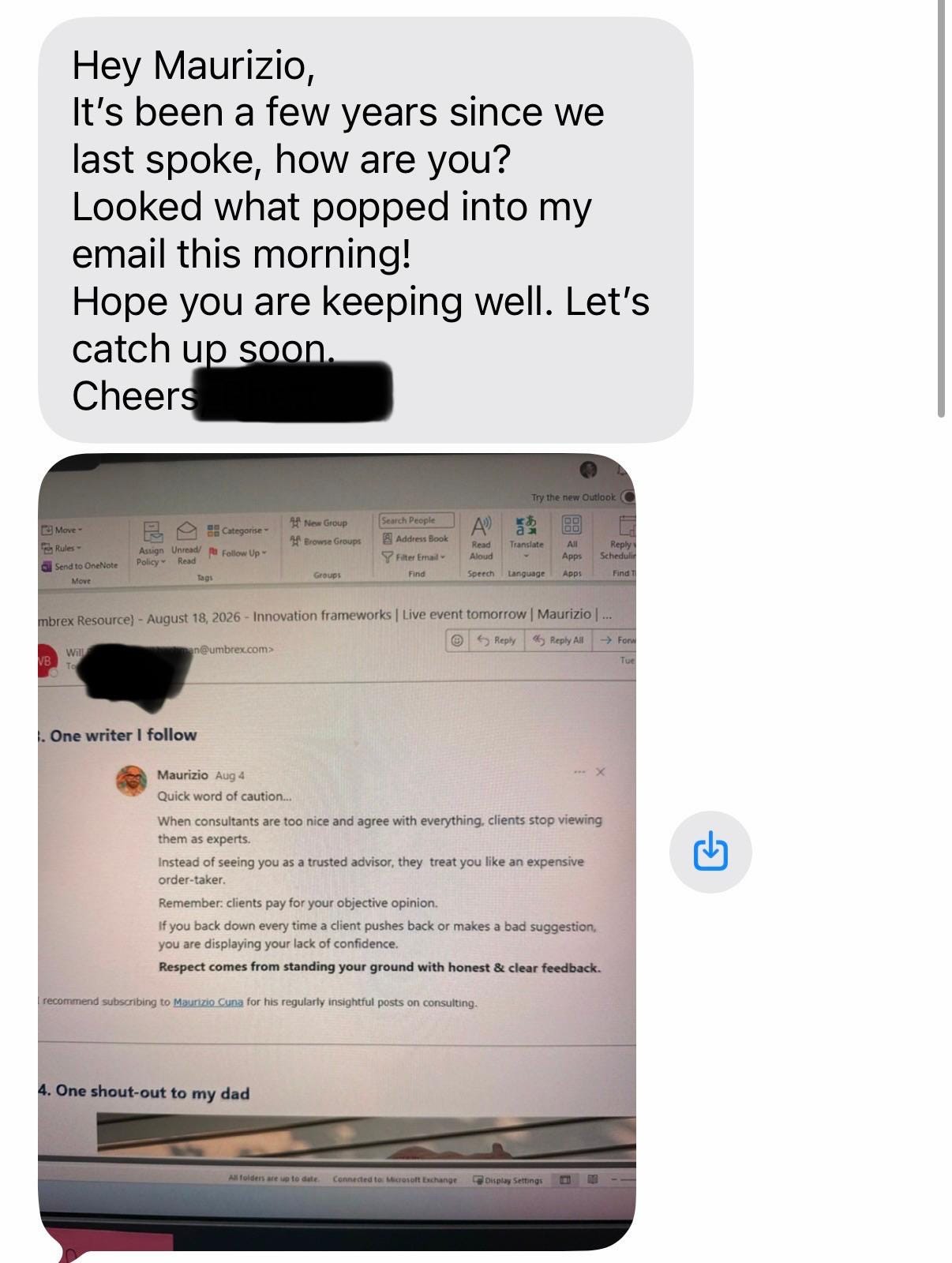
Am I famous now?! 😂 An old business partner of mine from almost 10 years ago sent me this text because my newsletter was recommended by Will Bachman to his subscribers (including my friend). Feels like I’m cool.
Have you looked into the Leaders Toolkit? It is a deck of 52 tools, frameworks and mental models to make you a better leader (use code CONSULTANT10 for 10% off);
The Consulting Intel private Discord group with 250+ global members is where consultants meet to discuss and support each other (it’s free).
Yes you are famous now.