


👋 Hi, it’s Maurizio. Welcome to my newsletter on everything professional services.
To find the capability currently blocking your system, and get a personalized plan for your performance transformation → Get Consulting Edge
I am always surprised by how easily the story of the businessman and the fisherman catches people.
Not sure if you are familiar with the popular parable, so let me summarize it for you.
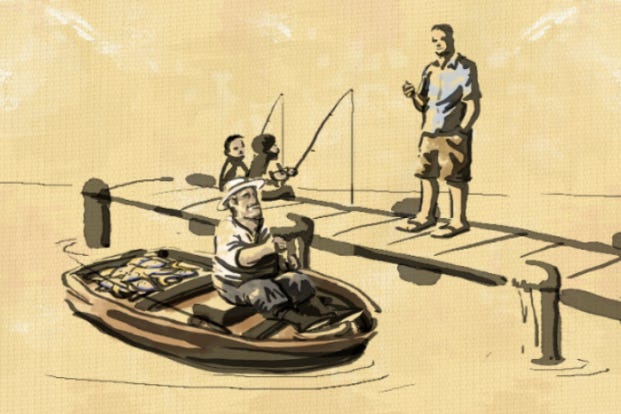
A wealthy businessman meets a fisherman relaxing by his boat, having caught just enough for the day.
The businessman outlines a grand vision of how the fisherman could scale his operation, build a fleet, take the company public, and eventually retire rich to do exactly what he is doing right now... sitting by the ocean, fishing, and drinking wine.
The story is probably designed to be a mic drop, meant to expose the futility of the rat race. But the more I think about it and read it in the wild, the more I realize it relies on a massive flaw.
It romanticizes stagnation while framing growth and ambition as a tragic waste of time, completely missing the point of what it actually means to live.
Life is finite, and it is arguably best spent collecting meaningful experiences.
The parable confuses the setting of a good life with the substance of it.
Spending a life actively doing things, imagining and achieving goals, intentionally improving, and finding ways to develop: that is the very essence of life!
We as individuals and professionals don’t evolve in a vacuum but rather grow by navigating problems.
The fisherman sitting on the bed of a river from birth to death has optimized his life for simple pleasures and low stress. Do you think that is a life well spent?
In doing so, he has insulated himself from the serendipity and complex opportunities life might have given him had he taken a bit more risk here and there.
A life completely devoid of hard challenges is probably a life without profound growth.
The businessman’s late nights, stressful negotiations, failures, learnings, pivots are so much more than just a meaningless detour on the way to retirement.
The parable assumes an almost utopian static world (try that in your next project planning!): it assumes the fish will always bite, the river will never dry up, no sudden health crisis will ever strike the fisherman’s family, and so on.
The simple life may appear as beautiful, yet it is fragile.
The businessman’s pursuit was about building the resources, the resilience, and the agency to weather life’s inevitable storms. When you solve life problems on a large scale, you build a safety net not just for yourself, but for those around you.
There is also the important question of what we leave behind.
The fisherman catches enough to feed his family, plays guitar, watches the sun setting, and sleeps. It is a peaceful existence, but an entirely self-contained one. The businessman, for all his flaws and sleepless nights, likely created jobs, solved industry puzzles, built infrastructure, interacted with the broader world.
Is the ideal life merely about personal contentment, or does it require pushing outward to leave a mark on others?
I think this story tries to convince us that because both the businessman and the fisherman end up on the same beach, their lives are equal. It’s a bit like resulting in poker (have you read Annie Duke’s Thinking in bets?).
The story confounds the outcome and the process, what happens after the decision and the decision-making framework itself, and that is wrong.
How many experiences has the fisherman missed while sitting there catching fish? How many lessons has the businessman learned that made him wiser in his chasing of life?
The businessman who retires to fish does not have the same mind as the fisherman who never left his village. He sits on that beach with a lifetime of data, relationships, perspectives, hard-won and field-tested wisdom.
The Greek philosopher Heraclitus famously said “No man ever steps in the same river twice, for it’s not the same river and he’s not the same man.” The businessman embodies this truth. The view of the water might be the exact same, but the viewer is fundamentally transformed.
That transformation is also why the pursuit is valuable per se, and it highlights what is truly important here: intentionality.
You don’t want to sleepwalk through life only to end up where the fisherman always was, shaped entirely by default rather than by design. You want to decide where to go, testing the boundaries of what you are capable of building and experiencing.
Spending a life chasing goals is not a waste of time because the process is as important as the destination.
If, at the end of a long dynamic life of solving problems and exploring the world, you use the fisherman’s beach as your destination, so be it. But the journey is what is most interesting.
The destination is only a small piece of the puzzle.
As usual, if you enjoy reading Consulting Intel, please do me a favor: spread the word and share this post.
👋
👀 Links of interest
A few corners of the internet you may find interesting:
This post on my X’s profile resonated with a lot of people. How should we re-imagine skilling ourselves in an AI-driven world?
 Maurizio@themgmtconsultInternet billionaires famously restrict screen time for their own kids. What's going to happen with the coming wave of AI pioneers? Let me tell you how I think it will go down. Skipping low-level mechanics in any sort of domain creates passengers. To instead create drivers…11:13 AM · Sep 25, 2026 · 2.41K Views2 Replies · 4 Reposts · 16 Likes

Have you looked into the Leaders Toolkit? It is a deck of 52 tools, frameworks and mental models to make you a better leader (use code CONSULTANT10 for 10% off);
The Consulting Intel private Discord group with 250+ global members is where consultants meet to discuss and support each other (it’s free).