


In the late 19th century, horse racing in Great Britain was one of the central public dramas of the age.
Crowds packed the grandstands to wager and witness the strange alchemy between animal, rider, and ground. Trainers and jockeys knew their horses intimately: how they breathed, how they carried weight, how their stride changed when the soil was damp or when the wind came sideways off the Downs.
Some horses flew down long, dry straights where the earth was firm and clean.
Others only came alive on tight, twisting circuits where timing and agility mattered more than brute force.
And some horses, despite being magnificent in appearance, collapsed into mediocrity at the first hint of mud.
After decades of watching champions rise and fail, a pattern became undeniable for jockeys and trainers: no horse could dominate every track, because the ground itself chose the winner.
Horses for courses.
The horse was not intrinsically “good” or “bad”, it was simply suited to certain terrain. And if you put the wrong horse on the wrong course, it didn’t matter how strong or beautiful or expensive it was. It would lose.
Over time, the horses for courses saying slipped into everyday English, especially in business and politics. It became a memento for something we forget far too easily:
Success is not only a function of capability, but also a function of context.
You have to know the environment you are in, the conditions you are running under, and the way the race is actually being contested.
Because the terrain chooses the winner.
(as an attendee to both the Ascot Race in the UK and Melbourne Cup Day in Australia, I can attest the horse-racing hype is still real to these days!)

The AI confusion
This is where we go wrong in today’s conversation around AI.
Just as trainers and jockeys learned that performance depends on matching the horse to the track, white collar professionals, and especially consultants, must now understand that their value depends on the context in which they apply their skills.
Everywhere I look, the debate is polarized between:
“AI will replace consultants!”
and
“AI makes everyone 10x!”
Both positions are so obviously lazy I cannot even believe those statements are actually being made. Both misunderstand the terrain.
The reality is, I think, simpler, but also more interesting:
AI is brilliant when the work is structured, documented, repeatable, and language-based;
AI is terrible when the work is ambiguous, relational, political, or dependent on courage and “common sense”.
What course are you running on? And is that the course you should be on?
If your day is filled with grinding through decks, writing documents, rewriting documents, summarizing documents, making spreadsheets, hunting for reference slides, doing desk research, responding to emails as fast as possible… You are running on the AI-friendly flat track.
On this track, the machine is already faster than you.
If you stay there, you will get commoditized. I cannot tell you exactly when, but I can exactly tell you it is going to happen. It does not matter if you are smart, or hardworking, or capable: you are racing on a ground where speed is the only metric, and (assuming Nvidia will keep delivering its chips) your competitor does not sleep.
The ending is predictable.
There is another track
Now imagine you choose a different terrain, for example a meeting room where people breathe, hesitate, reveal things without meaning to...
You begin spending more time there, as the person who draws the real questions to the surface.
You stop treating work as a sequence of deliverables to be produced and instead treat it as something to be understood.
You resist the reflex to respond immediately, and instead you sit with the discomfort of not knowing.
You ask the person across from you what they are actually worried about. You listen for the thing said indirectly, flinched at, softened, avoided.
Slowly, almost imperceptibly, the terrain changes beneath your feet!
The ground is no longer flat. It tilts and bends. Incentives pull in different directions. Personal histories shape what is possible. A single pause in the room carries more meaning than five pages of notes.
You begin to see how decisions are really made: in the space between people.
On this terrain, you rapidly realize that what matters is your ability to sense what is actually happening: WHO is protecting WHAT, where the fear sits, which outcome feels dangerous, and which one feels like relief.
This is not intuition in the mystical sense, nor is it calculation. This is not some fake guru stuff...
I am describing the practiced ability to read a situation in motion, to understand what cannot be openly stated, and to act in a way that changes the outcomes rather than just describing it.
A machine cannot do that!
We may even say that machines are intelligent (intelligence is cheap now), but machines have never been in meetings where the stakes were personal, where silence spoke louder than dialogue, where the decision could lead to some shift between people.
(PS: these are the types of skills I discuss in Beyond Slides, my #1 Amazon Best Seller book that includes 39 exercises you can train on — end of the ad 🤣)
What to do to become the right horse
This is where this reflection becomes practical, and please allow me to give you a few ideas you can start using straight away.
When you are handed a piece of work, don’t stop at delivering it.
Ask: “Why does this matter? Who actually cares about this? What would break if we got it wrong?”
You’d be surprised how often the sponsor doesn’t even know!
When you are in a meeting, stop trying to sound impressive. Instead, try naming the thing nobody is saying.
“The hesitation here is not about the cost. It’s about who ends up owning the outcome if this fails. That’s the real tension, isn’t it?”
That one sentence can be worth more than 200 slides.
And when you work with clients, do not jump into frameworks but rather begin with curiosity.
“What is the emotional cost of this decision for the people who will have to live with it?”
Now you turn into something more than a dealer of methodologies.
You become a trusted interpreter of reality, and AI cannot compete with that.
With this, I don’t mean to say AI is “dumb.” It is not. But AI has never sat in a room where the CFO’s face tightens when the CEO says ‘cost reduction,’ and you suddenly understand the stakes are not financial but personal.
The machine lacks exposure.
It lacks scar tissue.
It lacks context.
My recommendation is to stop asking how to outrun the machine, but instead start choosing terrain where being human is the advantage.
That means 4 things:
1) Spend more time in conversations than in documents;
2) Spend more time framing the work than producing it;
3) Spend more energy understanding incentives than analyzing data;
4) Spend more courage saying the uncomfortable truth early, rather than perfecting it on your own.
This is how you become the right horse, by placing yourself where your way of seeing the world is actually valuable.
Your strengths start to compound when you work in environments where your presence influences the conversation, where people speak differently because you are there, where decisions that were murky become clearer.
Where presence matters. Where the real work happens in the glance and the hesitation before someone speaks.
Where the ability to recognize what is shifting beneath the surface is worth more than any metric of efficiency.
As usual, if you enjoy reading Consulting Intel, please do me a favor: spread the word and share this post.
👋
👀 Links of interest
A few corners of the internet you may find interesting:
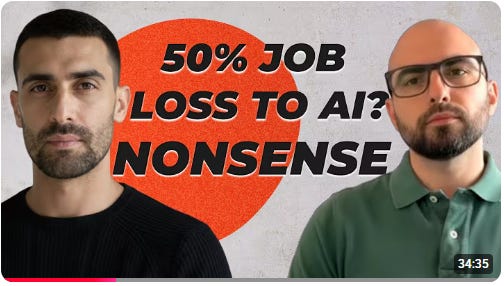
I recently spoke with Kenny Alami on a broad range of topics: from what I think AI will do to consulting, to how I use AI tools every day to increase productivity. This was a good conversation, so have a look if you are keen!

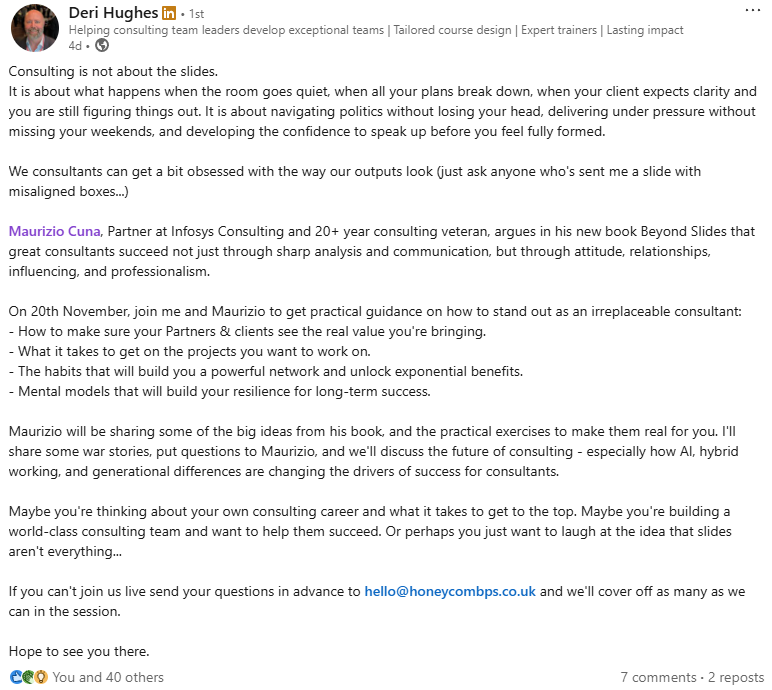
Also, I am meeting Honeycomb Consulting Skills and Deri Hughes on the 20th November for a LinkedIn Live session! Broad topics below:
Have you looked into the Leaders Toolkit? It is a deck of 52 tools, frameworks and mental models to make you a better leader (use code CONSULTANT10 for 10% off);
The Consulting Intel private Discord group with 250+ global members is where consultants meet to discuss and support each other (it’s free).
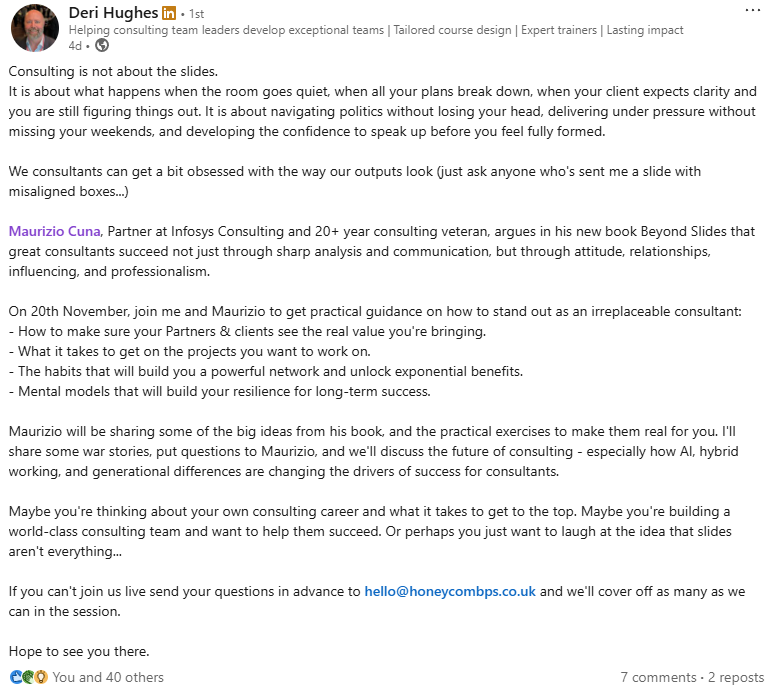
There is a lot to think about in this excellent post . On the surface, it is primarily relevant to people who do what I do - provide strategic advice on the impact of AI for business.
But it raises some interesting questions:
- AI is a highly efficient tool for information sharing. How will this change the way information flows and is used?
- In turn, how will that change how decisions are made? Changing how decisions are made changes everything.
- If AI takes over lots of repeatable tasks, that frees time so perhaps AI will lead to more not less social interaction?
- On the other hand, maybe those repeatable tasks are a dead end. What if the real power of AI is providing new and different ways of thinking about much more judgemental tasks?