


👋 Hi, it’s Maurizio. Welcome to my newsletter on everything professional services.
Close the capability gaps slowing down your progress, today → Get Consulting Edge
Traditionally, management consultants operated on clients paid tens of thousands of dollars a week for activities that were mostly “brilliant” and “exhausting grunt work” at once.
Smart junior consultants worked late into the night cleaning up heavy Excel files with too many columns and formulas, reconciling balance sheets, reading client interview notes to be summarized on some exec document, and “aligning left” boxes on PowerPoint.
In Beyond Slides I tell the story of when, during my first consulting job, coming back home from the office late at night, even the local pizzeria round the corner from my apartment was closed and I had to go to bed on an empty stomach…
Everyone involved back then assumed this work was secure.
When economists wrote about automation, they drew an unambiguous line: machines take routine manual tasks; humans keep the work that requires communication and judgment.
Large language models blew right past that line.
The clearest proof came from a field experiment run at Boston Consulting Group.
When consultants used GPT for standard business tasks, they worked faster and produced noticeably higher-quality deliverables. But on a task designed to sit just beyond what the model could handle, the consultants leaning on AI were 19% more likely to produce the wrong answer.
They grew complacent and trusted the smooth output to eventually stop thinking.
The takeaway should worry anyone selling knowledge work: large language models turn clear instructions into “competent” documents almost instantly, at essentially zero cost.
What they cannot do is tell you when you are solving the wrong problem, nor can they convince skeptical executives to act.
The AI Threat Matrix research
A recent research paper from parallel project Consulting Edge, titled The Consulting AI Threat Matrix (find the full paper following the link), maps this reality: instead of treating consulting as one monolithic job, we broke the profession down into sixty individual skills and tested them against two straightforward questions.
The first question is simple: How ambiguous is the problem?
Are the inputs already sitting in a folder, or are they missing? Would two smart professionals naturally reach the exact same conclusion, or could they disagree and both be right? Is the scope locked down, or does the client change their mind halfway through the project? When a problem is clearly bounded, AI dominates it. But when a problem is ill-defined and constantly shifting, a model can only guess at what you actually need.
The second question: Where does the work actually happen?
Does the job finish when you export a file (for example, a deck, a spreadsheet, a report) or does the real value happen live, in front of other human beings? Does the project fail because the analysis was wrong, or because internal politics torpedoed the rollout? If the deliverable is a document, you are competing directly with software. If the value lies in earning trust, guiding difficult people, and handling objections in real time, software can only help you prepare.
When you cross those two questions, consulting splits into 4 distinct worlds (don’t you love a good quadrant??):
At the bottom sits Commoditization. These are predictable tasks that end in a file: building financial models, running database queries, analyzing standard financial statements, and designing dashboards. A model does this in seconds. The billable rate for this work will soon go down to the cost of proofreading the output.
Next is Augmentation. These are tricky, ambiguous problems that still end in a deliverable, things like pricing strategy, scenario modeling, and building business cases. The model will hand you a convincing draft in two minutes. Your entire job is knowing enough about the domain and the reality to figure out where that draft is wrong.
Then comes Workflow Automation. These are the routine interactions consultants assume are safe simply because they involve people: weekly status updates, basic check-ins, and standard project scoping. But because these conversations follow predictable scripts, they will eventually be replaced by automated summaries and structured check-in tools.
Finally, in the top corner, is the Strategic Premium. This is the work AI cannot touch: crisis de-escalation, reading the politics of a boardroom, aligning executives who disagree, and holding meetings when an analysis threatens someone’s budget. The problem is ambiguous, and the solution must be negotiated live under pressure.
When you look at where all sixty skills land on the map, one finding stands out above everything else: not a single hard technical skill makes it into the safe zone.
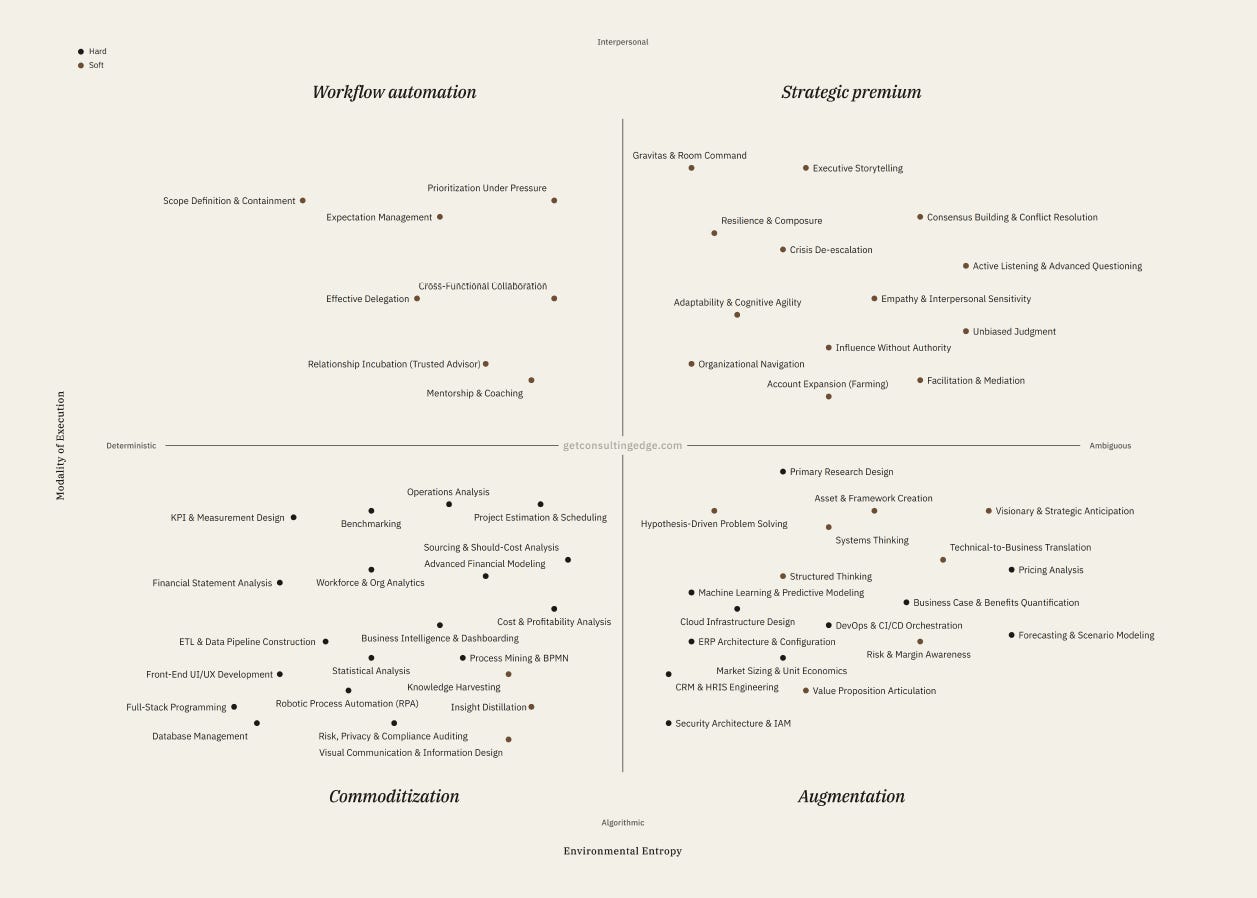
Full-stack coding, data pipelining, and statistical modeling are among the most vulnerable things a consultant can spend time doing.
Technical mastery is obviously still important, but treated as an isolated deliverable, it is easily replaceable by the machine. Meanwhile, the most insulated skill in the entire study is consensus building and conflict resolution.
Visual communication vs Executive storytelling
The paper illustrates this through a great contrast between two skills that sound identical on a resume: visual communication versus executive storytelling.
Making a beautiful chart belongs to visual communication.
The data is already known, and a model can turn a raw spreadsheet into an executive slide instantly. It sits squarely in the danger zone.
Executive storytelling, by contrast, happens in the room.
It is knowing which three numbers matter to this particular board, sensing when the CFO is getting defensive, and pivoting the narrative on the fly before the meeting falls apart.
The practical takeaway here is that your risk has almost nothing to do with your job title. A title blends the vulnerable work and the protected work together.
Your exposure is directly linked to how you spend your hours during a normal week.
If you spend forty hours finding your way through spreadsheets, polishing slides, and writing memos, you are working in direct competition with a machine that costs pennies to run. If you steer towards spending those same hours navigating client politics, running workshops, and steering strategic decisions, the machine only makes you more productive.
The only lasting edge to outrun AI is moving your weight toward the interpersonal work where the answer cannot be written down in advance, and where an algorithm cannot sit in your chair to take the heat.
If you want to dig into the full methodology, the scoring rubrics, and the individual rankings, you can read the complete paper here:

If you enjoy reading Consulting Intel, please do me a favor: spread the word and share this post.
👋
👀 Links of interest
A few corners of the internet you may find interesting:
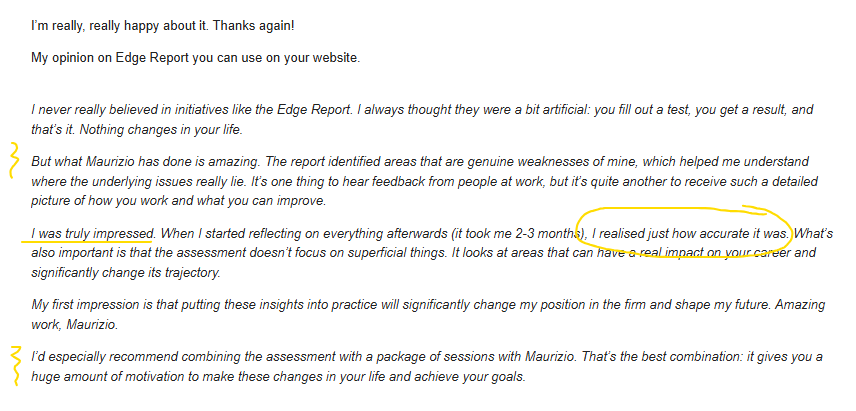
Recent feedback on Consulting Edge:
Remember that if you use code EDGE15 at checkout, you will receive 15% off any Edge product, and will then get a referral code earning you a commission every time someone else purchases using your code.
Who should you send it to? A few ideas:
colleagues in your firm who are going for promotion this year
people on your team, or juniors you mentor
peers at other firms you swap notes with
independent consultants you know (especially the ones still charging what they charged two years ago)
former colleagues who went freelance or moved in-house
Bulk pricing for teams is available separately - just reach out.
Have you looked into the Leaders Toolkit? It is a deck of 52 tools, frameworks and mental models to make you a better leader (use code CONSULTANT10 for 10% off);
The Consulting Intel private Discord group with 250+ global members is where consultants meet to discuss and support each other (it’s free).