


I recently came across this LinkedIn post from Vin Vashishta, and couldn’t help myself from dropping a comment right then right there.
For days, I kept thinking of the post. More came to mind, and so I decided to write a long-form piece.
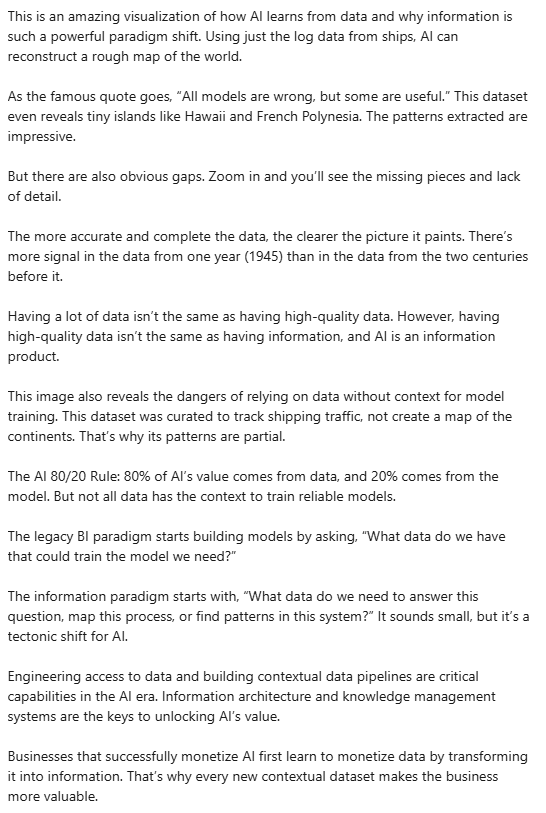
I linked the original post above, but I will also leave a screenshot here:
Look at those ship-log maps again.
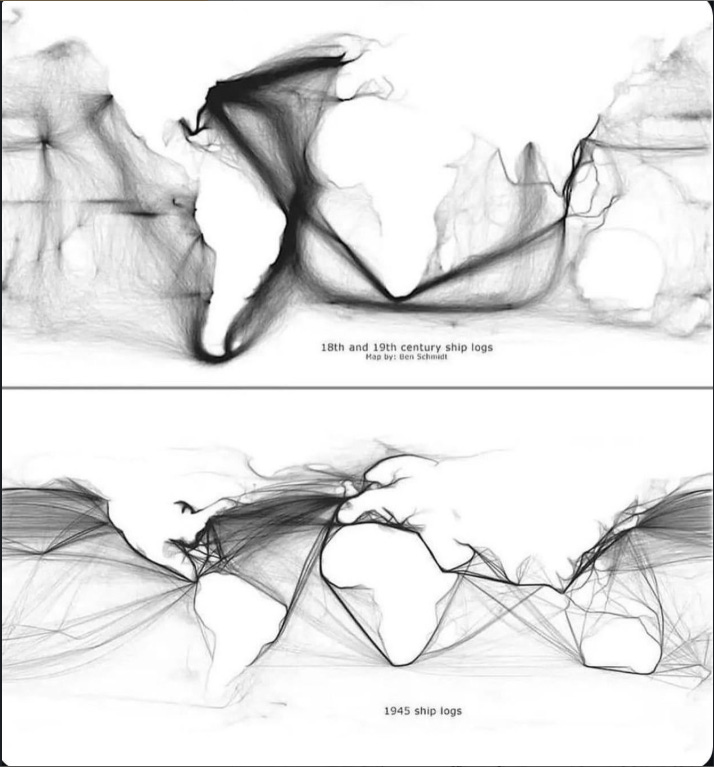
Thousands of tiny coordinates, each meaningless on its own, become a sketch of the world when placed together.
The Atlantic emerges. Trade winds appear as if drawn with charcoal. Even small islands show up as bright knots of traffic.
It proves two things at once:
Data can reveal structure that nobody explicitly encoded.
The picture remains partial because the data was collected for shipping, not for cartography.
As Alfred Korzybski warned first in 1931, “the map is not the territory.” And as George Box added some 45 years later, “All models are wrong, but some are useful.”
Both quotes fit perfectly here!

Having worked as a management consultant for the past couple of decades with large enterprises in 10 countries, I realized that big organizations have oceans of data… and a surprisingly small shoreline of use.
It is almost a tragedy.
Petabytes flow through warehouses and lakes, dashboards multiply, a new platform arrives every budgeting cycle, yet the insight that actually changes decisions is thin.
The reason is rarely a shortage of effort or talent. Often, it is a shortage of context.
Data is collected to run operations, settle invoices, comply with regulation, and click-stream a website. Later, executives ask this operational exhaust to answer strategic questions it was never designed to answer, which is why the insights often fall short.
The result looks like that ship map: suggestive, sometimes beautiful, but missing whole continents of meaning.
There is another pattern.
The conversation starts with the data that exists: “What model can we train with what we have?”
That framing feels pragmatic but can quickly become expensive. You end up bending the question to the data rather than shaping the data to the question.
The information paradigm flips this: “What decision do we need to make? What information would de-risk it? What data, with what traceability and structure, would produce that information reliably?”
The difference sounds semantic only, but it is instead HUGE!
Internal teams live inside the firm’s gravity: processes, incentives, and history pull every initiative into familiar orbits.
Backlogs are very full. Compliance is very real. Politics are the very operating system.
So, people optimize for what they can control: building pipelines, cleaning tables, hardening dashboards. All important work, for sure, but without an external forcing function, the hard questions often go unasked:
Are we answering the right problem?
Is the cost of precision greater than the value of the decision?
Which data is missing because nobody owns it?
High-quality data is not yet information!
Information is data given context relative to a decision. You can have exquisite accuracy and still be wrong for the task, like using ship logs to draw mountain ranges.
We may need consultants after all
This is where experienced external advisors earn their keep. They are probably not smarter than your people, but they do come unburdened by your history and armed with patterns from other places.
Breadth matters.
Someone who has seen insurer claims, retail replenishment, credit risk, mining maintenance, and airline scheduling notices recurring structures: queues, thresholds, matching problems, leakage loops, signal-to-noise constraints.
They carry “priors” about where value typically hides and where data usually lies to you. They know which questions are worth paying for, and which are false precision. They recognize when your map is drawn from one kind of ship.
Advisors also recalibrate scope.
They start with the decision and design the smallest trustworthy data product that moves it: the Minimum Viable Dataset. Then they layer context (eg, definitions and lineage) so the output survives contact with reality.
They help you separate governance that safeguards value from bureaucracy that suffocates it.
Most of all, they shorten the distance between discovery and action.
In my experience, this is the sequence that works inside complex enterprises. I will give it to you in 4 nice and simple steps.
First, enumerate decisions. “Approve this loan at this price.” “Reposition these store inventories.” “Escalate this claim.”
Tie each decision to a measurable consequence.
Second, ask what information makes that decision better by a specific margin. Not perfect. Better.
The pursuit of perfect information in corporate life is the most expensive hobby (almost like marriage, as a former boss of mine once put it to me 😁).
Third, engineer the minimum data with the right context to produce that information repeatedly. You discover quickly that some of your most valuable inputs do not exist yet: labels for edge cases, human feedback loops, ground-truth audits, or even third-party datasets you never considered procuring.
Finally, close the loop! Measure whether the decision actually improved outcomes in the wild and feed that learning back.
Without the loop you have analytics, but you don’t have intelligence.
Every wave of technology kills a layer of consulting and creates a new one.
Spreadsheets removed armies of number-crunchers and birthed model builders.
ERPs killed manual reconciliations and created process designers.
Cloud ate server rooms and created migration factories.
AI will automate report writing and slide drafting (maybe… one day… or maybe not!), and in doing so it will push consultants toward the work that only humans can do, like, for example, framing ambiguous problems, stitching together context across silos, negotiating trade-offs, designing governance that balances speed with risk, and building information supply chains that are resilient to noise and drift.
New tech also introduces new failure modes.
Model collapse from contaminated feedback, provenance disputes, privacy thresholds, subtle forms of bias, cost-to-serve surprises, hallucinations that look persuasive, regulatory regimes that evolve mid-project: these are only some of them, and someone has to design around these.
Someone has to hold the client’s constraints in one hand and the state of the art in the other, then craft the path through.
Consulting renews itself by moving up that curve, from deliverable factories to decision-architecture partners.
Where am I going with this?
None of this is an indictment of your teams. This is an invitation to treat your data with more dignity (is this the right word?).
Data becomes an asset only when it is coupled to questions that matter. That care produces information. Information, when wired into decisions and incentives, produces outcomes. Outcomes are a flywheel.
Bring in breadth when you lack it, but at the same time let outsiders hold the mirror, name the missing context, and help you choose what not to compute. After that, make the capability your own. A good advisor should design themselves out by leaving behind architectures, skill paths, and operating cadences that continue to pay dividends after they leave.
My summary is that enterprises often fail because they lack the right information at the moment of choice, despite having a lot of data. The shortest route from data to information is context, and context is hard to see from inside the jar.
That is why experienced, cross-industry advisors remain valuable. And that is why consulting will not die in the age of AI; it will simply change clothes and move closer to the frontier where new problems appear.
The ship-log maps are a gift.
They show that models can be useful long before they are perfect, and that purpose matters. Ask your data to draw the map you actually need, not the one that happens to emerge.
Build for information, not accumulation. When the picture remains foggy, invite a navigator who has sailed other seas to help you find the signal, and then to help your organization learn how to pull the signal out for itself, again and again.
Keen to hear what you think in the comments…
And, as usual, if you enjoy reading Consulting Intel, please do me a favor: spread the word and share this post.
👋
👀 Links of interest
A few corners of the internet you may find interesting:
My favorite author and thinker Nassim Taleb just released a new article on Medium (a lecture at the Annual Meeting of the Ron Paul Institute), and I think you should read it. A great quote from the article:
“The final point is that scale matters when it comes to governance. I have an aphorism phrased by friends as follows: I’m a libertarian at the national level, a Republican at the state level, a Democrat at the municipal level, and a communist at the family level.”
The Leaders Toolkit is a deck of 52 tools, frameworks and mental models to make you a better leader (use code CONSULTANT10 for 10% off);
The Consulting Intel private Discord group with 250+ global members is where consultants meet to discuss and support each other (it’s free).
“First, enumerate decisions…”
I’d suggest this should be the second step. The first step should be to identify what the problem/opportunity is and why it matters. Over the course of my consulting career, I’ve noticed that practically no one takes this initial step to define the problem clearly and identify the values and objectives the organization wants to satisfy by addressing the problem at hand (there may be multiple hierarchically related objectives, and some of them might be in opposition to others). A really good visual tool to facilitate mapping this is the objectives hierarchy. (See Ralph Keeney’s book Value-focused Thinking.) The end result of this step provides clarity about purpose and scope, clarifies potentially conflicting goals and objectives that emerge from siloed groups initially expressing too narrow or too privileged of a focus about the problem, and emerges potential decision alternatives that can be combined into decision strategies that lead into the next step.
Right on but maybe one additional nuance - GOOD consultants not only can figure out what the data means and how it helps their client, but they should be incredibly adept at (quickly) communicating it. We all have been in the room when an amazingly important strategy is lost in the delivery.