


If you knew me in my twenties, you would not have described me as “measured.” I was loud, fast, and absolutely sure that the last word belonged to me.
Then my hair started thinning. It sounds stupid, but it changed something.
There is a moment (every man knows it) when you see more scalp than you are ready for. That moment humbles you, and it forces you to rethink how you move through the world.
At first it made me self-conscious. Then it made me intentional. Later on, it rewired how I speak.
Today, before I say anything - especially in negotiations, partner meetings, or tense client moments when someone throws a little jab masked as “feedback” and you want to punch that person in the face - I pause and ask myself a boring (but lethal) question:
“Would the comment I am about to say help me get what I want from this conversation?”
Most people speak to protect their ego or to score points, or perhaps because they cannot tolerate the empty space between their ears. Funny enough, I used to be one of them, until I realized that people win arguments and still screw up outcomes all the time.
When King Pyrrhus of Epirus defeated the Romans at Heraclea and again at Asculum, his generals praised him. They said he had outsmarted Rome, humbled them, proven his strategic genius.
Pyrrhus famously replied:
“Another such victory and we shall be utterly ruined.”
He had won the argument (twice, actually), but each win costed him the very things he ultimately wanted: power and survival.
It is the old version of what we see every day in boardrooms and inboxes:
People who would rather win the point than win the outcome, people who cannot leave a comment unanswered (even when victory is already secure), people who keep talking until they lose what silence would have protected.
Pyrrhus defeated Rome on the battlefield (you may have heard of the saying “Pyrrhic victories”), but ultimately Rome defeated Pyrrhus in the long run, because Rome knew when to shut up, regroup, and play the game that actually mattered.

Countless times, I have witnessed consultants and clients “win” a debate and lose the sponsor. I have watched managers prove a point and burn goodwill they spent six months building. I have done it too, many times.
The older I get, the more I see this pattern everywhere: the conversation is already going your way… and then you spoil it by adding a comment that is clever but destructive, true but unnecessary, emotionally satisfying but strategically idiotic.
I once worked with a guy who simply could not help himself: he needed the last word, every time. In conversations, in meetings, and even worse, over email.
As his manager, I would get copied into threads where the other person had already agreed to exactly what he wanted: the outcome was locked in! And yet he felt compelled to nitpick some irrelevant detail, just to feel 100% right.
Why would you sabotage a win like that? When did “being right” become more important than getting what you came for?
These days, I run a simple algorithm in my head:
Is my comment necessary? Will this move me closer to the outcome I want? Do these words actually need a reply, or am I just trying to be right?
Nine times out of ten, the answer is no: silence would be a cheaper option that would keep the door open.
It took me a decade and a receding hairline to understand this. And, if that is not enough, this helped me also to notice that the less I speak, the more people listen.
If you want to become better at influence, at negotiation, at consulting, at parenting, or pretty much anything that involves humans and egos, try this:
Do not say the thing just because it feels good. Say the thing only if it helps you get where you want to go.
As usual, if you enjoy reading Consulting Intel, please do me a favor: spread the word and share this post.
👋
👀 Links of interest
A few corners of the internet you may find interesting:
I recently met Deri from Honeycomb Consulting Skills to have a chat on my book Beyond Slides.
It was a wide-ranging conversation where we unpacked a few skills every consultant needs if they want to stop being a slide-maker and actually master the profession, and why deliberate practice matters so much more than “experience” when it comes to communication, influence, and framing.
Deri shared a few war stories from his Bain days, and we also answered some great audience questions (eg, how do you gain confidence with senior clients, how to interpret a 1-1 vs a formal governance session, how to build trust, etc)
The webinar is now out, you can watch the whole thing below: enjoy!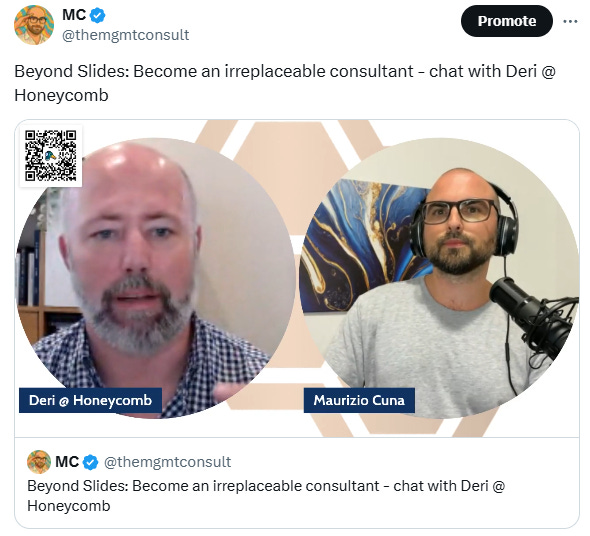
Have you looked into the Leaders Toolkit? It is a deck of 52 tools, frameworks and mental models to make you a better leader (use code CONSULTANT10 for 10% off);
The Consulting Intel private Discord group with 250+ global members is where consultants meet to discuss and support each other (it’s free).

Really like this article. I recently transitioned to industry still with consulting skills, reading the room and choosing what to say has helped progress an outcome I had in mind using the same algorithm noted in your article.
This is something I used to struggle with a lot. Always good to have a reminder to shut up. Thanks for the good read!