


I don’t know how to put this mildly but there is an enormous difference between micro-productivity (writing an email in 10 seconds) and macro-productivity (moving the needle on a multi-million dollar enterprise initiative).
I feel all over the internet you can find plenty of people telling you that AI will change the world because you now can, indeed, write an email in 10 seconds, but not enough people are actually describing the process of using AI in big companies, those with tens or hundreds of thousands employees.
In a large organization, the bottleneck is not usually defined by how fast someone can type.
More typically, the bottleneck is the complexity of alignment, governance, integration, regulations, and the resistance of people who have been working there since the days you were still in college.
Anyone operating in a large-scale enterprise knows that reality is more complex than what tech-bros and AI pundits describe.
In the enterprise world, nothing meaningful happens in a matter of hours!
Value is generated through transformational programs of work that span 18 months requiring dozens of cross-functional experts, an I’m very doubtful AI is going to eliminate those 18-month projects all together.
Instead, it is more likely AI is going to change the math of how we staff it:
The Old Model (50 people, 18 months)
VS
The AI-Augmented Model (25-30 people, 9-10 months)
That is still a massive gain, let’s not underplay it, but more akin to a structural shift than a magic wand.
In this post from a few months ago, I tried to present the case for change specifically in consulting over the next few years, but it’s clear the move will affect all knowledge work.
It’s a “compression”, not an “explosion”
While the “10x developer” or the “1-hour marketer” makes for a great headline, the actual data from the most accurate research aligns more closely with my “compression” theory than the “world is exploding” theory of the armchair AI gurus on your favorite social media:
McKinsey & Company: As explained in this comprehensive report, “The Economic Potential of Generative AI”, analysts found that the direct impact of AI on software engineering could range from 20% to 45% of current spending.
Similarly, in customer operations, productivity gains could reach 30% to 45%.
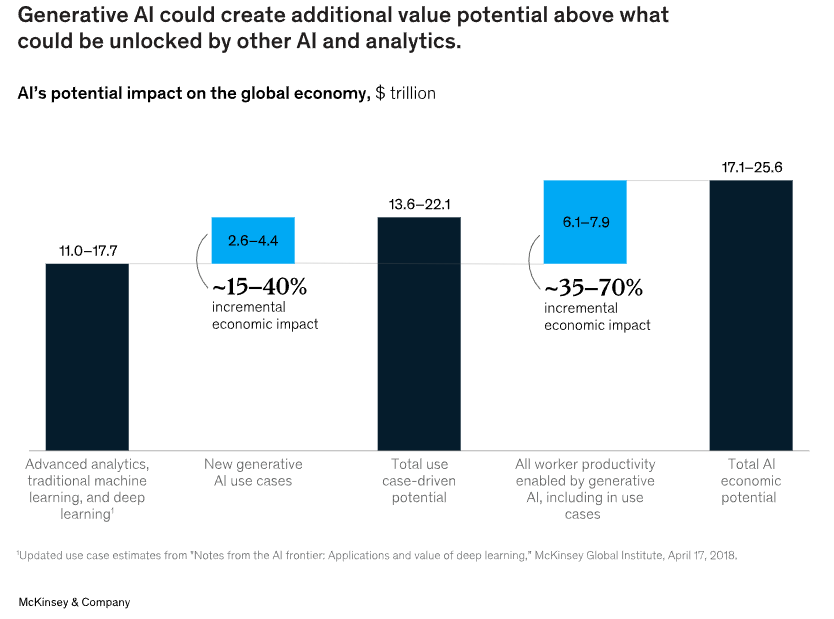
Goldman Sachs: Their research on “The Potential for Generative AI to Raise Global GDP” (although a bit dated) suggests that widespread adoption could eventually increase labor productivity growth by 1.5 percentage points annually. They estimate a total labor productivity uplift of roughly 15% in developed markets over a decade.
AI “lifts the floor” of what a team can produce rather than replacing the team entirely.
Gartner: Their “Top Strategic Predictions for 2026” suggests that 40% of enterprise applications will feature task-specific AI agents.
Furthermore, they predict that through 2026, 20% of organizations will use AI to “flatten” their structures, significantly reducing middle-management bloat.
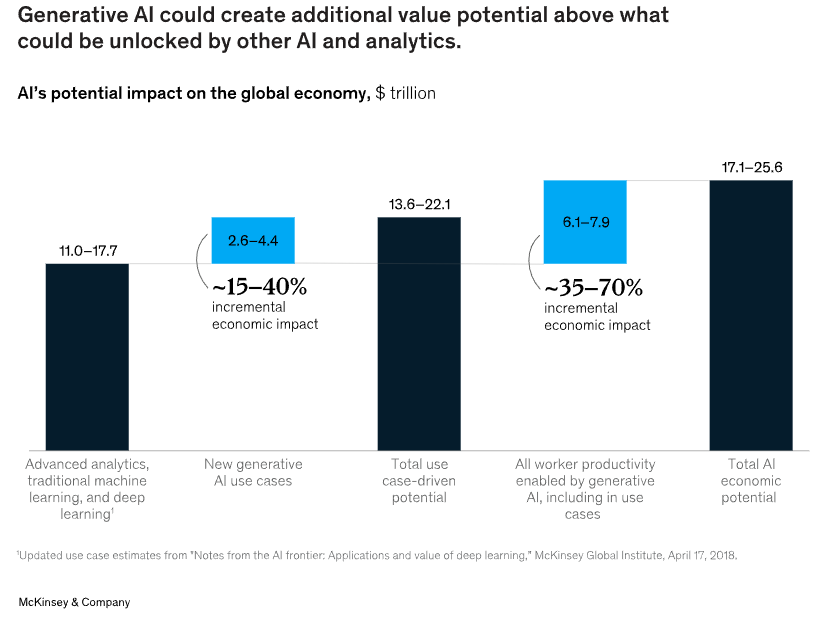
These numbers don’t suggest a “flatline” of 100% improvement across the board (also, good luck getting rid of humans).
They suggest we are getting significantly better at the heavy lifting, which allows us to move faster through the “boring” parts of the project lifecycle.
So, what happens to the workers?
If a team can now do an 18-month project in 9 months, they don’t get 9 months of vacation.
Instead of doing one program of work, that same team will likely be asked to do two.
The challenge moves from the number of human hours your employees can deploy, to the organizational capacity to absorb change potentially delivered in those human hours. We are quickly shifting from a shortage of “doers” to a probable bottleneck in decision-making and strategy.
AI in the enterprise is about density: we can pack more output into the same budget and the same headcount. We are not working less; we are just building more, and faster.
We have seen this movie before.
Think back to the Scaled Agile (SAFe) period. Enterprises didn’t adopt Agile to give people more free time, but because the competitive market demanded faster release cycles. Initially, there was a massive moment of confusion, with layers of bureaucracy trying to figure out how to “govern” speed.
Eventually, the “Agile” way just became the new baseline... and, perhaps ironically, enterprises ended up a decade later with more employees, not less!
AI is following the same trajectory.
Past the initial moment of confusion, enterprises won’t be able to just “cut hours”.
In a global market, if your competitor uses AI to 2x their rate of innovation without 2x’ing their costs, you cannot afford to take the “efficiency gain” as a cost-cutting measure. If you cut your 50-person team down to 25 to save money, but your competitor keeps their 50-person team and uses AI to deliver 4x the output, they will eventually iterate you out of existence.
AI raises the productivity floor for everyone, and enterprises will learn to overcome the internal organizational challenges to actually deploy the newly compressed capacity into the market.
It will take years, probably longer than what we all can imagine, but the direction of travel seems obvious.
What do you think?
👋
Quick note - Consulting Edge is the only measurement and transformation tool for consultants and knowledge workers that:
assesses your performance across six operating capabilities,
benchmarks it across a set of global knowledge workers,
pinpoints the one constraint limiting your growth,
hands you an actionable plan to resolve it.
Get your long-form, hyper-personalized Edge Report today.
I can predict with absolute clarity what will happen with AI in corporate settings.
It is going to turbocharge the unnecessary.
The reason big companies are inefficient is because they can be .
I work with a lot of large companies, and there's incredible amounts of busy work .
Now that AI allows people to do quite a lot more , or a little more, It just means that more distractions will be catered for .
- More preparation for the meeting that didn't need to happen./
- Better graphics on the newsletter that doesn't need to exist.
- Automated note taking on the poorly run meeting because no agenda was set.
I'm not remote, I'm miserable. I just know how things work
Ai is amazing, But the entire focus simply cannot be more .
It has to be a lot less and a lot better
But almost by definition, AI is about expanding things with averageness
The title and graph felt to me like there would be a deeper analysis of actual AI use-
All I've seen management do is generate name suggestions for projects. Colleagues use Consensus for literature review (which I'm sure isn't worth the output, but-) and marketing seems to use it for boilerplate and maybe emails.
I'm toying with letting it write JavaScript to write SVGs and maybe let it improve some python scripts I'm already using here and there, maybe have it port something from BerkeleyMadonna to Julia - stuff I know would take far too much effort to be worth spending the week-month it needs on. It works for this.