


I was born and raised in Puglia, Italy’s southern heel, a beautiful place on the Mediterranean sea, known for its tremendous food, its olive groves and coastline.

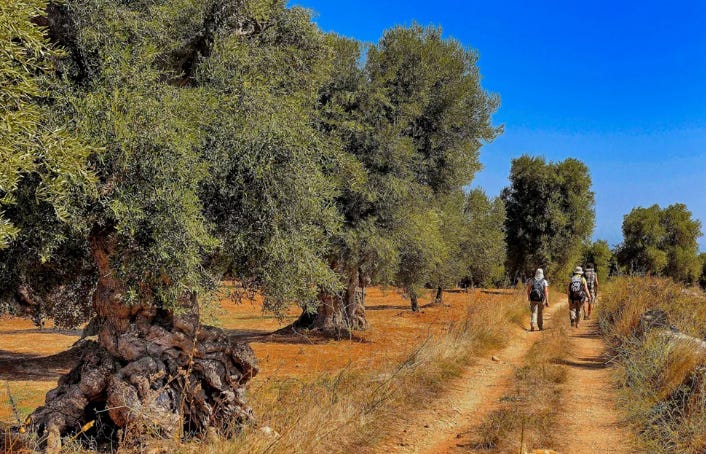
Every November over there, the air smells different: the mornings are colder, the sky a sharper blue, and the fields come alive with families dragging nets under centuries-old olive trees.
I remember my nonno waking us up before dawn. He used to wear the same wool cap (the coppola), the same old jacket, and carried a thermos of caffè so strong it could wake the dead. We would pile into his green Renault 6, bouncing down dusty roads until we reached the family grove. There came the ritual: laying out the nets, climbing ladders, and swinging those long sticks (the abbacchiatori) to knock the olives down.
It was honest (and brutal) work.
After hours, your arms felt like they had been ripped out of their sockets, your face stung from branches whipping back, and the sun roasted you from above. You would look at the net, half-filled, and wonder if the trees were mocking you. Then, at the end of the day, we would load the baskets into the Ape truck and take them to the frantoio.
Nonno would stand there, watching the olives get crushed, the green-gold liquid pouring out, and he would say something like: “Questo è l’oro della famiglia.” This is our family’s gold.
That olive oil, for an old man born in 1921, was a complex mixture of pride, dignity, identity, survival, and an important part of his legacy.
Years later, when I became a teen-ager, the machines arrived: the olive shakers that grabbed the branch and, in seconds, rained down more olives than hours of stick-whacking, were all automated, and we realized that the actual dignity was in producing better oil, faster, and sharing it with everyone.
Absolutely nobody missed the aching arms! Nobody romanticized the blisters!
We laughed, we drank a glass of negroamaro, and we wondered why we had wasted so much time before.
That’s exactly how I see AI in consulting today.
Too often, I see bright consultants equating manual effort with value. They spend entire nights buried in Excel, writing and re-writing formulas; they spend hours formatting PowerPoint slides until boxes align perfectly; they wordsmith a sentence fifteen times to ensure it “reads well.”
That is the olive stick. It projects diligence, but does not necessarily deliver the substance of impact.
I wrote about this in my book Beyond Slides: the danger of confounding activity and impact.
Formatting and perfectionism may soothe the consultant’s conscience, but they rarely shift outcomes. Clients (well, most of them, at least…) remember the insight and the courage to speak it, not the hours hidden behind cosmetic effort.
AI, used intelligently, is the olive shaker, in the sense that it can process datasets in seconds, generate first drafts of slides, synthesize a hundred pages of research into a coherent narrative, and even suggest analytical angles a human might overlook at 2am after about 20 hours of model crunching.
But here is the critical point: the tool alone does not define the value. The insight is the value.
Just as shaking a branch produces a flood of olives, AI produces a flood of output. Our role as consultants is deciding which olives make it into the press, which ones are discarded, and how to tell the story of the oil once it is bottled.
Clients do not want to pay you for the bruises on your hands. Not really.
They pay for your ability to navigate a political minefield of stakeholders and still chart a viable direction. They pay for your capacity to transform messy, scattered data into a coherent story that inspires conviction at the executive level, shifting the conversation from doubt to alignment.
This is why the consultants who cling to the “stick”, believing that pain equals value, risk obsolescence. They will exhaust themselves proving effort, while others, equipped with the right tools and the right mindset, will deliver impact faster, better, and with greater trust.
The lesson from my nonno’s olive grove still holds: the family’s wealth was not in the stick. It was in the oil.
As for me, yes, I will use the machine, and I will strive to master it, and I will reinvest every ounce of saved energy into the domains where humans remain irreplaceable, including navigating power dynamics, earning the confidence of stakeholders, shaping narratives that move entire organizations.
That is the oil worth bottling.
What about you? Let me know in the comments…
👋
👀 Links of interest
A few corners of the internet you may find interesting:
I recently teamed up with Richard Millington from FeverBee, writer of the popular newsletter Indispensable Consulting, to discuss ideas around mastering client relationships in a live private briefing. You can watch the entire session here:
“As an ancient Roman might put it: Errare humanum est; perseverare diabolicum. To err is human; to let a model fabricate your authority and then ship it... that is how careers end.” - This is from one my recent posts on LinkedIn. After years of having a LinkedIn account just because, I am actually enjoying being more active over there… Feel free to follow or connect with me on that platform as well!
The Leaders Toolkit is a deck of 52 tools, frameworks and mental models to make you a better leader (use code CONSULTANT10 for 10% off);
The Consulting Intel private Discord group with 250+ global members is where consultants meet to discuss and support each other (it’s free).
I was definitely hesitant to start leveraging AI - felt like cheating - but once I did I can’t imagine working without it. It increases my efficiency.
Like you, I liken it to other tools when I try to show others they need to lean in (esp ones in my age demo). A craftsman who uses a power saw vs a hand saw isn’t making a piece with any less craft. It’s the output of the beautiful table that matters to the buyer.
Always great insight. Thank you for sharing!
Great story and analogy