


Inevitably, over 20 years working as a management consultant across four continents, I have developed many strong opinions on “knowledge work”.
Chief among them: many capable professionals end their careers nowhere near their actual potential.
This unfortunate outcome is rarely due to a lack of intellect, effort, domain expertise, or opportunity, but it happens to them because of two key breakdowns:
The feedback loops around them are completely ineffective;
They have no objective way of knowing what to fix first to improve their performance.
The good news is: this ends today.
Below, I have detailed a 6-part framework you can run by hand in ~15 minutes. And at the bottom of this post, I am sharing details on something new opening for early access on August 8th that solves this exact problem.
Politeness doesn’t always help
Inside consulting firms, managers routinely sand down hard truths to avoid conflict.
You receive sweetened (and often late) feedback framed as “style” rather than structure: “be more strategic,” or “build executive presence.” You spend another year guessing how to operationalize those platitudes, forfeiting a compensation increase that should have been yours.
If you operate independently or in client-facing advisory roles, the feedback loop is equally broken. Your clients and closest stakeholders don’t give you a candid read when something falters; they simply delay decisions, reduce scope, or go silent and stop giving you business. Politeness protects the immediate relationship, but it slowly destroys your pipeline leaving you with a financial hole.
When the system feedback is imprecise, people default to over-compensation, working longer hours and applying brute force to visible outputs.
That approach seldom yields good results, because applying extra effort to a system burdened by an unrecognized bottleneck leads to accelerating exhaustion.
I look at Consulting not as a job title but more as a mode of work.
Whether you are an engagement manager at a strategy firm, a founder, a product lead, an internal advisor, or a sales engineer, if your role requires creating impact without formal authority under high ambiguity, I’m excited to tell you: you are doing consulting work.
In this mode of work, Capability is behavioral reliability when things around you are on fire, what survives time pressure, political heat, incomplete data, misaligned incentives.
And so, over time, I have developed a 6-part framework you can run by hand to check on your own operating system.
I am going to provide a detailed explanation in the next section, then scroll to the bottom to see how to get private access to what I’m opening on August 8th.
Here’s a practical exercise you can run
The six dimensions I am going to list below describe how effectively an individual operates under real consulting constraints.
The dimensions are conceptually distinct, but operationally interdependent, ie, weakness in one area can suppress the expression of an otherwise strong capability downstream.
To go through this exercise, reserve some introspective time, follow the directions I provide below, and give yourself an honest score from 1 to 5 on each dimension:
1 = Breaks down under mild issues/ambiguity;
3 = Reliable in familiar contexts; shaky when political/commercial stakes rise;
5 = Unshakable reliability; persists under severe time compression, political pressure, and senior pushback
After scoring, write down one specific, recent episode from your live work where this behavior held or failed.
Let’s start.
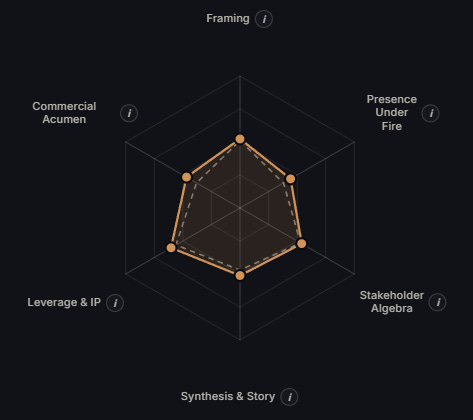
1) Framing
Defining the correct question to answer, bounding the problem appropriately, imposing clarity on ambiguity so work narrows down to what is relevant rather than expands randomly.
Weak looks like: Endless analysis, scope creep, spending immense energy building elegant deliverables for the wrong question.
Strong looks like: You name the decider, establish non-negotiable boundaries early, let ambiguity turn into a crisp decision path.
Self-Check: On your last ambiguous meeting, did you establish a stable decision frame within the first two conversations, or did the work widen for several weeks?
Self-Score (1–5): __/5
Recent Episode: _____(write about an episode related to your Framing dimension)_____
2) Presence Under Fire
Remaining composed, structured, and credible when challenged, particularly in senior or adversarial settings where emotional heat rises.
Weak looks like: Over-explaining, softening recommendations when interrupted, or letting hostile tangents hijack the room.
Strong looks like: You absorb heat without getting defensive, separate emotional noise from the core objection, keep the meeting anchored to decision criteria.
Self-Check: Recall your last tense steering committee or client challenge. Did your delivery get concise and structured, or did your narrative go all over the place?
Self-Score (1–5): __/5
Recent Episode: _____(write about an episode related to your Presence dimension)_____
3) Stakeholder Algebra
Mapping informal power, private incentives, veto points, then building alignment through sequencing and trade-offs rather than persuasion alone.
Weak looks like: Briefing the wrong person first, treating “buy-in” as a slide deck presentation, getting blindsided by late resistance in public forums.
Strong looks like: You map hidden agendas before pitching. You sequence 1:1 conversations to secure conditional support so the public meeting merely confirms what was pre-wired.
Self-Check: On your last recommendation that went nowhere, who held the real veto power, and at what stage did you discover them?
Self-Score (1–5): __/5
Recent Episode: _____(write about an episode related to your Stakeholder Algebra dimension)_____
4) Synthesis & Story
Compressing complex data into a decision-driving narrative that makes economic trade-offs explicit and enables movement to next steps.
Weak looks like: Information dumps, long updates, presenting thorough analysis that leaves stakeholders “informed” but stagnant at the same time.
Strong looks like: You strip away noise, isolate the two or three important facts, state the trade-offs clearly, and close with an explicit ask, owner, and timeline.
Self-Check: Did your last major recommendation produce an immediate choice, or did it spark another round of clarification?
Self-Score (1–5): __/5
Recent Episode: _____(write about an episode related to your Synthesis & Story dimension)_____
5) Leverage & IP
Turning individual effort into reusable assets, templates and systems so impact scales beyond personal billable hours.
Weak looks like: Starting every client engagement from a blank page, keeping your best thinking locked in your head, treating busy hours as a badge of honor.
Strong looks like: You build clean frameworks, templates, and operating rhythms that colleagues or clients can execute without you running them.
Self-Check: What asset or playbook have you extracted in the last six months that someone else deployed independently?
Self-Score (1–5): __/5
Recent Episode: _____(write about an episode related to your Leverage & IP dimension)_____
6) Commercial Acumen
Translating technical advice into hard economic logic: value drivers, unit economics, risk allocation, and the “cost of doing nothing”.
Weak looks like: Giving smart advice with no financial line-of-sight, discounting fees the second procurement pushes back, or relying on relationship strength instead of commercial logic when challenged.
Strong looks like: You anchor every proposal to client unit economics, present options with distinct risk/reward profiles, and defend headline value.
Self-Check: Can you explain, in under 60 seconds, how your current workstream directly protects client revenue or reduces operational cost?
Self-Score (1–5): __/5
Recent Episode: _____(write about an episode related to your Commercial Acumen dimension)_____
Understanding constraint dominance
Once you have completed the steps above, do not simply average your scores.
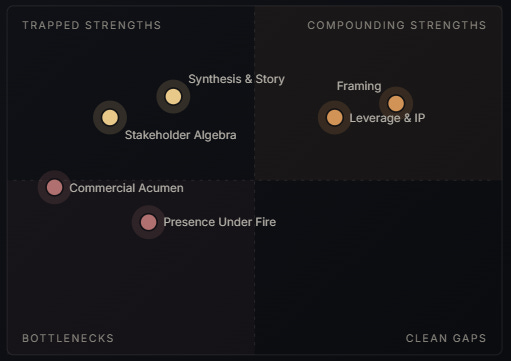
Consulting capability behaves like a constrained system, where upstream limitations cap the expression of downstream strengths.
For example,
If your Framing is weak, world-class Synthesis & Story will fail, and you will simply tell an elegant story about the wrong problem.
If your Stakeholder Algebra is weak, your Commercial Acumen will get neutralized by hidden office politics.
If your Presence Under Fire is unstable, your best strategic choices will evaporate the moment a senior stakeholder pushes back.
Start by isolating your lowest upstream score.
That becomes your critical bottleneck, the primary problematic dimension suppressing the rest of your system. You need to fix that first.
What happens on August 8th?
Now, obviously, a manual pass on paper is a useful starting point, but abstract self-assessment has documented limits:
There is extensive research showing that declarative knowledge (ie, “knowing what to do”) has little correlation with how you actually perform under real organizational pressures. Self-image bias and good intentions inevitably obscure default habits.
A manual score gives you a working hypothesis. It is a decent proxy, but it cannot map the complex, non-linear dependencies between your skills, nor can it benchmark your execution against your global peer group. It is an oversimplification.
The paper score offers a rough measurement but does not lay out the exact path to improve in the areas where you are the weakest, nor does it provide explicit Done criteria, clear grading, or a structured personalized plan based on your objectives.
For the past several months, I have been working on something designed to solve this exact problem. On August 8th, I am officially revealing what I have built, and opening early access exclusively for Consulting Intel subscribers.
The initial beta cohort responded tremendously to the experience, and I am excited to open the doors.
I am capping the initial launch group to ensure I can personally oversee the calibration data, so subscribers will receive a private access link and an exclusive launch rate that will never be offered publicly again.
If you have colleagues or friends who are ready to debug their professional performance, forward this email to them so they can join the subscriber list before August 8th.
Set a calendar reminder for August 8th.
The private reveal and launch link will land directly in your inbox.
👋
can't wait. nice piece as usual. note: There seems to be a broken figure on the page.
Very nice framing and looking forward to learning more about the cohort
Question about self scoring: how accurate/inaccurate can that scoring be and is this something to be done as a "monthly check in"?
Asking because I tried doing this score based self evaluation a few years ago. I tried making it as granular as possible for the scoring, but I still felt it was challenging to accurately say if these scores helped me/others see if performance was going in the right direction