


How did I manage to achieve ~$1bn in combined sales throughout my career so far?
When I work on a proposal I rarely try to be better than a competitor, and that’s for a simple reason: if I aim to be better than them, I am accepting their terms, and haggling over the same set of table stakes.
Instead, I like to think in terms of category of one: making choices that my competitors find impossible to mimic (a good book for a primer on the idea is Snow Leopard).
Differentiation is usually incremental:
If a competitor offers a 24-hour response time, you offer 12;
If they have 5 features, you have 6;
Etc…
This is a race to the bottom because it assumes the customer is looking at a single, shared yardstick. In this scenario, the customer’s most logical conclusion is to eventually choose the cheapest option: after all, you have already indicated that you are essentially the same.
A category of one is the result of deciding to solve a problem in a way that makes your competitor’s entire infrastructure a liability.
We could think of it this way:
Differentiation is being a slightly faster horse;
A category of one is the person who built the car.
The car doesn’t compete with the horse. It doesn’t care how fast the horse is. It operates on a different logic, requires different fuel, and serves a different need for distance and scale.
If the horse breeder wants to compete, they cannot just “work harder” (good luck with that), they have to stop being a horse breeder all together!
Now, I started this article by saying that I rarely try to be better than a competitor. Sometimes I do, because the truth is you cannot be a category of one if you are afraid to say “no” to certain customers.
And I don’t always say no...
Proposals often go south because they try to be everything to everyone: you hedge too much, and safety is the enemy of the category of one.
To occupy a space alone, you must be willing to be unattractive to the masses so you can be indispensable to a specific few.
A quick test:
If your competitor can look at your proposal and say “We do that too, just differently,” you are differentiated.
If they look at it and say “We literally cannot do that without dismantling our business model,” you are a category of one.
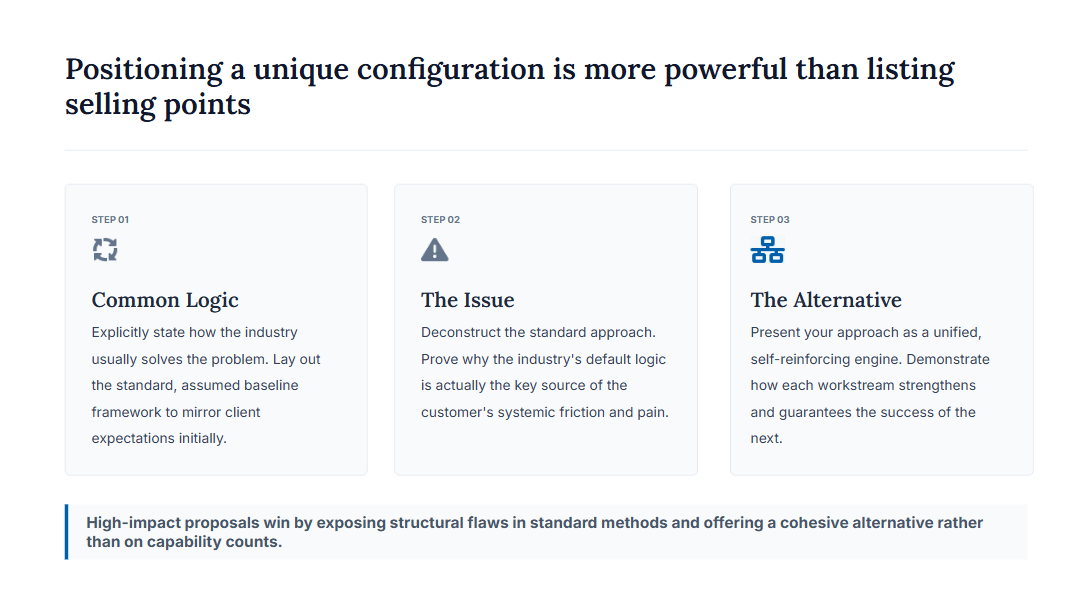
When I write the skeleton of a proposal, I don’t focus on my unique selling points, but I like to talk about unique configuration of how we work in 3 steps:
What’s the common logic? Explicitly state how the industry usually solves the problem
What’s the issue with that? Show why that standard logic is actually the source of the customer’s pain.
What’s an alternative possibility? Present your approach as a cohesive system where every part reinforces the other.
There is no single secret sauce ingredient.
I have to show I have a kitchen with a whole set of unique equipment vs the guy down the street.
It is surprisingly easy
Being a category of one sounds daunting because we think it requires some singular world-class superpower. My strong belief is that it doesn’t, and at the end of this article I will even give you an exercise you can run today to show you how, in practice, you can change your beliefs and position yourself accordingly.
The key concept here is that you need to find rareness at the intersection of 3-4 common skills. Practical example:
A great coder is common;
A great coder who understands behavioral economics is rare;
A great coder who understands behavioral economics and the specific regulatory hurdles of the healthcare industry is a category of one.
When you combine all these layers, you create a logic that your competitors cannot follow without dismantling their own business models. They might be better coders, or better economists, or better compliance officers, but they cannot be that specific combination.
A lot of people try to build a solution first, and then go looking for a problem. I try to consistently do the opposite.
Every complex problem has a specific jagged shape. Standard industry solutions are usually round: they are designed to fit as many holes as possible. They leave gaps.
You need to instead look at the jagged edges of the client’s specific pain and assemble your capabilities to fit that exact geometry.
Admittedly, it doesn’t always work...
The secret (but, is it really a secret?) to being the only is the willingness to be the wrong choice for almost everyone else.
Incidentally, a book I gift to every new analyst I hire is The courage to be disliked: if you haven’t read it, you should (also, have a look at this free document I put together. 200+ people found it useful: The 39 books all consultants should read).

Differentiation tries to please the whole market while being slightly different, but a category of one is designed to be perfect for a specific problem and useless for everything else (I wrote about this here as well).
This isn’t actually harder than traditional competition. In fact, I believe it’s easier! Competing to be better is an endless (and frankly exhausting) treadmill.
Instead, building a category of one is simply a matter of looking at your existing tools and deciding to arrange them in a way that solves a problem no one else is willing to touch.
To close, I will leave you with an exercise.
Look at your own set of skills or your organization’s assets (yes, you can apply this framework more broadly than just your own persona): which 2 or 3 standard capabilities do you have that, if forced together, would make your competitors uncomfortable?
Start from there.
Let me know.
As usual, if you enjoy reading Consulting Intel, please do me a favor: spread the word and share this post.
👋
👀 Links of interest
A few corners of the internet you may find interesting:
This is a Note I posted recently… A quick taster of something cool to come soon 👀
Have you looked into the Leaders Toolkit? It is a deck of 52 tools, frameworks and mental models to make you a better leader (use code CONSULTANT10 for 10% off);
The Consulting Intel private Discord group with 250+ global members is where consultants meet to discuss and support each other (it’s free).