


“Timeo Danaos et dona ferentes.”
I fear the Greeks, even those bearing gifts.
When Laocoön screamed those words at the gates of Troy, his countrymen ignored him: they were too enamored with the craftsmanship of the wooden horse, and too eager to claim a trophy that indicated the end of a long exhausting war.
While this was happening more than 3,000 years ago, in the spring of 2026 the boardrooms of the Fortune 500 are reenacting this ancient tragedy with startling similarities.
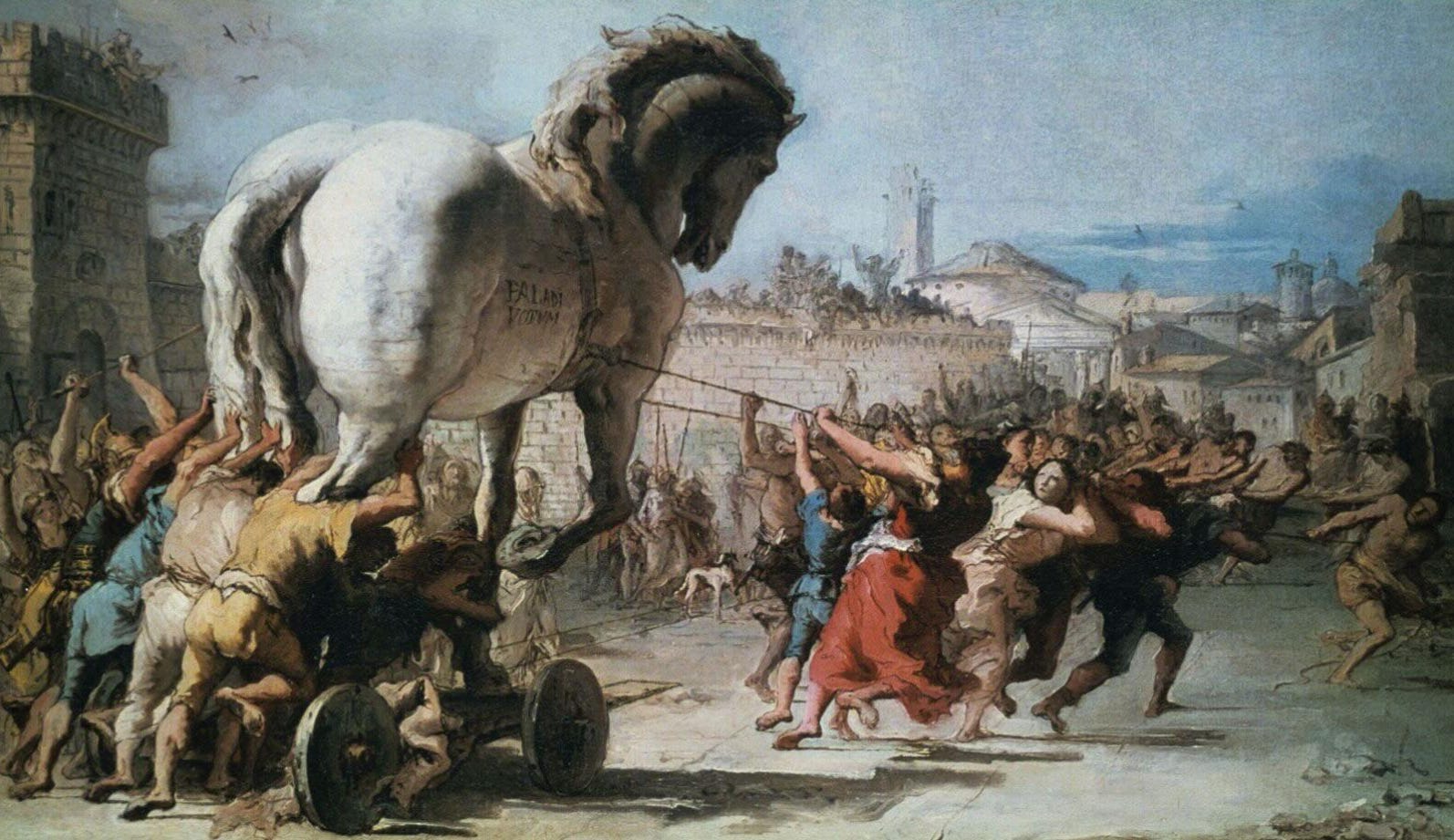
The “Greeks” (led by Sam Altman of OpenAI and Dario Amodei of Anthropic) have arrived at the gates of the global enterprise.
But this time, they didn’t arrive alone.
They were pulled through the gates by the very people paid to guard them: the world’s elite consulting firms.
Is this the Great Alliance or the Great Infiltration?
In February 2026, OpenAI formalized its “Frontier Alliances,” a series of multi-year, multi-billion-dollar pacts with the “Big Three” and “Big Four.”
McKinsey, BCG, Accenture, Deloitte, and a few more, signed up to use the software and also agreed to embed OpenAI’s Forward Deployed Engineers (FDEs) directly into their client teams.
On the surface, it’s the ultimate win-win.
Accenture reported a staggering $2.2 billion in AI-related bookings in a single quarter this year, and that makes sense: for the consultants, AI is a sustaining innovation that allows them to charge premium transformation fees while their analysts use the latest LLMs to deliver their artifacts more effectively.
But look closer at the belly of the horse.
The consultants are providing the one thing Silicon Valley has always lacked: access.
They have the MSAs and the NDAs, the trusted relationships: they have the “keys to the city”, ie, the proprietary, non-public data that sits in the dark corners of legacy ERP systems and mainframe from the 90s.
I am getting more and more concerned that, by “partnering” to implement AI, consultants are hand-delivering the training data the AI giants need to survive.
We are in peak data crisis
Why would OpenAI and Anthropic, both companies valued in the hundreds of billions, need a middleman?
Well, they are starving.
In April 2026, Stanford’s AI Index Report confirmed what many feared: we hit peak data.
The high-quality human text on the public internet has been exhausted, and so to keep the scaling laws alive, and reach the promised land of AGI, the models need new biological material.
They need the logic of a merger, the nuance of a supply chain disruption, the proprietary workflows of a global bank, the strategic decisions of a telco business.
Consultants are the harvesters here.
Every single time a BCG analyst uses an OpenAI-backed agent to “optimize” a client’s logistics, that agent is helping while also learning.
There are 3 different actors involved in this play, and each one of them brings their own different perspective:
The high-level consultant says: “We are augmenting our value. We will sell the idea; the AI just handles the execution. By being the first to master these tools, we ensure our seat at the table remains permanent.”
The AI giant thinks: “Consulting is a high-cost, low-scale complication. Our goal is the ‘Autonomous Enterprise.’ Once our agents are embedded in the code, the client doesn’t need a quarterly review from a consulting partner but an API.”
The client states: “I don’t care about the consultants or the AI firms. I care about my profitability. If the horse gives me the answers without the $500/hr billable rate, I’ll burn the city down myself to save the costs!”
The innovator’s dilemma here is uniquely cruel.
To stay competitive, the McKinseys and Accentures of the world (yes, I’m clubbing together consultancies broadly) must offer the best AI tools because if they don’t, a lean, AI-native boutique will. But the better the tools become, the more they erode the fundamental unit of consulting: the billable hour.
In the below article I already shared my early thoughts on how I see the next evolution of consulting firms, and I think I am directionally correct:

But as we move into the agentic age in the second half of 2026, we are seeing the rise of a specific category of ghost firms.
These are AI-driven systems that can perform the work of an entire analyst class (including research, slide creation, financial modeling, etc) for the price of a few million tokens.
How more or less cost-effective those million tokens will be versus hiring a typical consulting pyramid, we will only know in a few quarters/years, when the price of the token themselves will stabilize (they are now the cheapest they will ever be).
What happened the morning after in Troy
The issue of the Trojan Horse was two-fold: the Greeks were inside, and the Trojans had nowhere left to go.
The risk in the enterprise is that by the time the consultants realize they have automated 80% of their own intellectual property, it will be too late: they will have already trained the models that replace them.
They will have given OpenAI and Anthropic the direct relationships with the C-suites.
I sometimes think Sam and Dario are not your friends, they didn’t come to help you build a better consulting firm. They came to build a world where the “consultant” is just a legacy function - a ghost in the machine that was once a person.
As the sun rises on the enterprise landscape of 2027, the “Frontier Alliances” may well be remembered as the moment the gatekeepers handed over the keys and walked themselves into the history books.
I hope I’m wrong and, anyway, it’s all in our hands.
As usual, if you enjoy reading Consulting Intel, please do me a favor: spread the word and share this post.
👋
👀 Links of interest
A few corners of the internet you may find interesting:
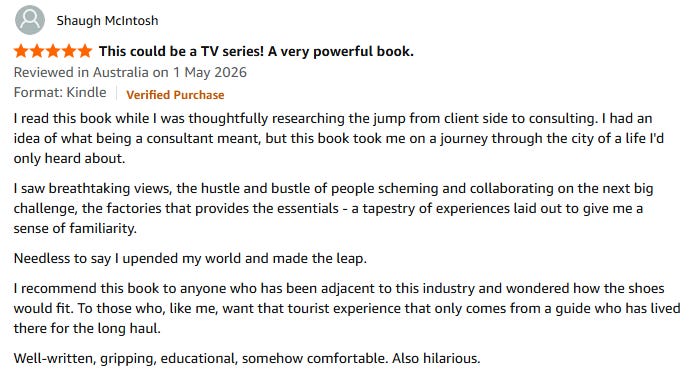
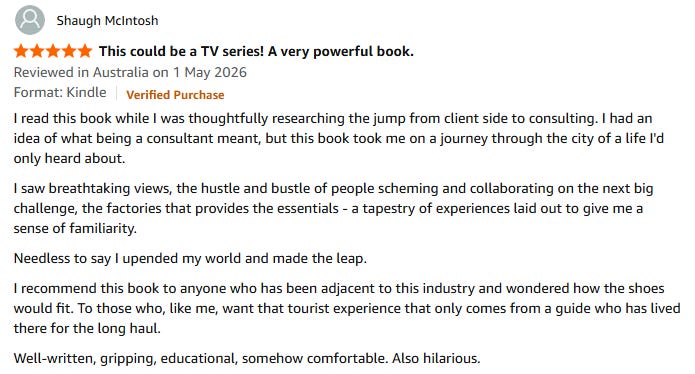
I keep receiving awesome reviews from readers of Beyond Slides. Cannot thank all of you enough for your support!
Have you looked into the Leaders Toolkit? It is a deck of 52 tools, frameworks and mental models to make you a better leader (use code CONSULTANT10 for 10% off);
The Consulting Intel private Discord group with 250+ global members is where consultants meet to discuss and support each other (it’s free).
The next two to three years are going to be incredibly interesting.
On one hand, AI in many companies is still just a chatbot like Copilot. On the other hand, powerful tools like Codex are democratizing code, and the capabilities of a single employee are now massive.
From my conversations with Big 4 partners, many still believe that not much is going to change. Their readiness to adapt is limited. I also see a lot of fear. How do you invent an outcome-based business model when you’ve been working in a "time and materials" model for 20 years? How do you rebuild an entire company from the ground up around this new approach?
It’s a massive shift that requires years that, in my opinion, they simply don't have.
Can't help asking: why would they sleepwalk into this?