


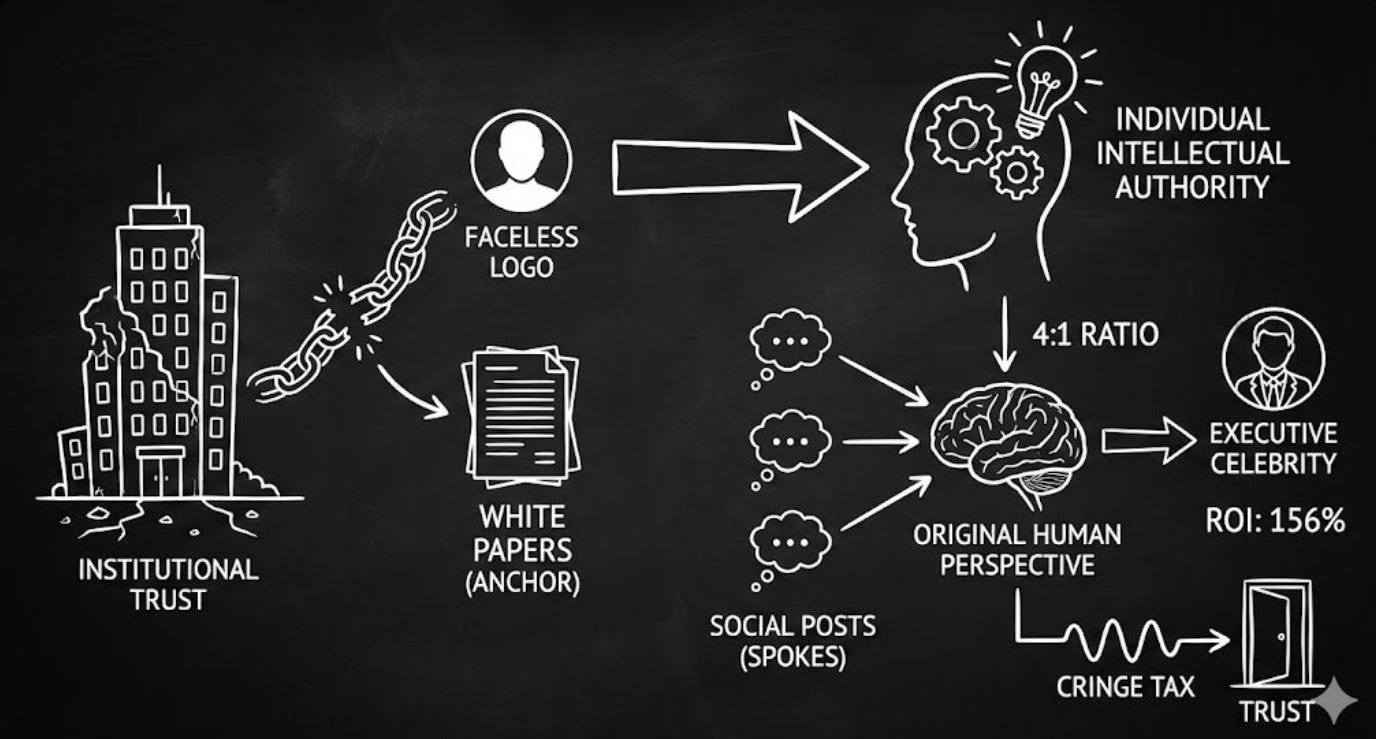
In 2026, Institutional Trust is dead: 70% of the global population believes institutional leaders are deliberately misleading the public.
If you are not visible, you are invisible - and most firms are currently ‘Ghost Brands’: they have 5,000 employees but only one authorized voice (the corporate PR account).
The hypothesis behind this article is that the firm’s logo has become a secondary asset in 2026: the primary driver of brand equity in the next 5 years will be the Collective Intellectual Authority of its visible experts.
To succeed as a Founder Intellectual or Executive Celebrity, you must transition from being a “manager of a brand” to being a trust broker, a human proxy who bridges the gap between corporate complexity and individual resonance.
I noticed a lot of interest around one of my recent posts on X, so I decided to put together this article to highlight core ideas of my research:

Everything discussed in here is something I am personally testing through my public media outlets:
My book Beyond Slides (a #1 Amazon best-seller in UK, US, Australia and Italy, published in June 2025)
This newsletter (free to subscribe, started in 2024)
My LinkedIn profile (always happy to connect - I have been posting regularly since June 2025, after a decade and a half of lurking)
For context, you may know I am a corporate executive (specifically, I am a partner at a large management consulting firm), but I do expect much of what I discuss in this article to apply to most startup founders and corporate executives in most industries across most developed western countries.
Surely, there’ll be case-by-case considerations to make, but I hope this detailed guide gives you some practical ideas for you to take forward.
In the next sections, we are going to go into specific tactics and, at the end, I will also leave 32 weblinks of articles/reports that were part of my research.
Let’s start.
The macro-environmental catalyst: the “insularity mindset”
Global trust is shifting.
What began as a crisis of grievance has evolved into a crisis of insularity, where people are retreating into smaller, more comfortable circles. This explains why they now place more trust in figures they know, favoring “My CEO” (trusted by 60%+, as per the Edelman Report) and their coworkers over traditional institutions like the media or government.
This environment creates a powerful opportunity because the traditional, faceless approach of B2B marketing is no longer working. In response, high-performing firms are scaling up their investment in human-led insight, treating marketing as a core growth function and increasing its share of revenue from 10% to 12% in 2026.
The overarching strategy is clear: executive visibility should not be about promotion.
Instead, executives must be positioned as “Category Explorers,” using social platforms to navigate plus provide knowledge and sense-making in their industry’s real-time ambiguities.
As institutional trust wanes, the visibility of individual executives on digital platforms has therefore become a critical asset.
Research led by Professor Ann Mooney Murphy at Stevens Institute of Technology demonstrates that social media has created a new pathway for achieving executive celebrity, independent of traditional media gatekeepers.
This “social media celebrity” becomes a strategic tool that correlates with firm reputation, mainstream media visibility, and even executive compensation.
When institutions are mistrusted, the logo becomes a barrier. To break through, we must dismantle the black box of the firm and replace it with a visible intellectual trail.
This begins with Phase I: The “Proof of Thought” protocol.
Phase I: The “Proof of Thought” protocol
Visible authority is not built through “best practices,” but through Evidence-Based Intelligence, defined as distinctive, research-backed insights that provide the inspiration to act.
A. Strategic Vulnerability & The Practicality Effect
The “cringe tax” associated with early-stage personal branding is actually a trust signal.
“Perfect” corporate claims trigger skepticism, however, the Practicality Effect proves that when a leader acknowledges a minor weakness or an unfinished thought, their subsequent expert claims are perceived as significantly more believable.
The Tactic: Share the “v0.1” of a mental model or a project struggle. Occasionally posting a hypothesis you aren’t sure of proves you are working at the cutting edge, not just recycling the past.
B. The curator’s edge
In a world of information overload, the executive’s value is as a “High-Pass Filter”.
Curation is communal labor that builds interpersonal trust. By showing how you know what you know, you form para-social relationships: these are emotional bonds with followers that correlate with increased firm reputation and executive compensation.
The Tactic: Publicly share your browser tabs, obscure whitepapers, or niche data sets that shape your thinking. Your value is not just what you know; it’s how you filter the world.
Sharing what you read is only the first layer of authority.
While your information diet proves you are informed, clients ultimately pay for your execution. To bridge the gap between thinking and doing, we move to Phase II: Operational Transparency (showing the work).
Phase II: Operational Transparency (showing the work)
Intellectual authority must be backed by Operational Transparency, the deliberate disclosure of internal processes to reduce knowledge asymmetry.
94% of consumers are likely to be loyal to brands that offer complete transparency. In professional services, “a delay explained is a delay forgiven,” whereas silence is perceived as a failure mode.
The Tactic: Redact and publish internal strategy memos or “behind-the-scenes” videos of problem-solving sessions.
Phase III: The Polyphonic Leadership Model
The greatest risk of the Celebrity Executive is Key Person Risk, which can discount a firm’s market valuation by 10% or more if all authority is centralized in one star.
A common objection here is: “If we make our partners celebrities, what happens if they leave?”
This is a valid risk assessment, but the solution isn’t to keep them invisible, but rather to institutionalize their brilliance.
Strategic risk management requires a shift from a monophonic (single voice) to a polyphonic (multiple voices) communication model, with the goal to multiply the firm’s surface area for trust.
By cultivating personal brands for multiple senior leaders and experts, the organization ensures that credibility is distributed rather than centralized:
Succession planning and apprenticeship: Grooming potential replacements and investing in their training to reduce dependency on a single visionary;
Strategic documentation: Formalizing business processes and relationship management within a CRM to move ownership from the individual to the organization;
Executive Duo Leadership (EDL): A model gaining popularity in finance and technology, where two leaders of equal status jointly manage the company, providing protection against burnout and executive isolation.
Perhaps paradoxically, “de-branding” the individual means ensuring that multiple experts represent the firm in podcasts, articles, and videos.
Tactical implementation for 2026
The move toward individual celebrity does not mean abandoning formal assets like white-papers; rather, it changes how those assets are distributed and perceived.
Modern B2B strategy requires a balance between Individual Resonance (reach and trust) and Institutional Authority (validation and conversion).
Some ideas to explore:
The Reach vs. Conversion paradox
The most common mistake is assuming that high engagement on social media automatically equals sales. Data suggests a distinct split in how personal profiles and company pages perform on platforms like LinkedIn:
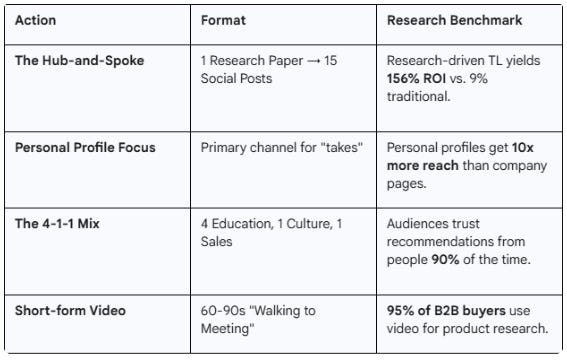
Personal Profiles: Typically generate 10x more reach and 5x more engagement than company pages. They are the primary engine for “Proof of Thought” and for building the top-of-funnel para-social relationships that make an executive a “celebrity” (which we discussed above);
Company Pages: While reach is lower, they often drive 6x more conversions per impression. Serious B2B buyers use the company page as a “digital shopfront” to validate legitimacy and research the team before signing a contract.
The “Hub-and-Spoke” content model
To balance formal research with free-flowing thought, the most effective executives use a Hub-and-Spoke strategy:
The Hub: A high-value, formal “hero asset” (like a research-backed white paper on letterhead). This provides the evidence-based intelligence that 73% of B2B buyers trust more than marketing materials.
The Spokes: 10–15 pieces of “free-flowing” informal content derived from the hub. This includes contrarian takes on LinkedIn, “walking to a meeting” videos, and screenshots of browser tabs.
The strategy is to use the informal posts to talk about the industry in general without mentioning the company. This builds your identity as the “favorite teacher” in the industry: only after you have built this trust do you point them toward the “Hub” for deeper insight.
Tactical suggestions for senior teams
To avoid the “cringe” of over-promotion, senior colleagues should adhere to a structured content mix (this is, incidentally, roughly what I am also personally doing on my LinkedIn profile for example):
The 4-1-1 Rule: For every six posts, four should be valuable/educational (no mention of the firm), one should be “gentle branding” (e.g., a team culture highlight), and only one should be a direct call-to-action (e.g., “Download our new white paper”).
The 70-20-10 Rule: Allocate 70% of content to education (solving the client’s “problem of the week”), 20% to personal connection (sharing a struggle or curious observation), and 10% to self-promotion.
The Zero-Link Strategy: Posts without external links (pure text or image galleries) generate 60% more engagement than those that try to drive traffic away from the platform. Share the insight in the post itself; don’t make them click a link to “learn more”.
Note that the 4 (value) and 70 (education) above should never mention the firm. In my experience, this is the hardest part for executives to grasp. You will want to “soft sell”, but if you mention the firm in the value phase, you have broken the spell of the human proxy.
To be explicit, this approach is not yet the gold standard in corporate communication (large enterprises move slowly and are late adopters of new trends), but all research points to this as the general direction of travel.
An executive team starting now has the opportunity to create an entire category, and acquire a lead in the market perception which will be hard to bridge for competitors.
Navigating the “cringe tax”
The term corporate cringe describes messaging that tries to appear “cool” through forced emotional appeals.

To avoid this “cringe tax”, I finally recommend five actions:
Kill the Jargon: use plain English and a conversational style rather than corporate jargon. Followers value leaders who relate on a personal level and look like “one of us”, not senior leaders who over-complicate their prose because of their hidden desire to sound intelligent;
Strategic Vulnerability: If you look like a “LinkedIn Bro,” acknowledge it. Admitting the awkwardness of the platform actually increases your E-E-A-T (Experience, Expertise, Authoritativeness, Trustworthiness) signals and, ultimately, will benefit you;
Human Over AI: While 74% of teams use AI, content labeled as AI-written can halve engagement. Your human watermark is your unique, fallible point of view: why would you give that away?
Who cares?: most founders/executives are paralyzed by status anxiety, ie, the fear of looking silly to their peers. But your peers are not your customers! Your competitors will call you “cringe” because your visibility highlights their invisibility. If the people you are competing with don’t like what you are doing, you are winning.
Outcome over Optics: Frame your mindset as a business calculation. Would you rather have a “perfect” reputation among 100 peers who will never hire you, or be “a bit much” for 10,000 prospects who now see you as the only authority in the room?
The bottom-line ROI
Let’s be honest: the first time a Senior Partner posts a raw, unedited video of themselves “thinking out loud” about industry displacement, their peers will snicker. There will be comments about “vanity projects” and “LinkedIn influencers.”
Ignore everything.
By the time your competitors realize that this isn’t a fad, you will have built an Intellectual Infrastructure: you will have a library of your thoughts, your mistakes, and your curiosities that works for you 24/7.
This is about sales velocity.
Data from IBM and Oxford Economics has shown that high-quality thought leadership delivers a ROI of 156%. Why? Because it short-circuits the sales cycle.
When an executive is a “Visible Expert,” the prospect doesn’t spend the first three meetings vetting the firm’s competence: they have already spent six months “thinking with” the executive online!
The trust is pre-baked, and research shows these prospects move through the pipeline 35-40% faster.
In 2026, systems win and hustle loses.
By building an Intellectual Infrastructure around your key people, you move from a commodity service provider to a category-defining authority.
Are you ready to start your journey to become a Founder Intellectual / Executive Celebrity?
As usual, if you enjoy reading Consulting Intel, please do me a favor: spread the word and share this post.
👋
Works cited you can further review
2025 Edelman Trust Barometer, https://www.edelman.com/trust/2025/trust-barometer
2026 Edelman Trust Barometer | Edelman, https://www.edelman.com/trust/2026/trust-barometer
Edelman Trust Barometer 2026: 70% retreat into insularity - HRZone,
https://hrzone.com/2026-01-edelmann-trust-barometer-2026-insularity/
2025 Edelman Trust Barometer | Edelman, https://www.edelman.com/au/trust/2025/trust-barometer
Study Reveals How CEOs Become Social Media Celebrities, https://www.stevens.edu/news/study-reveals-how-ceos-become-social-media-celebrities
The influence of CEO and CFO media visibility on the market value of the firm | Corporate Governance | Emerald Publishing, https://www.emerald.com/cg/article/doi/10.1108/CG-10-2024-0542/1278945/The-influence-of-CEO-and-CFO-media-visibility-on
The New Rules Of Reputation And Brand Equity In An AI-Driven Future - Forbes, https://www.forbes.com/councils/forbescommunicationscouncil/2026/01/07/the-new-rules-of-reputation-and-brand-equity-in-an-ai-driven-future/
The psychology of trust: Why customers believe some brands over others (with examples),
Thought Leadership as a Platform for B2B Marketing ROI – TopRank...,
https://www.toprankmarketing.com/blog/thought-leadership-platform-b2b/
Measuring the ROI of Thought Leadership | Cindy Anderson and Anthony Marshall,
The ROI of Personal Brands and Thought Leadership - Roloff Consulting,
https://www.roloffconsulting.com/the-roi-of-personal-brands-and-thought-leadership/
The impact of thought leadership in the B2B decision-making process - The SEO Works,
https://www.seoworks.co.uk/downloads/impact-of-thought-leadership-in-b2b-decision-making-process/
Professional Services Marketing Trends for 2026 - Milvanta, https://www.milvanta.com.au/post/professional-services-marketing-trends-for-2026
How Can Vulnerability Affect Brand Connection? - Lifestyle → Sustainability Directory, https://lifestyle.sustainability-directory.com/question/how-can-vulnerability-affect-brand-connection/
The 9 Psychological Tactics Companies Use to Win Your Trust: Inside the Science of Brand Credibility - Status Labs, https://statuslabs.com/blog/psychological-tactics-companies-use-to-win-your-trust-inside-the-science-of-brand-credibility
Tuning Your Voice: Trends in Brand Language - Antidote, https://www.antidote.info/en/blog/reports/trends-in-brand-language
Corporate Cringe - Doctor Spin, https://doctorspin.net/corporate-cringe/
The Psychology of Trust | Brandtrust, https://brandtrust.com/blog/the-psychology-of-trust/
How To Create Behind-the-Scenes Content That Builds Trust and Transparency,
2
Operational transparency: The new currency of trust - Retail Banker International, https://www.retailbankerinternational.com/comment/operational-transparency-new-currency-of-trust/
Human-Centric Content at Scale: Balancing AI Efficiency with Authentic Storytelling, https://www.ndash.com/blog/human-centric-content-at-scale-balancing-ai-efficiency-with-authentic-storytelling
Content Marketing in 2025: Authenticity vs AI? : r/DigitalMarketing - Reddit,
AI Content vs Human Content: What Actually Wins in 2025? - Grafit Agency,
The 2026 B2B Content Strategy Most Marketers Miss, https://theb2bplaybook.com/b2b-content-strategy-2026
Four Ways to Manage Key Person Risk - Brady Ware, https://bradyware.com/manage-key-person-risk/
Managing Key Person Risk - BusinessRiskTV.com, https://businessrisktv.com/managing-key-person-risk/
Monophony and Polyphony - Doctor Spin, https://doctorspin.net/monophony-and-polyphony/
Assessing the impact of key person risk on business valuation - William Buck Australia, https://williambuck.com/news/ex/general/assessing-the-impact-of-key-person-risk-on-business-valuation/
THE POTENTIAL OF THE EXECUTIVE DUO LEADERSHIP - DSpace,
https://dspace.ut.ee/bitstreams/add6a22f-48ed-4271-8bc7-f3637cb8b250/download
B2B content distribution strategy for demand generation that drives engagement - ViB Tech, https://vib.tech/resources/marketing-blogs/dp-b2b-content-distribution-strategy-for-demand-generation/
B2B Marketing Strategies For 2026 | AI, Alignment & Personalization,
Professional Services Marketing: Must-Know Trends For 2026 - ON24,
https://www.on24.com/blog/professional-services-marketing-must-know-trends-for-2026/
👀 Links of interest
A few corners of the internet you may find interesting:
My first book Beyond Slides became a #1 Amazon Best Seller in the USA, UK, Australian and Italy;
Have you looked into the Leaders Toolkit? It is a deck of 52 tools, frameworks and mental models to make you a better leader (use code CONSULTANT10 for 10% off);
The Consulting Intel private Discord group with 250+ global members is where consultants meet to discuss and support each other (it’s free).
Really good article, MC. Too bad most senior partners are too 'entertained' by their internal status games to genuinely engage. But that's where the opportunity lies for the rising tide, right?
> Share the “v0.1” of a mental model or a project struggle
Right now I've come to realize the incredible potential of Adversarial Multi-Agentic AI for strategic thinking, and I'm diving very deep into the technical side of it, so I can build a POC myself to showcase the value. After all, AI amplifies everything - it can amplify good judgment that's uncomfortable, or consensual bias towards disaster! Let's see which way modern day leaders will choose...
Thanks for this Maurizio - probably the most personally valuable article I have read on substack. Really helped crystallise some ideas I have been fumbling with for at least a year. Looking at it through the lens of a solo consultant these days.
One thought, the big consultancies have a great pool of individuals - partners and others - to adopt this kind of model. Some will be better at it than others. In this case, the new boy - Palantir - appears to be far from this go to market strategy so perhaps this will be their weakness?