


Your title may say “Leader”, but your calendar says “Salesperson.”
Anyone in business spends roughly 40% of their professional life trying to move people from Point A to Point B, selling visions to candidates, budgets to the CFO, change to a skeptical workforce...
In an era where AI can automate your code, draft your emails, synthesize your data, and make videos of singing cats, these human-centric influence skills are the only truly resilient assets we have left.
However, the vast majority of business leaders never spent a single hour studying the actual mechanics of influence, so they rely on “gut feel” and “charisma”... fragile tools that fail the moment the stakes get high.
I have spent two decades in management consulting across the US, Europe, Asia, and Australia distilling these 63 principles: your field manual for the 40% of your job you were never trained for... and your only biological advantage in the age of Artificial Intelligence.
In this article, I am going to share with you these gold nuggets.
Read them, study them, understand them, re-read them, practice them, stick to what works (and share this post with a friend!!). If you do that, you will be unrecognizable in 1 year.

Let’s start!
I. The foundational mindset: sales as leadership
1) Sales is the engine of strategic execution
Strategy is easy; execution is hard. The space between a slide and a finished product is filled with people who need to be convinced: if you cannot persuade your team to change their habits or your board to release capital, then consider your “strategy” as an expensive hallucination.
2) The 40% reality check
Data shows business leaders spend roughly 40% of their time “non-sales selling”, ie, persuading, influencing, moving others, etc. If you spend nearly half your week doing something you have not studied, try to tell me you are not an amateur at the most frequent part of your job?
3) The “used car” fallacy
The “used-car salesperson” stereotype is about extraction: taking value away from someone. Modern leadership sales is instead about alignment: creating value where none existed. To sell properly, think about how the other person is going to win off what you sold.
4) Meritocracy is BS
If you follow me, you already know the belief that “the best work wins” is a comforting lie. The corporate graveyard is full of technically superior products that nobody bought because their founders weren’t able to sell them. High-quality work requires a champion who can navigate the politics of buy-in: without a “sales” effort, you will squander your great work.
5) Being technically great is definitely not enough
An elegant piece of code or a perfect financial model is just an input, where the output is organizational change. If you don’t sell the “why” to the people who have to live with the “how,” they will subconsciously sabotage your greatness to protect their own comfort.
6) Preparation beats charisma
Over time I learned that charisma is a fragile asset because it fluctuates with your mood. Preparation is a rock: knowing your client’s quarterly goals, their recent failures, their boss’ pressures, the next half-year strategy, etc allows you to speak with an authority that “charm” alone can never replicate.
7) Influence is a learnable structure
Stop hiding behind the excuse that you are not a “natural”: it is a trite one. Understand that influence is a sequence of steps: research, diagnosis, framing, and co-design. It is a hard skill, much like financial analysis, and it yields to practice and protocol.
8) Sell with intent
Never walk into a meeting just to “catch up.” Every interaction should have a measurable objective (eg, learning something new) or a strategic objective (eg, moving a decision forward).
Sell with intent rather than “socializing” on the company’s dime.
9) Ethics are your armor
As I explain in detail in my #1 Amazon best-seller Beyond Slides, in a tight professional network your reputation travels faster than your resume. Ethical persuasion is the most pragmatic thing you can do. If you trick someone into a “yes” today, you lose the ability to ask for anything for the next 10 years. Be careful!
II. Trust is an equation
10) The formula
Because I am an engineer, I like formulas for everything. In their popular book The Trusted Advisor, David Maister, Charles H. Green and Robert M. Galford show that trust is a calculation:
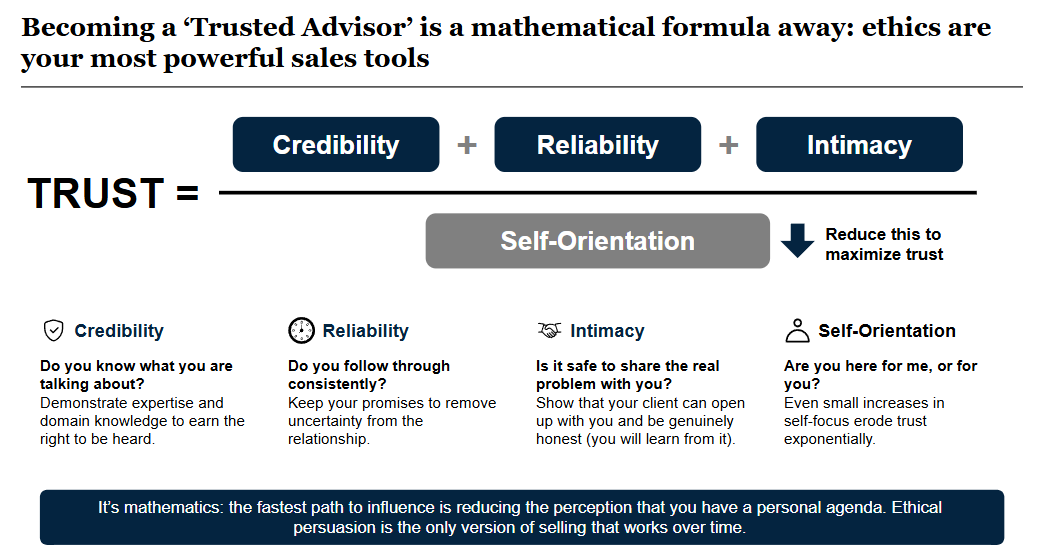
Trust is computable. If the result is low, you can usually point to exactly which variable you are failing on.
11) Credibility is your entry fee
This is your “right to speak”, built on domain expertise and the quality of your insights. Bear in mind that, if you have not done the work to understand the industry or the problem or both, no amount of “sales technique” will save you!
12) Reliability is the boring superpower
In my definition, reliability is the consistent absence of surprise. If you promise a follow-up by noon and deliver it at 11:55am, you are slowly depositing trust points which, over time, reduce the perceived risk of saying “yes” to your big ideas. The opposite is also true...
13) Intimacy creates safety
Intimacy in a professional sense means “the ability to talk about what actually matters.” You need to create an environment with your clients where they can say, “I am worried this project will make me look bad to my boss” without fearing it will be used against them.
14) Self-orientation is deadly
This is the denominator of the trust equation above. If your “self-orientation” is high (ie, you clearly care more about your promotion, your quota, your ego, your ideas, etc than the other person’s problem) the trust score goes to zero, no matter how smart or reliable you are.
15) Check your Ego at the door
To influence another person you have to make that other person feel like the hero of the story. If you are too busy trying to be the smartest person in the room, you are signaling high self-orientation which actively destroys your own influence.
III. It is all measurable
16) Stop the pitch
A pitch is performative. A pitch demands a grade. When you pitch, the other person instinctively moves into “judge” mode, and continuously looks for flaws. A pitch creates an adversarial dynamic from the very first sentence. Hence, stop the pitch.
17) Open with what hurts
I have never seen a doctor bursting into the room shouting about a new miraculous drug. Normally, they come near you and ask you where it hurts. You should learn from that: don’t offer a solution until you have performed a thorough “biopsy” of your client’s current situation.
18) Avoid “performance mode”
When you start “selling,” your voice changes, your posture shifts, and you start looking for approval. This whole demeanor triggers the buyer’s flight or fight response. Stay in “consultant mode”: calm, curious and objective.
19) Lower the defenses
A diagnostic/measurement approach makes your client feel “seen”. Naturally, when people feel understood, their biological defenses tend to drop. They stop looking for reasons to say “no” and they become more inclined to look for ways to collaborate.
20) Measure by outcomes
Amateur salespeople celebrate the signature to their contracts, but long-term, real leaders celebrate the impact they manage to create. If the project fails 6 months after the “sale”, you did not succeed. And you did not succeed simply because you have failed (which you did, by the way) but more because you have just created a future detractor.
21) The organic reference
When you solve a problem through diagnosis, the client becomes your best salesperson! They will all over spread the idea that you didn’t simply sell them a tool but that you understood their business and fixed it. That is how you build a career.
IV. Stakeholder management: mapping the invisible
22) The organization is a web.
Business decisions are rarely made by one person in a vacuum. They are the result of a complex, often invisible web of internal politics, debts, history, compromises, past agreements, and fears. Your job is to map that web before you try to pull on any of the strings.
23) Find the hidden power
Counterintuitively, title does not always equal influence. Often, the most important person to “sell” is the long-tenured middle-manager or the executive assistant (!) who has the ear of the General Manager. Ignore them at your peril.
24) Informal authority rules
In every company, there are people who everyone goes to for “the real story.” If these informal leaders have not been sold on your idea, they will kill it with a single skeptical comment in the hallway or a joke that isn’t a joke, and you will suffer the consequences.
25) The peer sale is the hardest
Generally speaking, your peers are your competitors for resources and attention. To get them to support you, you must find the “WIIFM” (What’s In It For Me). If your project doesn’t make their life easier, or doesn’t make them look good, or doesn’t make them money, why would they help you?
26) Consensus first, ask second
The big meeting should never be the place where people hear your idea for the first time. The meeting is just the public confirmation of a dozen private “yeses” you have already secured.
Great work rarely gets sold in the boardroom. It gets seeded in the corridor, in casual chats, in the 10 minutes before the meeting starts. That’s when the real pitch begins.
27) Multi-thread
If you only have one champion in an organization, you are one resignation away from total failure: how do you people don’t get that? This must be the #1 mistake in B2B sales. Build relationships at multiple levels: above, below, and beside your main contact. Create more than 1 champions.
28) Personal success metrics
Every stakeholder is motivated by something personal: maybe they want to work fewer hours, maybe they want a specific title, maybe they want to advance their financial position, maybe they want the glory of high achievement. If you can align your project with their personal ambition, they will fight for you.
29) Build the well before you are thirsty
If the first time a client hears from you is when you need a budget approval, you have already lost, my friend. You have to work on building those relationships during the moments when everything is going well; don’t wait for the moments of crisis.
V. Discovery: the science and art of listening
30) The 70/30 rule
About 20 years ago, I had a Scottish boss who told me this sentence for the first time: “You have two ears and one mouth for a reason”. If you are talking, you are only repeating what you already know. If you are listening, you are gathering the intelligence you need to win.
31) Curiosity is a weapon
Genuine curiosity is disarming: when you ask deep, probing questions (your consultative line of questioning) about how a business works, you demonstrate that you care enough to get the root cause right without stopping at the symptoms.
32) The power of open-ended questions
Questions that start with “How” or “What” force the other person to think and reveal their logic. “Do you like this?” is a dead end, why would you let your client talk less when you can have them talk more? For example, “How would this impact your team’s workload?” is a gold mine. Use that category of questions.
Also, check my viral article on Consulting Intel (my popular newsletter):

33) The 3-second silence
Human beings hate silence. When a stakeholder finishes an answer, wait 3 seconds. In that vacuum, they will almost always add a “but...” or an “actually...” or something else that will give you more information. That contains additional nuance to a truth they were hesitant to share.
34) Listen for “no-shows”
OK, careful on this one... You must pay attention to what is conspicuously missing. If a manager talks about everything except their team’s morale, the team’s morale is likely the problem. That silence is louder than the words they spoke.
35) Symptoms vs. root causes
“We need more leads” is a symptom. “Our sales team doesn’t know how to close” is a root cause. If you only treat the symptom and never investigate the root cause (a bit like the NHS in the UK does 🤣), the disease will just move elsewhere. Always ask “Why?” until you hit bedrock (Toyota famously came up with the five whys).
36) Mirroring language
If a client calls their problem a “cluster,” why do you call it an “issue”? Use their specific vocabulary, show that you are an insider who truly understands their specific pain. Leverage a bit of psychology here: mirroring works.
37) Knowledge is the scoreboard
Every meeting is an intelligence-gathering mission for us. If you didn’t walk away with a piece of information you didn’t have before, you lost an opportunity and you squandered the meeting, even if everyone smiled and the coffee tasted good (rare event outside of Italy, anyway).
VI. Sell career safety
38) Features are for amateurs
Do you really believe your client cares about “near real-time data sync”? Your client cares about not having to stay late on a Friday to fix a report and then get pounded by their boss at 8:30am on Monday around why that happened. Do not talk about what the product is, but spend time talking about what the product does for the buyer.
39) Sell emotional safety
High-level executives in large enterprises typically optimize their careers on doing damage-control, are generally risk-averse, and rarely looking for “revolutionary” change. They look for the option that won’t blow up in their face. Your job is to prove that your solution is the safest bet they can take.
40) The 2 executive questions
Every C-suite decision is filtered through 2 fundamental lenses: 1) “Will this make me look good?” and 2) “Will this reduce my risk?”
If your proposal doesn’t answer both, it will be ignored and forgotten, in favor of another proposal that does it.
41) Impact language
Translate everything into the language of the C-suite: risk mitigation, capital efficiency, market share, strategic legacy, etc.
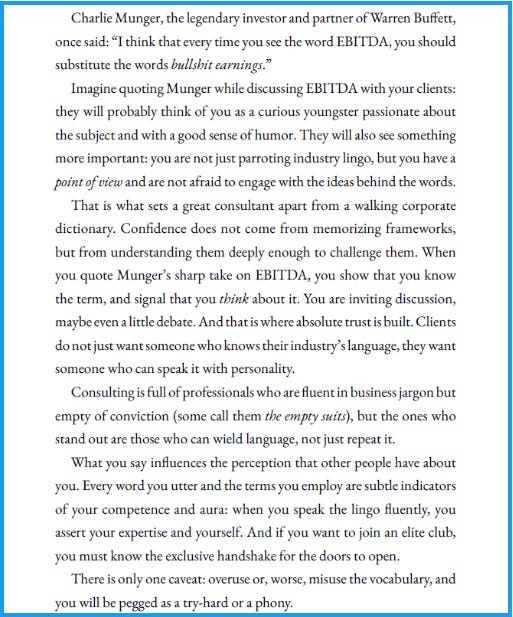
If you can’t describe your project in these terms, you are not ready to present it. I touch on this in Chapter 4 of Beyond Slides (a brief extract below):
42) It is all about the data, until it isn’t
Data is necessary but insufficient. People use data to justify a decision, but they make the decision based on trust and a good story. Use the data as a foundation, but build a strong narrative on top of it.
43) Professional survival
If you lived the corporate world long enough, you must have realized that everyone is scared. If you can show a stakeholder that your project will act as a shield for their career and/or a ladder for their promotion, they will become your most loyal advocate. Show them unequivocally what’s in it for them.
VII. Co-design to your advantage
44) Perfection is a barrier
A perfect, polished presentation feels like a finished product that leaves little room for your client to add their “fingerprints” on it. This makes them feel like a spectator rather than an owner, and may be counterproductive if you need their support later on.
45) The 70% draft
Show up with a proposal that is solid, on the “right direction”, but deliberately incomplete. Caveat the presentation with a “This is my 70% thinking; I need your expertise to get the last 30% right”. This transforms the conversation from a “review” into a “workshop.”
46) Joint ownership
Betty Crocker’s instant cake mixes initially failed because they were too easy. Then, she asked consumers to add fresh eggs themselves (thus increasing the effort involved), and sales skyrocketed. Psychologically, we are biased toward things we help create (the “IKEA effect”): treat your client as your co-author.
47) Redlining is your shortcut
Every time a stakeholder suggests a change and you incorporate it, they are buying in. By the time the final version is ready, they can’t say “no” because they would be saying “no” to their own ideas. Who does that?!
48) Recruit your critics first
If you know someone is going to oppose your idea, go to them first. Openly ask them to coach and mentor you. Request their “expert advice” on how to fix the flaws in your plan. Be strategic about it and don’t get scared: if they help you fix it, they can no longer attack that flaw in public because that would reflect negatively on themselves.
VIII. Reframing resistance and “no”
49) Use every “no” as data
People don’t understand that a “no” is rarely the end of the conversation. An initial negative reaction is just the start of the actual process of diagnosis. It means you have hit a nerve or a boundary. At that point, your job is to calmly and methodically investigate what that boundary is made of.
50) The shield of resistance
Resistance is usually a protective mechanism. When a client tells you something like “it’s too expensive”, what they mean is that they don’t trust the value enough to risk their budget. In that scenario, you should address the fear rather than going straight to price.
51) The magic question
This is as helpful to you as it is helpful to your client: “What would need to be true for this to work?” This single question makes your brain go from “rejection mode” to “problem-solving mode”, and it forces the client to detail out the roadmap to a “yes.”
52) Translate the value
When I first moved to the UK from Italy, people could not understand me and I could not understand them. Same for your clients: if they don’t see the value, you are speaking the wrong dialect. A CFO cares about cash flow, a CMO cares about brand equity. If you use the CMO’s language with the CFO, then why do you complain when you hear a “no”?
53) The cost of “doing nothing”
Sometimes the most powerful thing you can sell is the status quo’s price tag: in a lot of enterprises that’s a very expensive number. Show them exactly how much money or time they are losing every day by not doing the thing. Make the “no” feel more expensive than the “yes”: show with precision the cost of doing nothing.
54) Engagement is the goal
This is not easy to see through, but I came to realize that argument is a form of interest. If someone is challenging your logic, they are likely mentally “trying on” your solution. The only thing you should fear in that context is apathy, the polite “thanks, we will think about it” that goes nowhere.
IX. Tactical execution
55) Recruiting is a high-stakes sale
All the people that you would want in your team have options: you are not special. To hire them, you must do a great job at selling them on a vision of their own future growth. Flip it in your head: it’s not you buying their time but you selling them a purpose.
56) Budgets are won, not granted
When you work in a medium/large enterprise, you learn to look at a budget request as a competitive sale, where you are competing against every other department’s “great idea.” Your job is to frame your request as the highest-yield investment the company can make.
57) Change is a 1-1 game
I am very clear on this: you never change a culture with a series of town halls and all-hands meetings. Actually, changing a culture is so so hard. Your only hope is through dozens of individual “sales” calls with key influencers until you reach a tipping point where the “new way” becomes the “easy way”. Still hard!
58) Be brief
Learn this as early as possible please. Executives have “attention poverty”, and so if you can’t explain the impact of your idea in 120 seconds or less, they will assume you have no clue what you are talking about. Cut the fluff, start with the bottom line, avoid word salads, go straight to the point and be brief.
59) Check the incentives
People are rational actors based on how they are paid. If your proposal makes the company money but costs a manager his bonus, guess what that manager will do? He will kill it.
Always follow the money, it’s easy.
60) Intention beats “smooth”
People can smell a “salesy” person from a mile away. If your genuine intention is to solve their problem, your occasional stumbles or lack of “polish” won’t matter much. Be genuine and truly willing to help: that’s the ultimate lubricant for influence in my experience.
61) You are not Jordan Belfort
Have you watched the Wolf of Wall Street, the movie about Jordan Belfort’s life? Yeah, forget about that stuff. High-pressure tactics are for people who never plan on seeing the buyer again! In leadership, you see the same people every damn day: play the long game please, do not take yourself out of it.
62) Walk through the door together
There will be moments when you won’t see eye to eye with your clients. In those moments, remember what you are there to do. You don’t need to “win” an argument. Your goal is to reach a point where both parties agree that the proposed path is the most logical one. If you had to “beat” them, they will resent you later.
63) The post-sale is the real sale
The moment they say “yes” is when the real work begins. If you disappear after the approval, get called and redirect the problems to someone else, or are suddenly too busy to show up on a day’s notice, you will destroy your Reliability variable for the next time you need something (check Rule #10 above).
I have created a 1-hour presentation around sales essentials for business leaders. I have given the talk to MBA students, consulting professionals, and corporate employees.
If you want to have access to the presentation, I would be very happy to share it with you - I don’t like to hoard!
Leave a comment and I will DM you the link to the presentation.
Many thanks, and all the best in your personal and professional life!
As usual, if you enjoy reading Consulting Intel, please do me a favor: spread the word and share this post.
👋
👀 Links of interest
A few corners of the internet you may find interesting:
I swear this is the absolute most entertaining video on the whole of YouTube. Oz Pearlman, the famous “mentalist”, gets ripped apart in this FIVE-HOUR VIDEO (yes, 5 hours!) by an Australian Law student who reveals his entire set of tricks. Super fascinating. I’m sure you’ll find bits and pieces you’ll want to steal here…
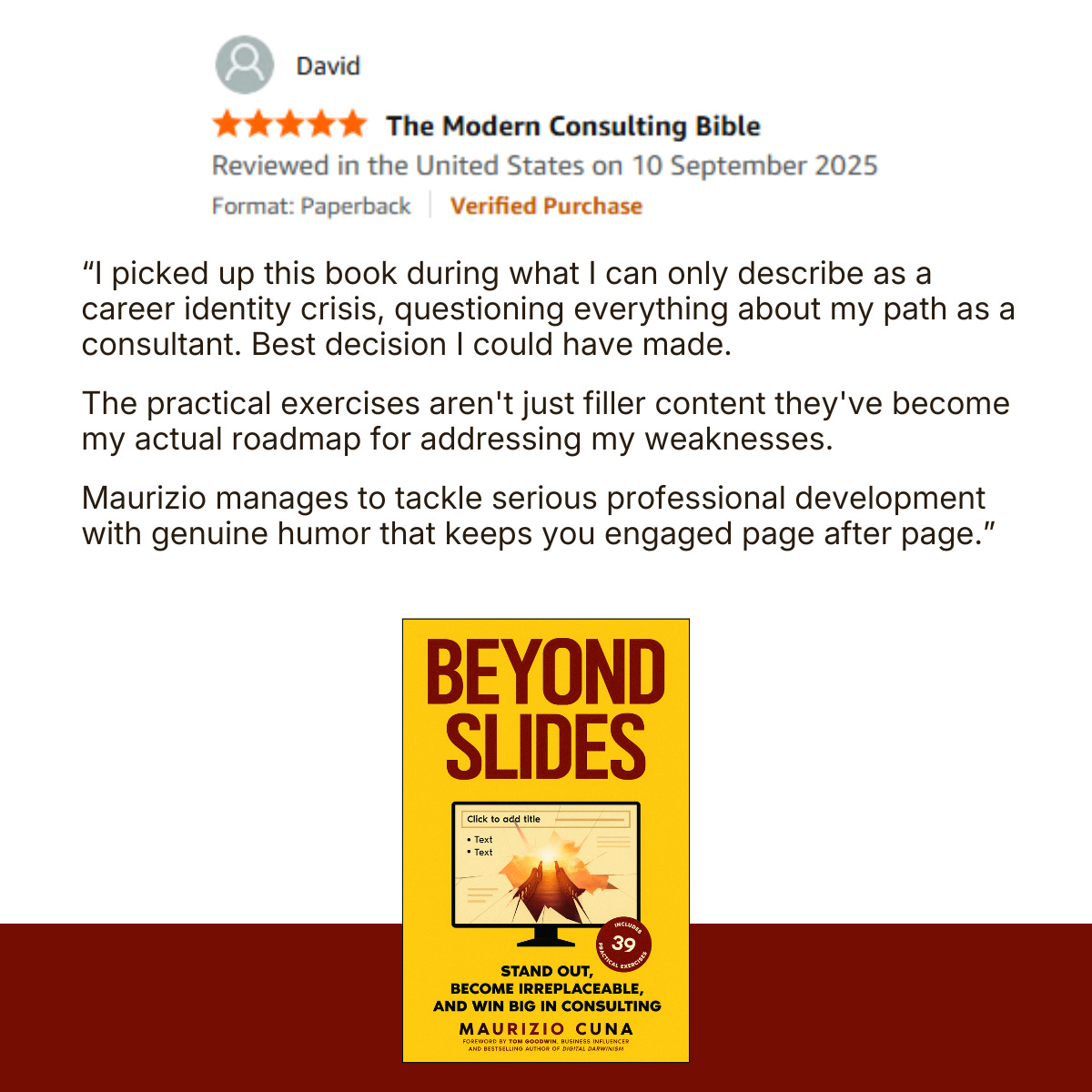
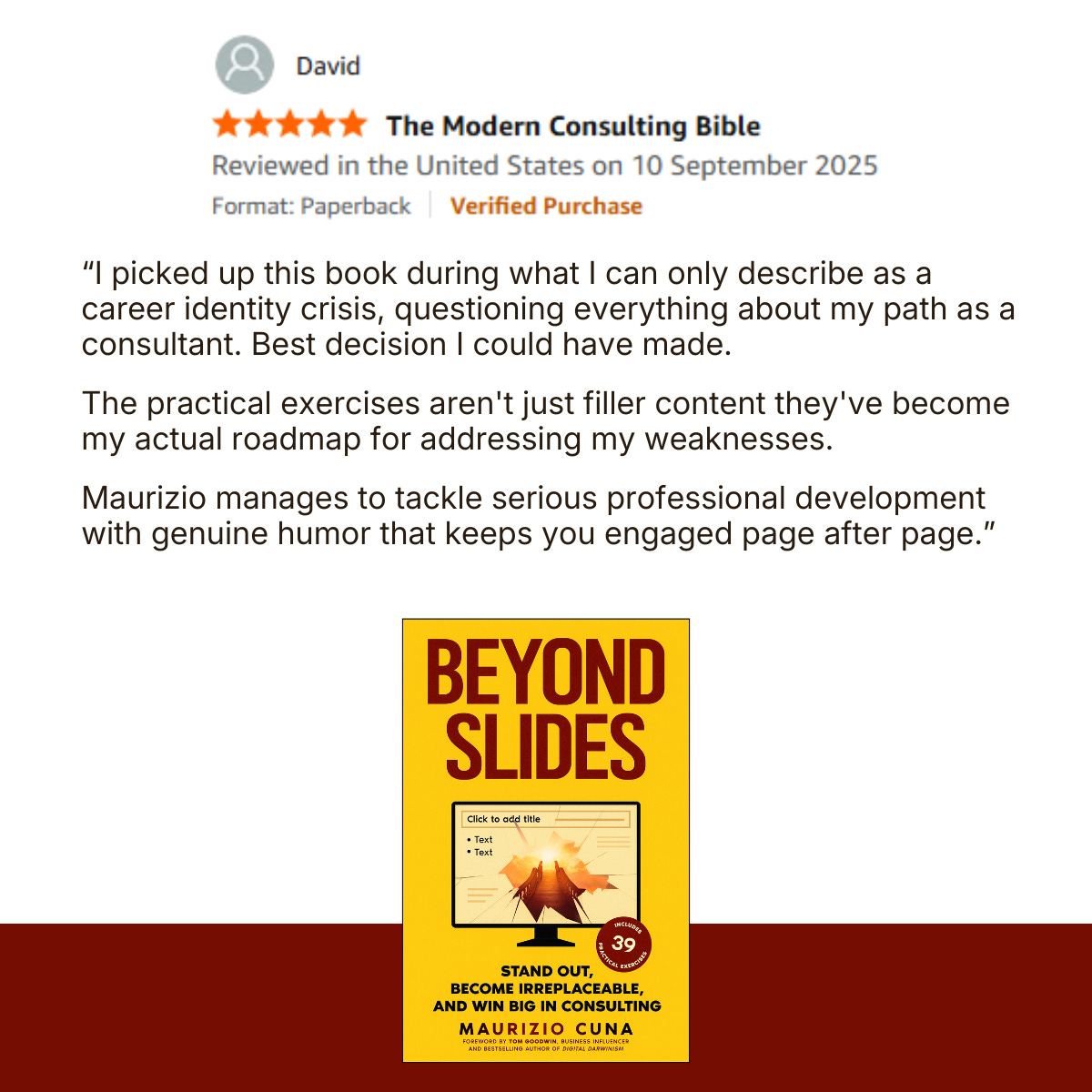
My first book Beyond Slides became a #1 Amazon Best Seller in the USA, UK, Australian and Italy. This is a review from a reader:
Have you looked into the Leaders Toolkit? It is a deck of 52 tools, frameworks and mental models to make you a better leader (use code CONSULTANT10 for 10% off);
The Consulting Intel private Discord group with 250+ global members is where consultants meet to discuss and support each other (it’s free).
Yep - gold nuggets indeed. Would love the link if you're happy to share. :)
This is really great - lots to dig into further here. Would love to see the link you mentioned if you’re happy to share.