


👋 Hi, it’s Maurizio. Welcome to my newsletter on everything professional services.
Close the capability gaps slowing down your progress, today → Get Consulting Edge
It seems the world is reaching the conclusion AI is expensive.
I agree, but probably not for the reasons many may expect.

In the basement of my grandparents’ house in the South of Italy, there still is an old dining table made of solid walnut wood.
That thing is ridiculously heavy and scarred from decades of use, and yet it does not wobble. My grandfather bought it more than 50 years ago, and with a bit of care, it will easily outlive me.
Two years ago, I bought a desk online online for my daughter.
It arrived flat-packed in a cardboard box, made of wood pulp glued together and covered with a paper-thin plastic veneer. It was (admittedly) cheap, it showed up at my door in a couple of days, and it took me 20 minutes to assemble. However, after moving home just once, the screws stripped and the legs got shaky.
The whole thing ended up on the curb.

I’m sure you guys are all interested in my furniture, but why am I sharing these two stories with you?
We did this to furniture.
We did this to nutrition with fast food.
We did this to clothes with fast fashion too.
Are we doing this to knowledge work with Generative AI?
Are our products actually getting better, or are we flooding the world with lower-quality artifacts, faster?
There is an asymmetry
Follow me for a second.
There is an undeniable asymmetry in how generative models function. For a novice, AI produces a genuine leap in capability: it raises the floor. A non-coder goes from zero to a functioning Python script, and an incoherent email turns into a powerful note.
For experienced practitioners, however, the technology introduces a persistent gravitational inevitable pull toward the mediocre and the mean.
Large language models are trained on the statistical average of human output: what they synthesize is fundamentally average.
They produce slides packed with corporate platitudes and generic icons that don’t say much, and the little they say isn’t memorable.
They generate pages of prose that look complete yet lack authentic voice or conviction or non-obvious insight.
In software engineering, they spit out code that passes basic unit tests while introducing subtle architectural rot and hidden technical debt.
This is starting to smell like the Enron for brains: the perceived productivity gain is largely an accounting trick.
Generating an artifact in 45 seconds is indeed superhuman velocity, but it comes with a cost of verification, contextualization and editing that is not nothing.
Untangling and sanity-checking an LLM-generated draft often takes more mental friction than drafting the core thesis with intention from scratch.
Just look at the job market: roles focused exclusively on “fixing AI” mistakes have surged by over 85%:

Worse, because any generated draft looks superficially acceptable or even client-ready (it’s not, but it looks as such), teams frequently surrender their critical faculties, accept the “good enough” particle board, and hit send.
Do you really know “what great looks like?“
A common counterargument is that most enterprise artifacts should in fact be cheap and disposable.
Yes, that is partially fair.
Of course, not every piece of corporate output requires heirloom-grade craft.
Agonizing for 4 days over an internal sprint retrospective or an alignment deck that will be skimmed once for 8 minutes is probably economic waste. We are talking about bullshit jobs after all, right?


For disposable administrative bureaucracy, cheap AI particle board is completely rational.
But it is possible that overtime organizations will lose the ability to tell the difference between what can be disposable and what cannot.
Writing, designing, coding are the primary mechanisms through which humans think.
You sit down with a blank screen to build a technical system or articulate a corporate strategy so that you can create the artifact, yes, but obviously the value is not the artifact.
The value is the effort of the process, and through that effort you gain understanding.
If you offload that to an LLM, you get the artifact but you don’t get the understanding.
Now, to the most controversial bit of this post.
This rush toward cheap volume is not even an AI problem actually.
It is an incentive problem.
I cannot remember if it was Roger L. Martin or Rory Sutherland, but one of the two has pointed out a basic truth about business that corporate leaders constantly forget, something along the lines:
Any idiot can cut costs. The actual point is whether you can cut costs without destroying value.
Cutting costs is easy! Anyone in business knows this.
You just lay people off, or switch to cheaper materials, or tell everyone to use AI to work 3x as fast.
In a corporate culture where the average CEO stays for only 3-4 years, this playbook is frankly irresistible.
Show up, cut expenses, push everyone to churn out work with AI, show a neat spike in “productivity” on your quarterly reports, collect your bonus, and leave.
Generative AI seems to be the ultimate accelerant for this playbook because it creates synthetic productivity.
Imagine an executive who mandates AI adoption across engineering, product, and marketing, and immediately shows the board glowing metrics:
Code churn and commit volume up 40%;
Slide decks and campaign variants generated in minutes instead of weeks;
Support tickets “resolved” at record speed.
On paper, efficiency has skyrocketed. How good!
But synthetic productivity measures output volume, not durable long-term enterprise value.
Meaning requires effort
Whether you look at Stoicism or modern psychology, the consensus is the same: character and understanding are only built through resistance.
We are currently treating the human act of thinking as if it were an operational inefficiency to be optimized, but I believe that by removing the very effort of writing, coding, deciding, over a long enough timeline we are going to lose both the quality threshold and the human comprehension behind it.
Meaning takes effort, and there is value in the struggle (do you remember the parable of the fisherman and the businessman?)
Which brings me back to my grandfather’s walnut table.
The reason that table is still standing in the basement after 50 years is only partially because of the quality of the wood. It is also because the person who built it understood that some things take as long as they take.
They didn’t optimize for the fastest possible output.
Pasta Rummo is amongst my favourite pasta brands. Cosimo Rummo, its founder, used to say something so important they keep printing it on the packaging:
“Pe’ fa’ ‘e cose bone ce vo’ tiemp’”
If you are not familiar with Neapolitan dialect, that translates “To make good things, you need time.”

Generative AI will keep getting faster.
It will flood our companies and our screens with an endless ocean of cheap artifacts. And speed will become the new average.
At that point, what is going to be your differentiator?
If you enjoy reading Consulting Intel, please do me a favor: spread the word and share this post.
👋
👀 Links of interest
A few corners of the internet you may find interesting:
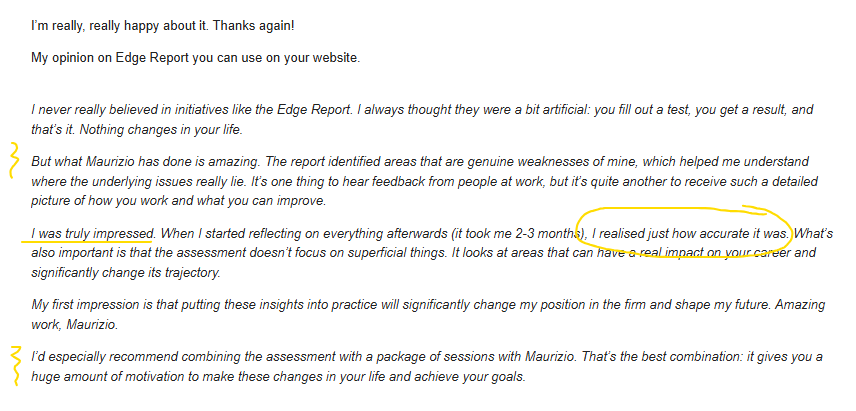
Last week, I received new feedback on Consulting Edge. I will add this and a few more comments I have been collecting to the Testimonials section on the website, but this was awesome for me to read:
Remember that if you use code EDGE15 at checkout, you will receive 15% off any Edge product, and will then get a referral code earning you a commission every time someone else purchases using your code.
Who should you send it to? A few ideas:
colleagues in your firm who are going for promotion this year
people on your team, or juniors you mentor
peers at other firms you swap notes with
independent consultants you know (especially the ones still charging what they charged two years ago)
former colleagues who went freelance or moved in-house
Bulk pricing for teams is available separately - just reach out.
Have you looked into the Leaders Toolkit? It is a deck of 52 tools, frameworks and mental models to make you a better leader (use code CONSULTANT10 for 10% off);
The Consulting Intel private Discord group with 250+ global members is where consultants meet to discuss and support each other (it’s free).